How long do canvas prints last is one of those questions that gets a suspiciously round answer everywhere you look - "decades" or "a lifetime" - without anyone committing to specifics. So here is the actual answer: a quality canvas print, printed with archival inks on proper gesso-coated canvas, stored or hung in reasonable conditions, will hold its color for 75 to 100 years. A cheap one from a random marketplace, printed with dye-based inks and hung in direct sunlight, starts fading visibly in two to three years. The gap is that wide.
How long do canvas prints last - the numbers behind the claim
The 75-100 year figure comes from accelerated light-fastness testing. Labs expose prints to high-intensity UV light and extrapolate the fade rate to real-world conditions. Giclée-grade pigment inks on canvas consistently hit that range when tested at roughly 450 lux - which is normal ambient indoor lighting. Dye-based inks, the cheaper alternative, test out at 25-40 years under the same conditions. That sounds okay until you factor in that most people hang prints near windows, in kitchens, or in rooms with strong artificial light, all of which accelerate fading significantly.
The canvas itself almost never fails first. It yellows a little over decades, can sag if the stretcher bars are thin wood that warps, but structurally it is fine. The ink layer is where prints die, followed by the coating - or the lack of one.
The four things that actually kill a canvas print early
Direct sunlight is the obvious one. UV light breaks down pigment molecules regardless of ink quality - it just does it faster with cheaper inks. A print hung opposite a south-facing window without UV-filtering glass is aging ten times faster than one on an interior wall.
Humidity and heat are less obvious but just as bad. Kitchens and bathrooms are genuinely terrible places for canvas. Steam and temperature swings cause the canvas to expand and contract repeatedly, which eventually cracks the gesso layer and the ink with it. That cracking is not a defect - it is physics.
Touching the surface damages the coating. The oils from your fingers do not wipe off cleanly even if you cannot see residue, and over time those spots attract dust and hold moisture differently than the rest of the print.
Finally - and this one is underrated - the quality of the coating applied after printing matters a lot. A UV-resistant varnish or laminate layer adds years, sometimes decades, to the lifespan. Many budget printers skip it entirely.
Where you hang it changes everything
The ideal wall for a canvas print is an interior wall, away from windows, out of kitchens and bathrooms, somewhere with stable temperature between roughly 60-75°F and humidity under 60%. That covers most living rooms and bedrooms without much effort. Hallways near exterior doors are borderline because of the temperature swings every time someone opens the door in winter.
If you are buying wall art for a kitchen specifically, honestly consider a metal print instead. Metal handles humidity far better and the surface is wipeable.
A simple care schedule that takes about ten minutes a year
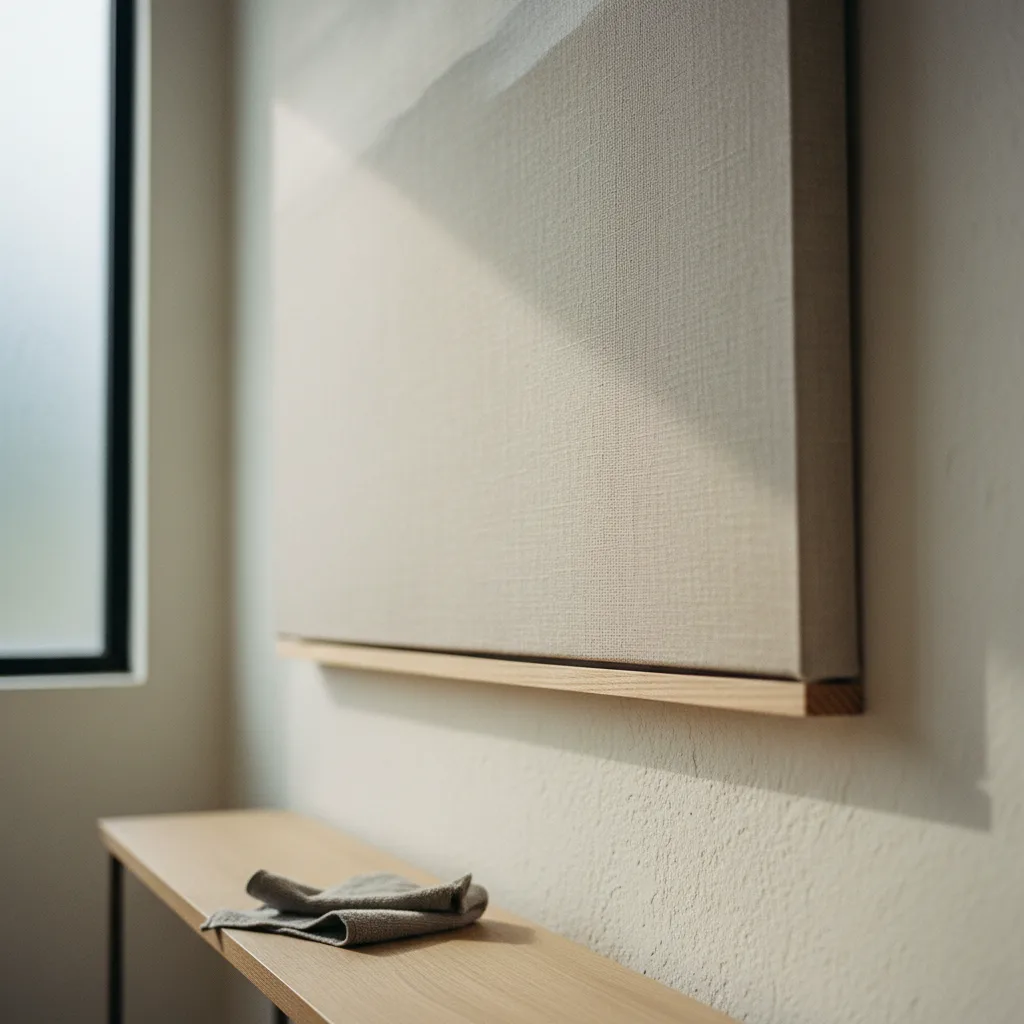
Every few months, dust the surface with a dry microfiber cloth - light, no pressure, no product. That is genuinely all most prints need in a stable room.
Once a year, look at the stretcher bars from behind. If the canvas has developed any slack or the bars look bowed, you can tap the wooden wedges (keys) deeper into the corners with a rubber mallet to re-tension it. Most canvases ship with these wedges included and people throw them away without knowing what they are for.
If the surface picks up a smudge, use a barely damp cloth - water only - and blot rather than wipe. Let it dry completely before putting it back up.
That is it. No special products, no annual re-varnishing, nothing elaborate. The care schedule is short because placement does most of the work.
What to look for when buying
Ask or look for pigment-based inks, not dye-based. Ask whether a UV-resistant coating is applied. Check the stretcher bar thickness - anything thinner than about 1.5 inches on a large print will warp eventually. If a seller cannot answer any of those questions, that tells you something.
The canvas prints at EnjoyPoster use pigment inks with a protective coating as standard, which is why we are comfortable talking about lifespan at all. If you want something completely maintenance-free and are okay with a different look, the metal print category is worth a look - different texture, tougher surface, good for high-humidity rooms.
Bottom line: buy once, hang it right, and you will never think about it again for the rest of your life. Buy cheap and skip the care, and you are replacing it in five years.