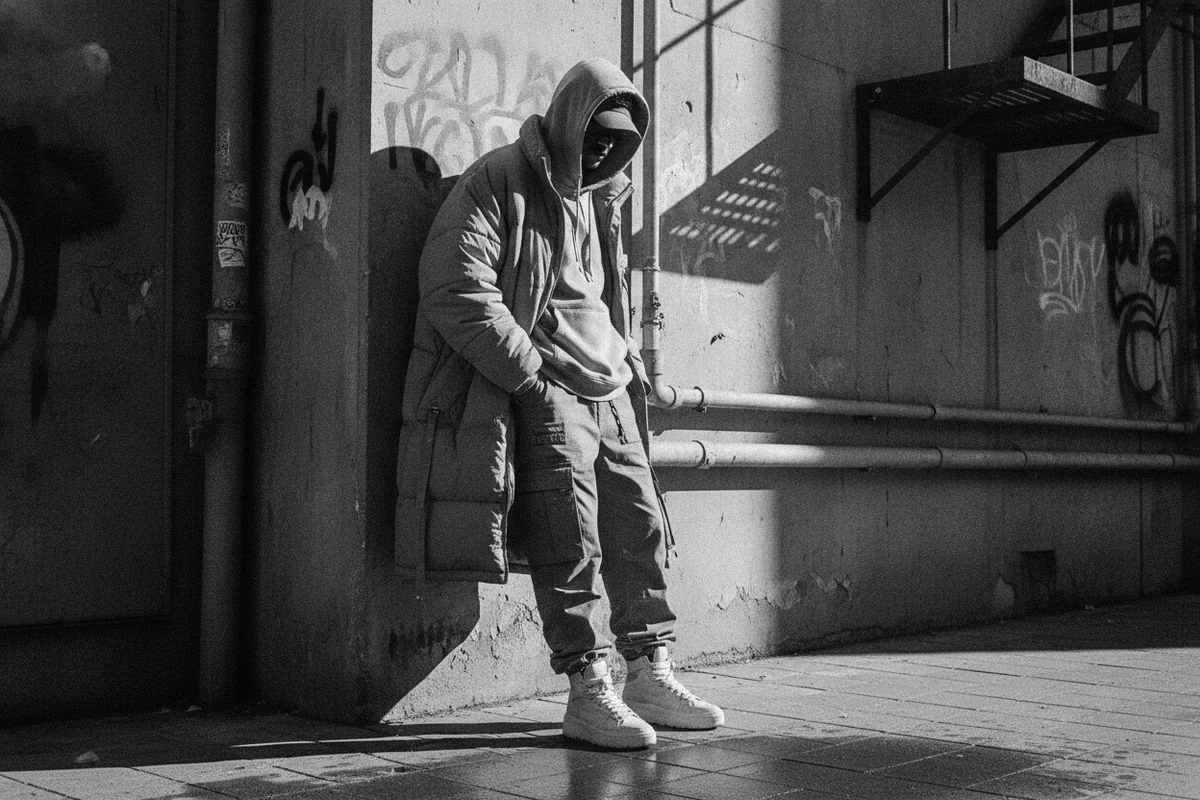
Somewhere around 2015, wearing clothes that actually fit you started to look kind of square. Not everywhere, not all at once - but in the parts of menswear that were paying attention to what was happening on Fairfax Avenue in Los Angeles or around Harajuku's backstreets, the signal was clear: going big was the move.
That shift didn't come from nowhere. The oversized fit streetwear trend history stretches back further than Supreme drops and Fear of God lookbooks, and understanding where it came from makes it easier to read where it might be going.
Where oversize actually started
The honest answer involves multiple threads running at once. Hip-hop in the late 1980s and early 1990s is the obvious starting point - Tupac in a Starter jacket three sizes too big, FUBU cuts that draped rather than fitted, the whole aesthetic of not being squeezed into prep-school tailoring. Some of that was pure attitude. Some of it was economic: hand-me-downs and older siblings' clothes meant big fits were just what you wore. The style absorbed the reality and turned it into a signal.
Japanese streetwear was doing something different but parallel. Brands coming out of Ura-Harajuku in the early 90s - Neighborhood, Undercover, early Hiroshi Fujiwara projects - were playing with proportion as a deliberate design choice rather than a social one. They were cross-pollinating American workwear and military surplus with an art-school eye for silhouette. The clothes looked big because they were supposed to look big, full stop.
These two currents fed each other through the 2000s largely under the radar of mainstream fashion coverage. Then the internet made subculture porous.
The 2010s: when big went mainstream
Tumblr and early Instagram gave visual reference points to kids who had no local scene to plug into. You didn't need to live in Tokyo or New York to see what Palace was releasing or how A$AP Rocky was putting outfits together. The mood board replaced the record shop as the place you caught up with what was happening.
By around 2012-2014, a cluster of things landed at roughly the same time. Kanye West's alignment with fashion houses like Maison Margiela and his early Yeezy work pushed dropped shoulders and elongated cuts into genuinely mainstream music culture. Rick Owens - who had been building his architectural, volume-heavy aesthetic since the late 90s - suddenly had a much wider audience. And Jerry Lorenzo's Fear of God, launched in 2013, packaged the whole thing into something commercially accessible: flannels, distressed denim, oversized hoodies that read as luxurious rather than sloppy.
Within a few years, fast fashion had caught up completely. H&M and ASOS were selling "relaxed fit" and "longline" everything. The silhouette had gone from a subculture marker to a product category.
Why it stuck for so long
Fashion cycles usually churn faster than this. Skinny jeans ran for about a decade, which felt exhausting by the end, but oversized fits have been the default for close to ten years now without any serious mainstream correction. There are a few reasons for that staying power.
One is that the look travels across genders in a way that fitted clothes don't. An oversized crewneck looks intentional on basically anyone, which is partly why it became so central to the gender-fluid styling that took hold in the late 2010s. Brands that wanted to reach a broad audience had an obvious reason to keep building in that direction.
Another is comfort, which sounds boring but matters. Post-2020, after a year-plus of everyone working from home in sweatpants, going back to structured, tight-fitting clothes felt genuinely strange. Oversized silhouettes slid from a style choice into something more like a baseline expectation of how clothes should feel.
And then there's the resale and collector angle. Streetwear culture has always had a relationship with archiving and reference, and the oversized aesthetic had deep enough roots in Americana - workwear, coaches jackets, military surplus - that it didn't date the way trend-driven fashion usually does. A vintage 90s Champion hoodie looks correct in 2024 in a way that a 2009 skinny-cut band tee mostly doesn't.
Signs the pendulum is moving
That said - something is shifting. It has been building for a couple of years but it's getting harder to ignore.
The clearest indicator is what's happening with trousers. Straight-leg and slightly tapered fits have been creeping back since about 2021 among the people who usually move first. Not skinny - nobody is going back to spray-on denim, or at least nobody credible - but a definite pull away from the extremely wide, almost pajama-like silhouettes that peaked around 2019-2020. Brands like Our Legacy and Auralee have been doing precisely cut, mid-weight trousers with a trimmer leg for a while now, and that sensibility is filtering down.
Tops are more complicated. The boxy, dropped-shoulder T-shirt has been so thoroughly absorbed that it may just be the new normal rather than a trend - the way slim-cut Oxford shirts became a standard item rather than a "preppy revival." But even here, there are signals: shorter crops, closer-fitting knit layers worn over looser base pieces rather than everything being uniformly big.
What seems to be emerging is contrast rather than a full reversal. Big coat, tighter trouser. Relaxed shirt, fitted jacket underneath. The interesting look in 2024 tends to involve deliberate variation in fit across a single outfit, which is a more considered approach than just defaulting to maximum volume across the board.
What this actually means
The oversized fit streetwear trend probably isn't going away - it's just losing its automatic status as the default answer. For about a decade, "go bigger" was advice that almost always worked. That's no longer quite true, and the most interesting dressers seem to know it.
Which, honestly, is probably healthy. When any single aesthetic gets that entrenched, it stops being a choice and starts being a uniform. The subcultures that originally made oversized fits interesting were interested in them because they meant something - they were a deliberate rejection of a dominant mode. Once something becomes the dominant mode, the rejection has to come from somewhere else.
Where exactly that somewhere else is pointing right now isn't totally clear yet. But that uncertainty is usually when things get worth paying attention to.