
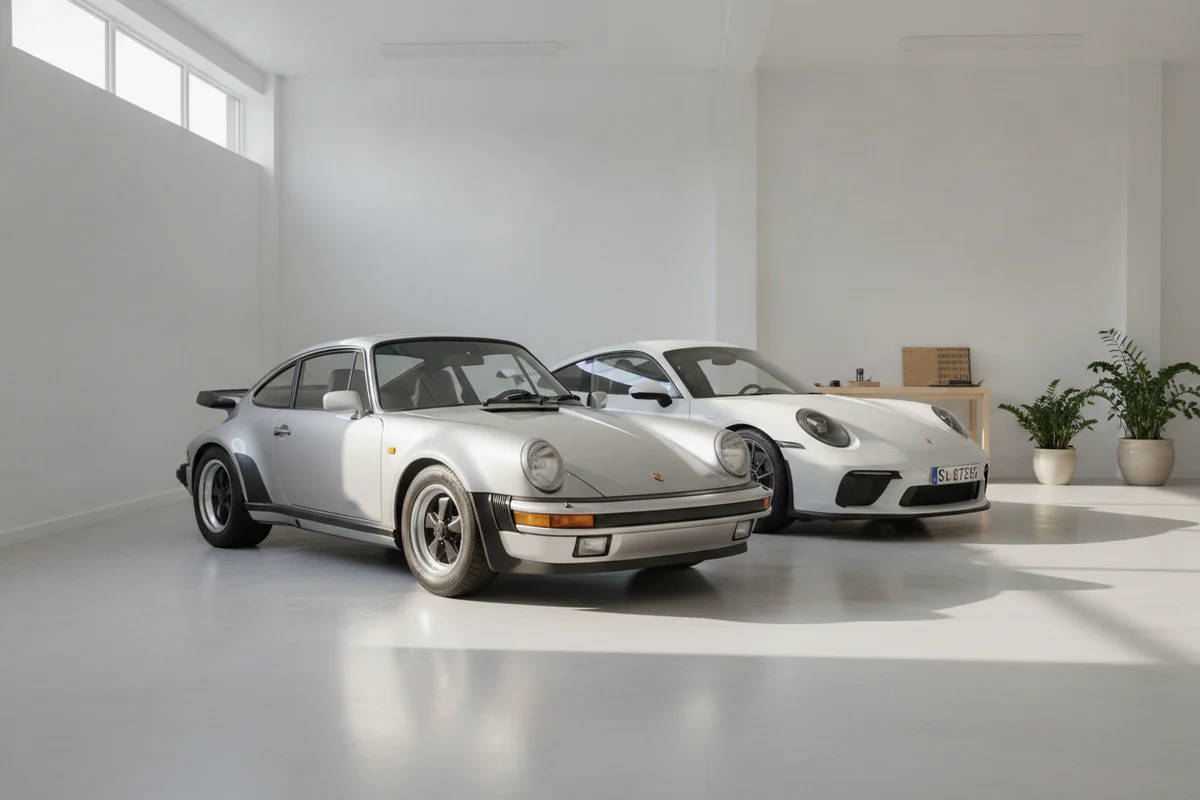
The switch happened in 1999, with the 996 generation 911. Porsche moved from the air-cooled flat-six that had defined the car since 1963 to a water-cooled engine, and a significant chunk of the enthusiast world has been arguing about it ever since. Twenty-five years on, the porsche air cooled vs water cooled debate shows no sign of cooling down - if anything, it has gotten louder as pre-1999 cars appreciate to genuinely absurd prices and younger buyers discover the older cars for the first time.
So what is actually being argued about? It depends who you ask. Engineers will give you one answer. Longtime owners will give you another. And values - financial and emotional - have warped the conversation further still.
What the engineering actually says
Air-cooled engines shed heat through fins machined directly into the cylinders and heads, with a fan pushing air across them. The system is mechanically simpler: fewer hoses, no radiator, no water pump, no coolant to degrade or leak. Porsche used this layout for decades partly by necessity and partly because it worked well enough for the power levels involved. The 3.2-litre Carrera engine from the mid-1980s made around 231 horsepower. That's not a lot by modern standards, but the cooling system handled it reliably in most conditions.
The honest problem with air cooling is thermal inconsistency. Cylinders closer to the cooling fan run at different temperatures than those further away. Porsche's engineers spent years managing this gap, and they managed it well, but they never eliminated it. At sustained high loads - track driving, climbing mountain passes in summer heat - the thermal picture gets complicated. Owners of classic 911s will tell you the cars run best when they're driven hard enough to generate good airflow, which is a charming quality and also a sign that the system has limits.
Water cooling solves the consistency problem. Coolant reaches every cylinder in a controlled way, temperatures stay within a narrow band, and the engine can be tuned more aggressively because the combustion environment is predictable. The 996's 3.4-litre engine made 296 horsepower, and later 997 variants pushed well beyond that. That kind of output from a naturally aspirated flat-six, reliably and without destroying itself, isn't really achievable with air cooling - at least not without the kind of exotic engineering that belongs in a race car, not a road car built to last.
The counterargument from the air-cooled camp is that simplicity is its own virtue. Fewer components means fewer failure points. A 30-year-old 930 Turbo with a well-maintained engine is a robust thing. The water-cooled 996 had the IMS bearing issue - an intermediate shaft bearing that could fail catastrophically - and while later engines addressed it, the early reputation stuck. Fairly or not, that episode gave ammunition to people who were already skeptical of the switch.
The sound question
This is where the engineering conversation ends and something harder to quantify begins.
Air-cooled flat-sixes sound different. The cooling fan is driven directly off the engine, and its whirr becomes part of the acoustic character. The engines are noisier in general - more mechanical chatter, more intake noise, a rawness that modern sound deadening and water-cooled smoothness have largely eliminated. Whether that rawness is better or worse is genuinely a matter of taste, but it's real and it's distinctive.
I've sat in a 1987 Carrera and a 2005 997 S back to back. The older car sounds like it's working. The 997 sounds like it's thinking. Both are good sounds. They're just different kinds of good, and which one you prefer tells you something about what you want from a car.
The air-cooled cars also vibrate differently. You feel the engine in a way that modern mounts and isolation systems have moved away from. Some people find that exhausting. Others find it addictive. It's one of those things that's difficult to describe to someone who hasn't experienced it, which is probably why enthusiasts spend so much time arguing about it online instead of just taking each other for drives.
What money has done to the argument
A clean 993 Carrera - the last air-cooled 911, built through 1998 - will cost you north of $80,000 today, and a nice one is closer to $120,000. That's a car that sold new for around $65,000 in 1996. The appreciation has been extraordinary, and it has changed how people talk about air-cooled Porsches in ways that aren't always honest.
Some of the enthusiasm for these cars is genuine and long-standing. But some of it is investors and speculators who have attached themselves to the air-cooled mythology because the numbers have been going up. When a car becomes an asset class, the discourse around it gets murky. People who bought 993s a decade ago as driver's cars have done extremely well financially, and that financial success has reinforced the narrative that air-cooled equals pure, correct, authentic - and that water-cooled equals compromise.
The reality is more complicated. A 997 GT3 RS is a serious driver's car by any measure. A well-sorted 991.2 Carrera S is faster, safer, more comfortable, and more reliable than any air-cooled 911. If you're buying a Porsche to drive it hard and often, the water-cooled cars are largely the better tool. If you want the experience of something older and less filtered, or if you want something that will probably appreciate, the air-cooled cars make sense too. These aren't mutually exclusive positions, but the debate tends to treat them as if they are.
Why it keeps going
Part of the reason this argument persists is that it's really about something bigger than cooling systems. It's about what a sports car is supposed to feel like, and how much modernity you want between yourself and the machine. The air-cooled 911 represents a particular relationship between driver and car - demanding, communicative, occasionally temperamental. The water-cooled cars are better in almost every measurable way and offer a slightly different relationship, more capable but also more managed.
Neither side is wrong about what they value. That's what keeps the argument alive.
Anyway - if you're new to Porsche culture and trying to understand what all the fuss is about, the best thing to do is spend time around both types of car. The debate makes a lot more sense once you've actually driven a 964 and a 991 on the same day. For people who already know which side they're on, the argument is part of the fun - it's the kind of thing that comes up at every trackday and garage meetup, right alongside arguments about correct wheel fitment and whether the Cayman has always been the better driver's car than the 911. The Porsche wall art collection captures both eras, which feels appropriate given that most serious enthusiasts end up respecting both sides eventually, even if they won't admit it out loud.
The switch to water cooling was the right engineering decision for where Porsche needed to go. The air-cooled cars were genuinely special in ways that mattered and still matter. Both things are true, and the fact that we're still arguing about it twenty-five years later says more about how much people care about these cars than it does about who's right.