Two engineers and a mill
In 1967, Hans Werner Aufrecht and Erhard Melcher left Daimler-Benz and set up their own engineering operation in a converted mill in Burgstall an der Murr, a small town in Baden-Württemberg. Aufrecht had been working on racing engines at the factory. Melcher was the other half of the mechanical brain trust. The company name came from their initials plus the village Aufrecht grew up in - Großaspach. AMG: Aufrecht, Melcher, Großaspach.
Their first serious project was a bored-out 300 SEL 6.3 engine. They took the already-large 6.3-litre V8 and stretched it to 6.8 litres, then put that car in the 1971 Spa 24 Hours. It finished first in class and second overall, beating factory entries. For a tiny two-man operation working out of a converted mill, that result got attention fast.
Through the 1970s AMG kept building a reputation the only way you can: by making cars faster than they had any right to be, and occasionally embarrassing larger, better-funded teams in the process.
The tuning years - and what made them different
AMG in the 1970s and 1980s was a proper tuner. They would take Mercedes production cars and rework engines, suspension, bodywork, interiors - whatever the customer wanted. The wide-arch body kits on the W123 and later the W126 became a recognizable look. The "Hammer" - an E-Class sedan with a 6.0-litre V8 shoehorned into it - came out in 1986 and would do 0-60 in around 5 seconds at a time when almost nothing in that body shape could. Car and Driver called it the fastest sedan in the world at the time.
What separated AMG from most tuners was that they never really went down the tacky route. Some tuners of the era were bolting on plastic spoilers and changing the badge. AMG was actually re-engineering the drivetrain, which meant the results held up. The cars were fast in a way that stayed fast, not just impressive on paper.
They also had an obsession with the engine specifically. Each AMG engine was hand-built by one technician start to finish - a process they formalized later and called the "one man, one engine" philosophy. A plaque with the builder's name still goes on every AMG engine today. That detail, maybe more than anything else, is what the brand faithful actually love about it.
The Mercedes partnership and what changed
By the late 1980s AMG had grown enough that Mercedes-Benz started taking the relationship more seriously. In 1990 they signed a cooperation agreement, which meant AMG could officially develop and sell tuning packages through Mercedes dealers. That was a significant shift - you could now walk into a dealership and order AMG options rather than going through a separate tuner.
The real turning point was 1993, when AMG provided the engine for the Mercedes-Benz C36 AMG. That was the first AMG car sold directly through Mercedes dealers as a finished vehicle, not as an aftermarket modification. The C36 used a 3.6-litre inline-six producing 276 hp. Not outrageous by current numbers but very fast for a production C-Class in 1993, and it marked the beginning of AMG as a factory performance division rather than an outside shop.
Daimler-Benz bought a 51% stake in AMG in 1999, and by 2005 they owned the whole operation. Aufrecht had retired by then. The mill in Burgstall was long gone - AMG had moved to Affalterbach, also in Baden-Württemberg, where they still build cars today.
The AMG badge and what it means to people who actually care about it
Here is where it gets more interesting than the corporate ownership timeline. AMG developed a following that is genuinely separate from general Mercedes enthusiasm. There are people who own AMG cars who will tell you they have no particular attachment to Mercedes as a brand but love AMG specifically. And there are hardcore Mercedes people who treat the AMG badge as almost a different thing - a subspecies.
Part of that is the engine note. The 6.2-litre naturally aspirated V8 that AMG ran from 2006 until around 2014 - used in the C63, E63, SLS and others - became one of the definitive sounds in modern performance cars. Flat-plane crank, high-revving, a genuine scream at the top end. When AMG moved to a turbocharged 4.0-litre V8, plenty of long-time fans were openly upset, even though the turbocharged car is faster in almost every measurable way. That kind of reaction is what cult following actually looks like.
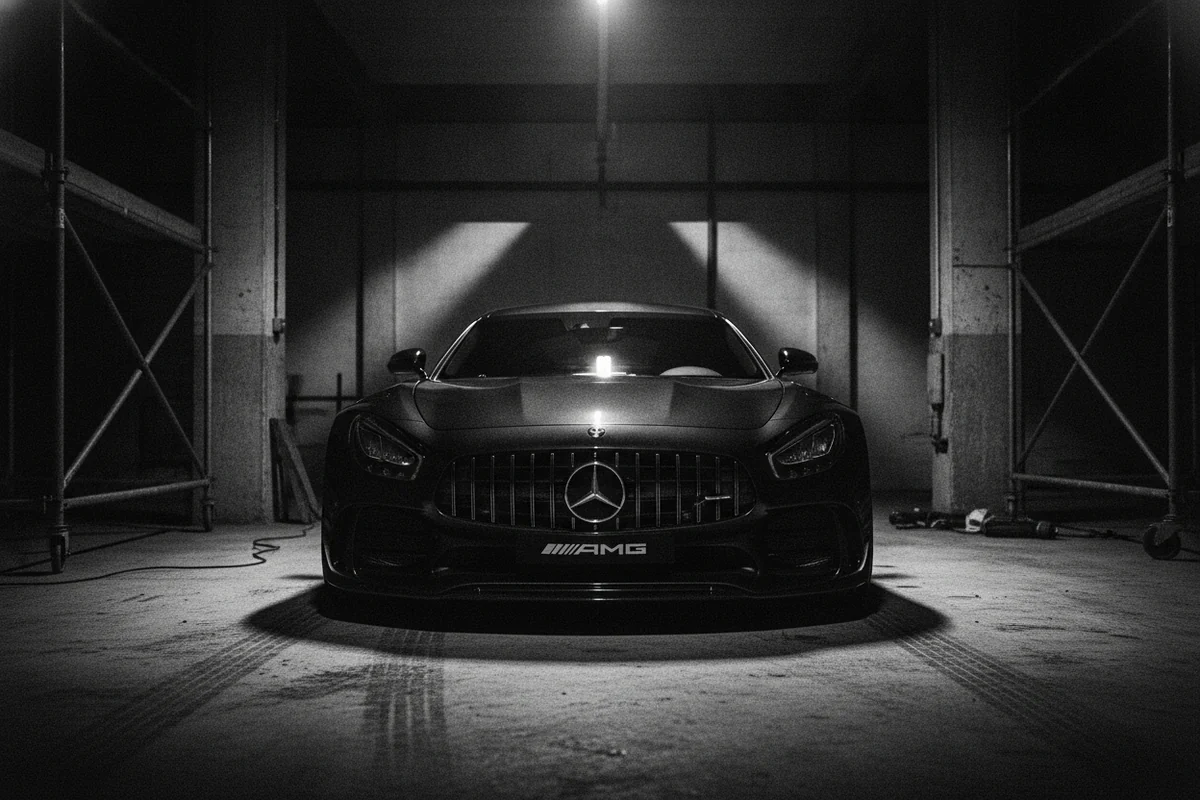
And for people deep enough in car culture that they put Mercedes and AMG wall art on their walls, the visual language matters too - the AMG letterforms, the Affalterbach branding, specific model silhouettes like the SLS gullwing or the C63 Black Series. These are not just cars to these owners, they're reference points.
The sub-brands have multiplied since the full acquisition. AMG GT, AMG ONE, the performance hybrids, the Formula 1 engine connection that Daimler used heavily in marketing. Some of this irritates traditional AMG followers who feel the badge has been diluted. AMG on an A-Class hatchback is a long way from a hand-built 6.8-litre engine winning at Spa. That tension is real and probably permanent.
What Affalterbach actually produces now
Today AMG employs around 2,000 people in Affalterbach. They produce well over 100,000 cars a year across the model range, which is a number that would have been unthinkable in the Burgstall days. The AMG Performance Studio still does bespoke commissions. The hand-built engine tradition continues, at least on the higher-end models. The Formula 1 connection through Mercedes-AMG Petronas is a marketing reality that keeps the performance credentials visible, for better or worse.
The real mercedes amg history is less about corporate milestones and more about the point where a small engineering operation proved it knew something the factory didn't, and then got absorbed by the factory it had proved wrong. That's a stranger story than the usual founding myth, and probably why the badge still carries weight that most performance sub-brands never manage.
Fifty-seven years from a converted mill to over 100,000 cars a year. Aufrecht and Melcher would likely have complicated feelings about it.