
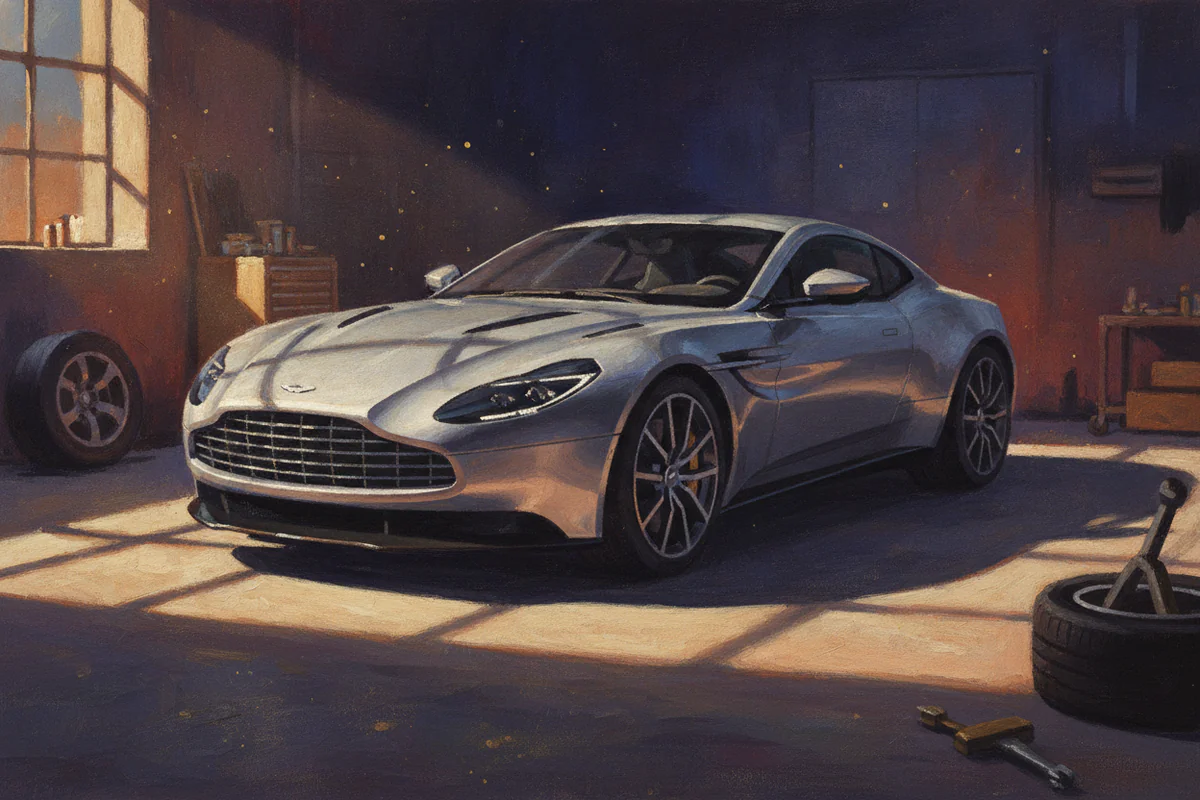
How a DB5 became more famous than the man driving it
In 1964, a silver-grey Aston Martin DB5 appeared on screen for roughly eleven minutes across the runtime of Goldfinger. It had an ejector seat, revolving number plates, and machine guns hidden behind the front indicators. None of those things were real, obviously. But somewhere between the premiere and the following Monday morning, the car became more famous than the gadgets, more famous than Sean Connery's suits, possibly more famous than Bond himself. That is a strange thing to have happened to a small car company from Newport Pagnell that was, at the time, quietly going broke.
The Aston Martin James Bond legacy is one of the most effective pieces of accidental branding in automotive history. Accidental because Eon Productions didn't approach Aston Martin with a sponsorship deck and a brief. The DB5 was chosen because it was the right car for the character - fast, British, understated in the way that very expensive things often are. The relationship grew from there into something that neither side could have engineered deliberately.
What the films actually did to the brand
Before Goldfinger, Aston Martin was known mainly by enthusiasts and by the sort of people who followed Le Mans racing. The DB4 had won admirers, the DB4 GT Zagato was genuinely coveted, and the company had a serious motorsport pedigree going back to the 1950s. But outside that world, most people couldn't have picked an Aston Martin out of a lineup.
After Connery drove one off a cliff in Switzerland while being chased by two women with machine guns - which sounds absurd written plainly like that - everything changed. The car became shorthand for a specific idea: intelligence, danger, taste, Britain at its most romanticised. It wasn't about speed figures or lap times. It was about what the car implied about the person driving it.
That implication has proven almost impossible to shake, which is both a gift and a trap. Aston Martin has spent decades trying to be taken seriously as an engineering company while also knowing full well that a lot of buyers are, on some level, buying into the Bond fantasy. The two things sit awkwardly together sometimes. A brand that wants credibility on the Nurburgring and also trades on spy mythology is pulling in two directions.
The cars, separated from the mythology
Here's the thing, though: the cars are actually good. Often very good. And this gets lost in all the tuxedo noise.
The DB5 that made the franchise famous was genuinely one of the finest grand tourers of its era. A 4.0-litre straight-six developed by Tadek Marek, a body designed by the Italian coachbuilder Carrozzeria Touring under their Superleggera method - that's lightweight aluminium panels over a tubular frame - and enough refinement to cover serious distances quickly without punishing the driver. Autocar tested one in 1963 and got 0-60 in 7.1 seconds, which was genuinely quick for the time, especially in something that could also carry luggage for a fortnight in the south of France.
Move forward to the V8 Vantage of the 1970s and you get a car that, in its 1977 form, was claimed to be the fastest production car in Britain. That claim was disputed - it usually is - but the point is Aston Martin was building something with real performance intent, not just polishing the Bond connection.
Then there's the DB7, which arrived in 1994 and basically saved the company after Ford took ownership. It sold in numbers Aston Martin had never seen before. The DB9 refined that formula further. And the Vantage and DBS that came afterward were, by any reasonable measure, serious driver's cars - not just objects that photographed beautifully, though they did that too.
The Aston Martin car poster is one of those prints that works because the cars actually look like art, not because someone art-directed them to. The proportions do the work.
Where the fiction and reality blur
The Bond films have featured other cars - a Lotus Esprit that turned into a submarine, a BMW Z3 that got more screen time than it deserved, a Citroën 2CV chase scene that was charming precisely because it was ridiculous. But the audience always comes back to Aston Martin as the "correct" Bond car, even during the years when Aston had no deal with Eon and the films used other brands. There's something in the visual grammar of an Aston Martin that reads as Bond, independently of any contract.
Daniel Craig's tenure as Bond leaned hard into this. Casino Royale brought back the DB5 almost as a piece of fan service, and it worked completely. The later films gave Craig a DB10, a car built specifically for Spectre with only ten made and none sold to the public. Aston Martin built ten cars that would never be driven by anyone except a film crew and a stunt driver, purely to keep the association alive. That's how seriously both parties take this relationship now.
Whether that's a healthy place for a car company to be is a fair question. Aston Martin has had serious financial trouble at various points - multiple administrations, ownership changes, a period in the late 2000s when it wasn't clear the company would survive in any recognisable form. The Bond association didn't fix those problems. Good cars and investment did, eventually. The mythology is a surface, not a foundation.
What "British cool" actually means here
There's a version of British cool that's all performance and no pretension - think Colin Chapman building racing cars out of whatever was cheap and light, or the original Mini being designed to solve a fuel crisis and accidentally inventing a cultural moment. Aston Martin's version is different. It's aspirational, slightly aristocratic, comfortable with its own expense. It doesn't apologise for costing a lot. And that maps onto Bond in an obvious way - the character is a government employee who somehow always wears bespoke suits and stays in hotels he couldn't possibly afford.
The fantasy holds because both the films and the cars are polished enough that you don't interrogate the internal logic. You just accept it. A DB5 is beautiful and that beauty is doing a lot of persuasive work.
The honest answer to whether Aston Martin earned its reputation independent of the Bond films is: yes, mostly, but probably not at this scale. The racing history, the engineering, the design - all of that was real and serious before Connery ever sat in the driver's seat. But the worldwide recognition, the instant cultural shorthand, the fact that someone in São Paulo or Seoul who has never seen an Aston Martin in person still knows what it represents? That came from eleven minutes in Goldfinger. It's worth being clear-eyed about that, even if you love the cars.