
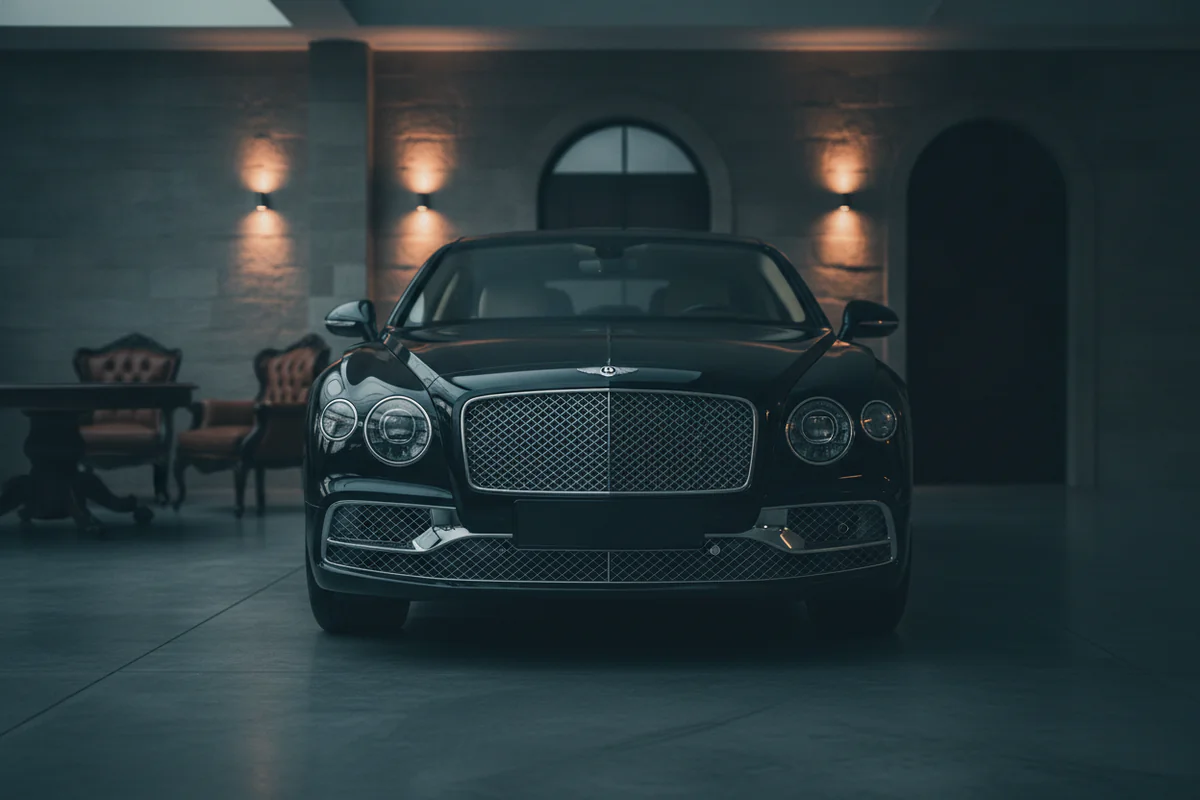
The factory that time didn't entirely leave behind
Bentley's factory in Crewe, Cheshire has been on the same site since 1946. That part is well known. What's less talked about is how much of what happens inside still involves someone sitting at a bench with tools in their hands, doing work that a machine could theoretically do but that Bentley has chosen, deliberately, not to automate. That choice is the whole story, really.
The Bentley handbuilt luxury heritage narrative gets deployed a lot in marketing - glossy videos of craftspeople pressing veneer panels, that sort of thing - but underneath the PR gloss there are real specifics worth understanding. Because if you're spending Continental GT money, or Flying Spur money, the question of what you're actually buying isn't trivial.
What still gets done by hand
Start with the hides. Each Bentley interior uses somewhere between 15 and 18 individual cowhides, selected by eye in Crewe rather than by automated scanner. Inspectors mark and reject sections with natural blemishes - insect bites, stretch marks near the belly - and a single hide might yield only a portion of usable leather after that process. The cutting, the stitching, the diamond quilting on a Mulliner specification seat: all hand-sewn. The double-needle stitching on a Bentley steering wheel takes a trained craftsperson around 15 hours to complete. That number tends to surprise people.
Veneer work is similarly labour-intensive. Bentley sources wood veneers - open-pore walnut, dark-stained burr, piano-lacquered options - and the veneer bookmatch panels in the cabin are oriented and aligned by hand. Getting the grain symmetrical across a dashboard fascia requires a skilled eye and considerable patience. The lacquering process runs to multiple coats with hand-sanding between each one, which is part of why the depth of finish looks the way it does in person, different from the lacquer on a production car interior that costs a tenth of the price.
Knurling on the switchgear - those small textured control rings and bezels - is hand-finished. The organ stop air vents that appear in various Bentley models are machined and then tumbled and polished to a specification checked manually. And the engine, depending on the model. The W12 unit that powers the top-tier Continental variants was, until that engine's recent phase-out, hand-assembled by a single technician who signs the finished block. The V8 has followed similar practice. One person, one engine.
The Mulliner effect
Mulliner is Bentley's in-house bespoke division, and it's where the handbuilt element reaches its logical extreme. Clients commission things there that have no precedent in any catalogue - specific inlays made from a customer's own materials, paint colours mixed to match a favourite photograph, embroidery that takes weeks. The division has been operating in various forms since the coachbuilding era, and it still functions with a small team that takes on projects other manufacturers would decline on grounds of complexity alone.
The reason this matters to buyers - and I think it genuinely does matter, not as sentiment but as practical distinction - is that Mulliner work produces objects that have no exact duplicate. A Rolls-Royce customer will tell you something similar, and fairly. But Bentley occupies a slightly different register: it's a car you can take on a motorway and push hard, one with real performance credentials alongside the craft work. That combination of dynamics and decoration is rarer than it sounds.
Why they haven't automated it all away
This is the question that's actually interesting. Bentley is owned by Volkswagen Group, which has the engineering resources to automate almost anything. They haven't, and the reasons are partly commercial and partly something harder to quantify.
The commercial reason is straightforward enough: handwork is a differentiator in a segment where buyers genuinely have every option. Someone buying at this level has considered Aston Martin, Rolls-Royce, Mercedes-Maybach, Porsche at the top of its range. The tactile evidence of handwork - the feel of the stitching, the weight of the controls, the variation in the veneer grain - is something they notice and pay for. Automate it and you close the gap to competitors who cost half as much.
The harder-to-quantify reason is about narrative durability. Luxury goods that carry a credible craft story retain their meaning over time. Hermes bags, A. Lange & Sohne watches - the value proposition holds because the making process is genuinely specific and slow. Bentley understood early that its heritage in Crewe, the address itself, the continuity of practice, was an asset that depreciated if abandoned. W.O. Bentley built engines by hand in smaller workshops before the company scaled. The modern factory is a different scale entirely, but the thread to that origin is real enough that it's worth preserving.
Anyway - the cynical read is that this is all storytelling in service of a margin. And it partly is. But the stitching is still there. The hours are still logged. The craftsperson's signature is still on the engine block. Those things exist independently of whoever is selling you the story about them.
What it means for buyers choosing between brands
If someone is weighing a Bentley against a Rolls-Royce, the handcraft comparison is roughly comparable at the top of each range, and personal taste in aesthetic direction probably matters more than any technical measure of which has more hand hours. But if the comparison is against, say, a high-specification Porsche Panamera or a Mercedes-AMG S-Class, the difference in the nature and quantity of handwork is significant and observable. You're not choosing between equivalent approaches dressed differently; you're choosing between fundamentally different production philosophies.
The buyers who find that distinction meaningful - and they are a specific kind of buyer, generally one who researches deeply before spending - tend to return. Bentley's customer retention figures bear that out. There's something about knowing the chair you're sitting in was stitched by a person who does only that, in a factory that has occupied the same Cheshire postcode for almost eighty years, that produces a different kind of ownership feeling than a vehicle assembled primarily by robotic cells.
Whether that feeling is worth the price is a question only the buyer can answer. But the feeling is based on something real, which is more than can be said for a lot of luxury marketing. The Bentley handbuilt luxury heritage pitch survives scrutiny, and that's genuinely unusual in this segment.