
Why some people still log it by hand
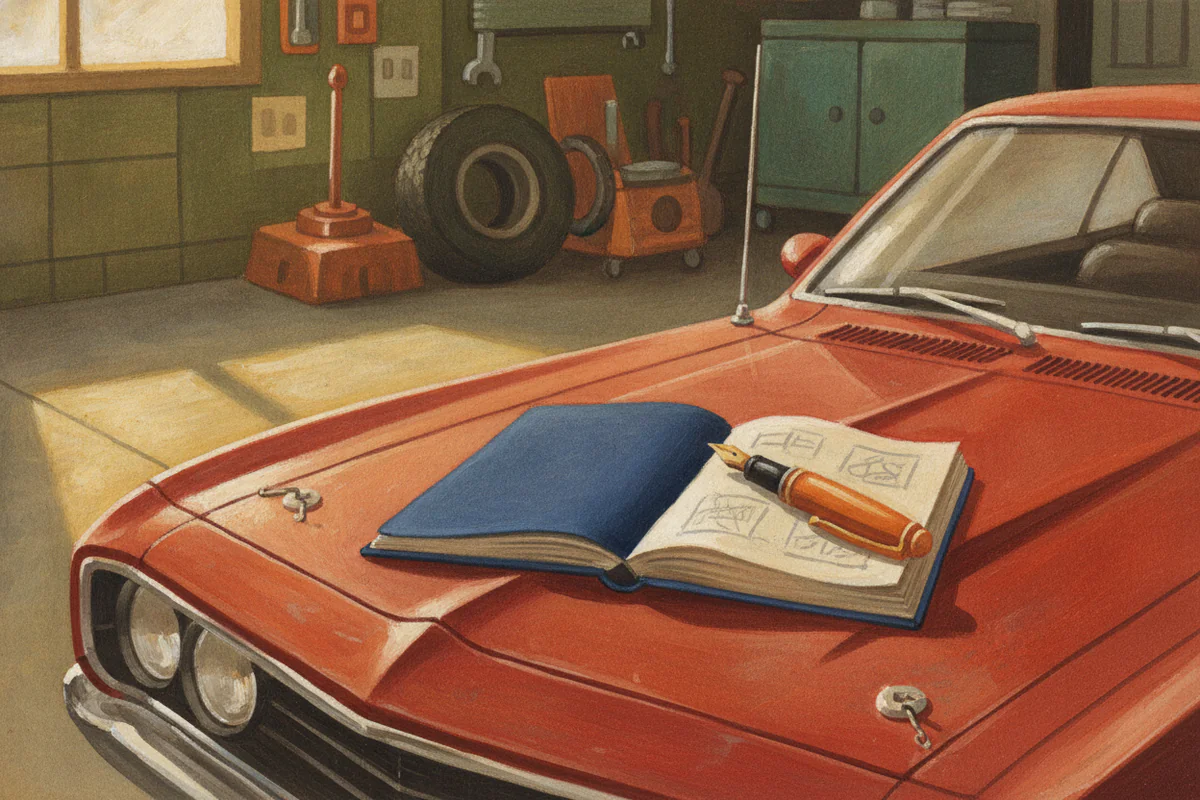
There are apps for this. There are spreadsheets, cloud dashboards, OBD-II dongles that auto-log everything to your phone. And yet a surprisingly large number of car owners - especially the ones who actually care about their cars - keep a physical notebook in the glovebox or on the workbench. I get it. A notebook doesn't need a login, doesn't sunset its free tier, and doesn't lose your 4-year service history because you switched phones.
For a certain kind of owner, the notebook is the car's record. Oil changes, tyre rotations, brake fluid swaps, the date you finally got around to replacing that one burned-out reverse light. Mods too - part numbers, torque specs, notes like "rear sway bar end links rattle slightly on cold start, check spring." That's not something you want scattered across three apps and a notes file.
So if you're going the paper route, it's worth picking the right notebook. Not all of them hold up well in a car environment or work well for this specific kind of logging.
What actually matters for this use case
Paper quality
Car maintenance notes tend to get written in imperfect conditions - standing next to the car, hands not entirely clean, sometimes under decent lighting and sometimes not. Thin, bleed-prone paper is annoying to write on with a ballpoint or a Sharpie, and it shows oil smudges more readily than a slightly thicker sheet. Look for something in the 80-100gsm range if the spec is listed. Leuchtturm1917 and Rhodia both use heavier paper than your average office-supply spiral. Moleskine's classic notebooks are fine but the paper is thinner than people expect given the price.
Binding style
Lay-flat binding matters here. You want to be able to rest the notebook open on the engine bay lip or on the passenger seat and have it stay flat while you write. Spiral-bound notebooks do this well. Sewn hardcover notebooks like Leuchtturm and Moleskine open reasonably flat after you break them in. What you don't want is a glue-bound softcover that wants to snap shut every time you let go of it - deeply annoying when you're trying to copy down a part number.
Format: ruled, dotted, or grid
This is personal, but I'd lean toward grid or dotted for this job. Mileage logs and maintenance tables benefit from having something to align columns to. Plain ruled lines work fine for notes but they're limiting once you start wanting to draw a quick diagram of which tyres you rotated to which position, or sketch out a wiring mod. Dotted paper handles both uses without looking chaotic.
Size
A5 (roughly 5.5 x 8.5 inches) is the sweet spot. Fits in a glovebox without being cramped to write in. A6 is too small for proper table layouts. Full A4 or letter size is awkward to keep in the car. If you're using the notebook purely at the workbench, A4 is fine - more space to spread out diagrams and service schedules.
Notebooks worth considering
Leuchtturm1917 A5 dotted hardcover
The indexed page numbering is genuinely useful here. You can designate page 1-20 as your mileage log, 21-40 as service history, and so on, then actually find things later. The paper handles ballpoint and fine-liner well. It's not cheap at around $25, but it lasts a long time and the build quality is solid. The hardcover means it can sit on a workbench without flopping around.
Rhodia Webnotebook A5
Rhodia's paper is some of the smoothest you'll write on, and the lay-flat binding is excellent from day one - no breaking-in period. The elastic closure keeps it shut in the glovebox without being a hassle to open one-handed. Available in blank, ruled, and grid. I'd go grid for this use case.
Field Notes memo books (3-pack)
Smaller than A5 and spiral-free, so they're not ideal for extended table logging. But they're inexpensive, durable enough, and genuinely pocket-sized - good for keeping one in the car purely as a mileage and fuel log, where entries are short and frequent. The brand makes a "Expedition" edition on waterproof paper, which is worth considering if your car's interior gets damp or you're writing notes outside in all weather.
Clairefontaine Age Bag notebooks
Clairefontaine paper is extremely well-regarded and the Age Bag series has a sturdy-enough softcover with solid stitching. The ruled paper at 90gsm handles most pens without bleed. Slightly less expensive than Leuchtturm and a good option if the indexing feature isn't something you'd use anyway.
A plain spiral-bound grid notebook
Honestly, a $6 Mead or Five Star spiral-bound notebook in grid format from any office supply store will do the job. It lays flat, it's replaceable, and you don't feel bad writing messy torque specs in it. If your notes tend toward functional over organised, this is fine. The paper is thinner and ballpoints can ghost through to the next page, but for most people that's not a dealbreaker.
A system worth thinking about before you start
The notebook choice matters less than having some structure before you start filling it. A few things that work well: keep the first 5-6 pages as a running mileage and fuel log, with columns for date, odometer reading, fuel added (litres or gallons), and a notes column for anything that felt off. Reserve a section from the back of the book for modification records - what you changed, what parts you used, where you bought them. Leave the middle for free-form service notes and anything that doesn't fit a table format neatly.
If you want a built-in reference point on the wall near your workbench - or just something that makes the space feel more like yours - some owners pair a functional notebook system with a print that reflects the car they're working on. A clean poster or canvas of your model on the garage wall is the kind of thing that costs almost nothing relative to what you spend on the car itself. Car prints at EnjoyPoster start at $29 unframed if you want something for the space without overthinking it.
One thing to do from the start
Write the car's details on the inside front cover the moment you open a new notebook - VIN, year, make, model, engine size, and the odometer reading at the time you start. It sounds obvious but it's easy to skip, and six months later when you're trying to remember whether the notebook covers your current car or the one you sold, you'll be glad you did it. Same goes for noting where you store the previous notebook when you fill one up and start a new one.
Paper records have one real advantage over digital ones: they don't require you to trust anyone else's infrastructure. Your service history lives in a drawer, it travels with the car if you sell it, and it doesn't disappear because a company pivoted. For people who care about that kind of continuity, the friction of handwriting is a reasonable trade.