
Desk decor for car lovers: keeping it sharp, not shrine-like
The problem with most "car lover's office" setups you see online is that they went too far. Neon signs, a dozen die-cast cars in a row, a poster of a Lamborghini taped directly to drywall. If that's your thing at home, fine - but if you're on video calls with clients, or you just want a desk that looks like an adult works there, you need a more edited approach. A couple of well-chosen objects will land harder than a shelf full of stuff anyway.
Here's what actually works, and what to skip.
Start with one piece of wall art
A single automotive print behind your monitor or to one side of your desk does more than you'd expect. It anchors the space, it shows up on camera, and it's easy to swap out if your tastes change. The key is choosing something that reads as design-forward rather than memorabilia. A clean line drawing of a 911's profile, a technical blueprint print of an engine, or a moody black-and-white photograph of a racing straight - those work in an office context. A cartoon rendering of your favorite tuner car probably doesn't.
Scale matters here. A 16x12 is fine if your desk is in a corner with limited wall space, but if you've got the room, a 24x18 or larger will actually register on camera instead of just being a vague rectangle people squint at. Car art prints framed in a simple black or natural wood frame look particularly clean on a home office wall - the framing does a lot of the heavy lifting in making something feel deliberate rather than casual.
One print. Not three. One.
The mug situation
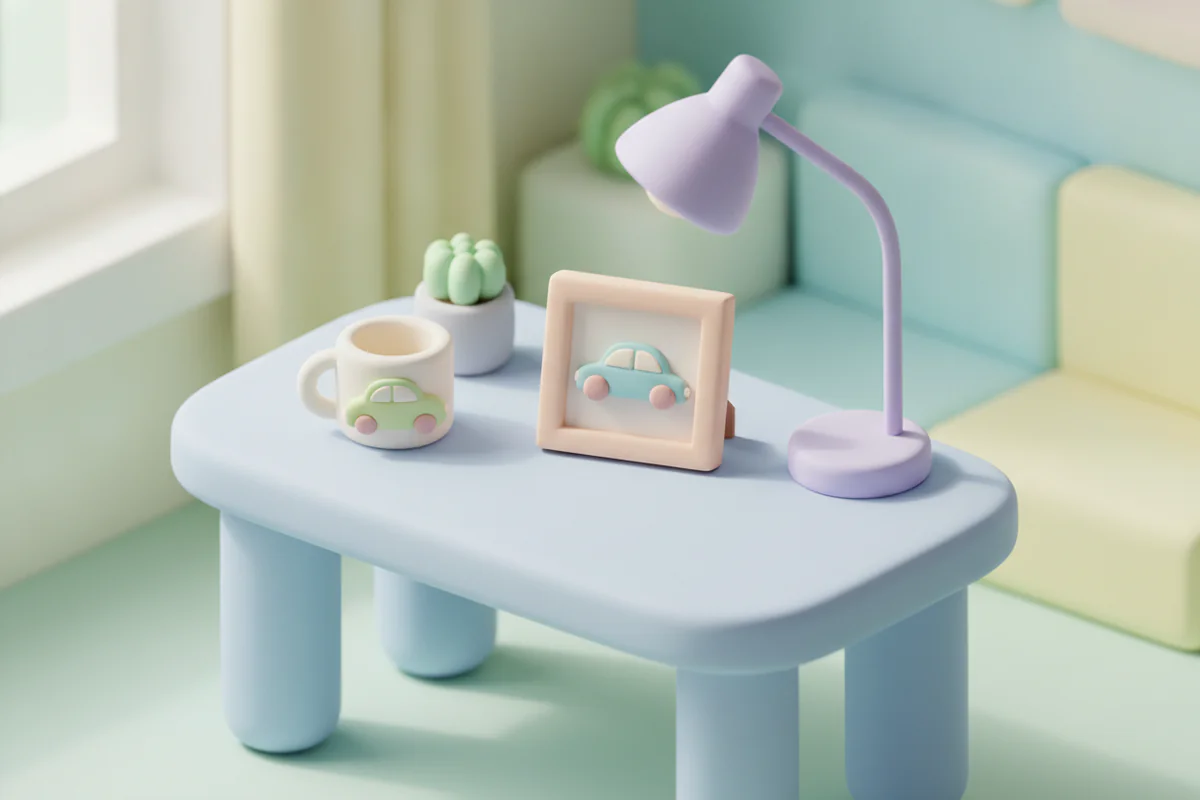
This sounds trivial, but your coffee mug is almost always visible on camera, and it says something. A mug with your favorite marque's logo or a simple illustration of a classic car is a quiet detail - the kind of thing another enthusiast will notice immediately, and everyone else will just register as "a mug." That's the sweet spot. You get the personal touch without it announcing itself.
Avoid the novelty end of the spectrum - brake disc coasters shaped like actual rotors, steering wheel mugs, that sort of thing. Once you go novelty, you've crossed from enthusiast into collector territory, and the desk starts to look like a gift shop.
One model, placed properly
A well-made scale model can be a genuinely nice desk object. A 1:43 or 1:18 of something you care about, positioned where it gets a bit of light and doesn't get buried under cables and stationery. The brands that matter here are Minichamps, Spark, Norev, IXO - models with real detail and proper paint, not the vague blobs you get from the bottom shelf of a toy store. An older Formula 1 car or a Group B rally car tends to read as more interesting and less juvenile than a current supercar, but honestly, if the model is good quality, the subject matters less.
One model. Maybe two if your desk is large and you place them with actual intention rather than just setting them down wherever. Once you have a row, you've got a display case, not a desk.
Subtle details that actually come up in conversation
A few other objects that work well without tipping into full automotive theme:
- A leather desk pad. Doesn't need to be car-branded - just quality leather has a similar warmth to the material in a good car interior, and it looks professional on camera.
- A gear-shift-inspired pen holder or small object. These exist in tasteful versions. Avoid the chrome novelty ones - look for something matte and minimal.
- A good print of a circuit map. Nurburgring, Spa, Monza - the track layouts are geometric and abstract enough to work as actual art without being obviously motorsport to anyone who doesn't already know.
That last one is interesting because it works as a conversation starter when someone does recognize it, and looks like a purely graphic print to everyone else. Anyway - that double function is worth thinking about when you're choosing anything for a space that other people see.
What to avoid
Skip anything backlit, anything that requires explanation to look intentional, and anything you'd buy at a racing track gift shop. Real carbon fiber accessories (key trays, business card holders) can work if the quality is there, but cheap faux-carbon-fiber plastic looks terrible and reads immediately as an afterthought. Branded team merchandise - caps, flags, replica jackets draped over a chair - all belongs somewhere else, not on a desk you're being professionally judged against.
Also worth saying: resist the urge to theme every single surface. The automotive details work because they're surrounded by normal office things - a lamp, some books, a plant. If every object on the desk is car-related, the effect is overwhelming. Contrast is what makes the pieces you care about actually stand out.
How to think about it as a whole
The goal is a desk where someone who knows cars notices things and wants to ask about them, and someone who doesn't know cars sees a clean, well-put-together workspace. That's not a difficult balance to hit if you're choosing carefully rather than accumulating. One good print, a quality mug you actually use, a model that means something to you - that's genuinely enough. Add things slowly, remove something when you add something new, and the desk stays sharp.
If it's starting to look like you're trying to prove something to visitors, you've probably gone one object too far.