
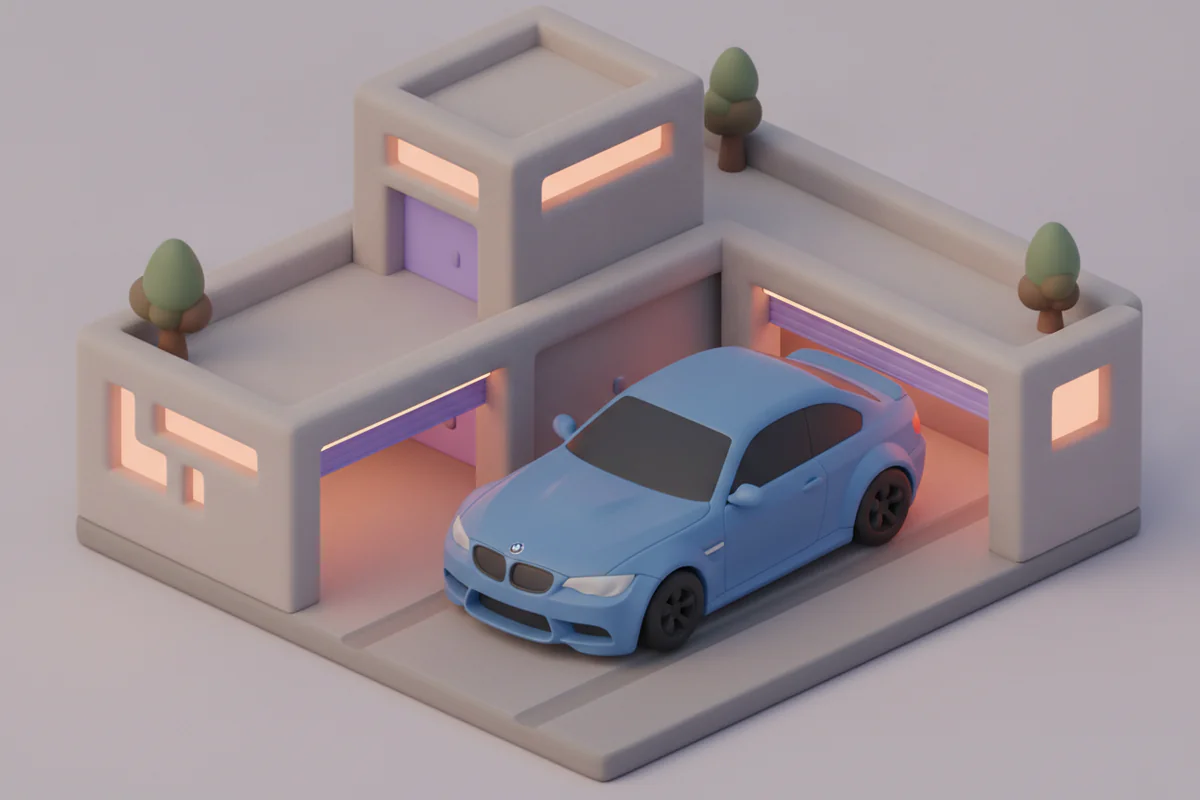
The car that started as a loophole
The original M3 existed because of a rule. Group A touring car racing in the mid-1980s required manufacturers to build at least 5,000 road-legal versions of the car they wanted to race. BMW wanted to go racing with a high-revving four-cylinder in a lightweight coupe body. So in 1986 they built the E30 M3, sold it to the public, and went to win things - which they did, extensively, in DTM and the European Touring Car Championship.
The road car got a 2.3-litre S14 four-cylinder making 197 hp in standard European trim, a completely different rear bodywork section with that iconic ducktail spoiler, flared arches, and a windscreen raked more steeply than the standard E30. It weighed about 1,200 kg. It was not comfortable, particularly. The steering communicated everything. Enthusiasts treat it now like a religious artifact, which is either entirely justified or slightly overdone depending on who you ask - but the car really was remarkable for what it was.
A limited Evolution variant pushed output to 220 hp, and the Sport Evolution of 1990 reached 238 hp from 2.5 litres. By then the E30 M3 was already becoming a collector's piece.
The E36: more car, less theatre
When the M3 returned in 1992 as the E36, it had grown up considerably. Gone was the four-cylinder. In came a 3.0-litre inline-six - the S50, eventually enlarged to 3.2 litres and producing 321 hp in the final European Evolution spec. It was quieter, faster in a straight line, more refined and dramatically more practical. You could take passengers somewhere without punishing them.
Enthusiasts have always been slightly cool on the E36 compared to what came before and after it, which feels a little harsh. It handled beautifully, the six sounded wonderful at high revs, and the cabin was genuinely usable. But it lacked the raw, unfiltered character of the E30, and the E46 that followed was so good it somewhat overshadowed the E36 in retrospect.
The E46: the one everyone agrees on
The E46 M3, built from 2000 to 2006, is the generation that almost no one argues against. The S54 inline-six displaced 3.2 litres, made 343 hp, and revved to 8,000 rpm with a sound that still gets used in YouTube compilation videos for good reason. Variable valve timing, individual throttle bodies, and a redline that felt genuinely exotic for a production car in 2001.
The chassis was extensively reworked - wider tracks, revised suspension geometry, massive cross-drilled brakes as standard. The SMG automated manual gearbox was controversial at launch and remains divisive; the six-speed manual, though, is considered by many the best gearbox BMW ever fitted to anything. Coupe only, no estate, no SUV variant, just the car doing what it was supposed to do.
Values have climbed steadily for clean examples. A low-mileage manual E46 M3 in good condition now costs more than a new mid-range family car, which would have seemed absurd fifteen years ago.
The E90/E92: the V8 years
For the fourth generation BMW made a decision that still divides opinion: they dropped the inline-six and fitted a 4.0-litre naturally aspirated V8. The S65 produced 414 hp, revved to 8,400 rpm, and made a noise unlike anything else wearing an M badge before or since. Available as a sedan (E90), coupe (E92), and convertible (E93), it was the most powerful naturally aspirated M3 ever made.
It was also heavier, partly because of the engine and partly because the underlying E90 platform was bigger. The steering, while still hydraulic, felt slightly more assisted than the E46's. And the SMG had been replaced by a dual-clutch gearbox that was quick but sterile in a way the manual wasn't. The manual transmission was available, thankfully.
The V8's rod bearing issues became a well-documented problem - owners who didn't use the right oil or skipped oil changes sometimes found catastrophic engine failure waiting for them around 60-80,000 miles. Fixed with a relatively simple parts replacement if caught early, but a legitimate ownership concern. Knowing this going in matters.
The F80: turbos arrive, the arguments begin properly
The 2014 F80 is where BMW M3 history evolution discussions get genuinely heated. BMW turbocharged the M3 for the first time, fitting a 3.0-litre twin-turbocharged inline-six - the S55 - making 425 hp and 550 Nm of torque. Performance was extraordinary: 0-100 km/h in under four seconds, a broader usable power band, better fuel economy than the V8, and a new dual-clutch gearbox that was significantly better than the old one.
What it lost, depending on your view, was the character. High-revving naturally aspirated engines have a specific feel - power that builds progressively, an incentive to use the full rev range, a sense of occasion at 7,500 rpm that turbo engines rarely replicate. The F80 was faster than the E92 in almost every measurable way. Whether it was more satisfying is a question with no clean answer.
The F80 also introduced electronic steering (no hydraulic rack), which remains the most common complaint from drivers who owned both it and an E46 or E92. Accurate, fast, but filtered.
The G80: 503 hp and a grille conversation
The current G80, launched in 2020, makes 503 hp from an updated twin-turbo six in Competition trim. It comes as a sedan or a wagon (the M3 Touring, finally, after decades of requests), and for the first time as an xDrive all-wheel-drive variant. The M xDrive system can be set to rear-wheel-drive mode, which goes some way toward satisfying purists.
The performance numbers are roughly supercar territory from a decade ago. The chassis is tremendously capable. And then there's the kidney grille, which BMW enlarged to dimensions that prompted an immediate and prolonged public reaction when the car was revealed - enthusiasts and mainstream commentators alike found it jarring against the relatively clean body. Whether it has aged into acceptance or remains too much depends who you're standing next to at a car meet.
The G80 also weighs close to 1,800 kg in some configurations. The E30 M3 weighed 1,200 kg. That number tells you something about where the car has been and what it's become - not worse necessarily, just genuinely different in intent.
What the arc actually looks like
Looking across all six generations, the M3 started as a barely-disguised racing car and has become an exceptionally fast, technology-heavy performance sedan that competes in a completely different category. Each generation was, at launch, faster and more capable than the one before. Each generation also prompted some section of the existing ownership base to argue the soul had been lost.
The E30 crowd said it when the E36 six arrived. The E46 crowd said it when turbos came with the F80. The argument is permanent, probably. And it's worth noting that the E30 M3, which everyone now agrees was pure and special, cost roughly the equivalent of a base 5-series when new - it was not cheap or accessible, it was a homologation special built to a racing brief. Nostalgia smooths over a lot.
For people who've followed the car through all of this, the BMW wall art and gift collection covers the full range of generations if you want something on the wall that reflects which era you actually prefer - and the arguments about which one that should be can carry on indefinitely.
The honest read is that no single generation of the M3 got everything right, and every one of them was interesting for specific reasons. The E46 remains the generation with the fewest weaknesses. The E30 has the best story behind it. The G80 is probably the last naturally-driveable M3 before electrification changes things in ways nobody can fully predict yet - which makes right now a reasonable time to pay attention to what it is rather than what it replaced.