
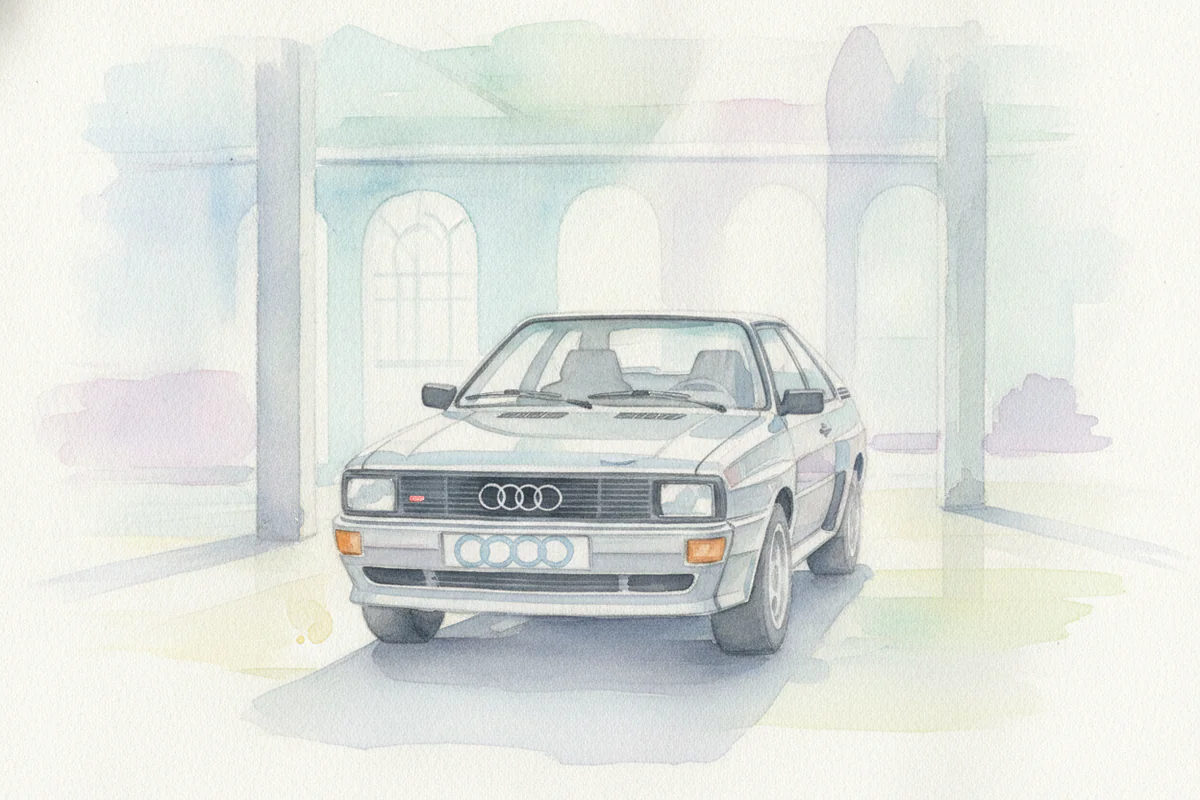
There is a line that any serious Audi fan can recite on command, usually with some attempt at a gruff Northern English accent: "Fire up the Quattro." It comes from a BBC drama, not a motorsport broadcast. And yet it has done more to cement the romance of Audi's all-wheel drive system in popular memory than almost any actual race result. That is a strange thing when you think about it, because the real Quattro story is already extraordinary enough to not need any help from television.
Where the phrase actually comes from
The line appears in Ashes to Ashes, the 2008 BBC sequel to Life on Mars. The show follows DCI Gene Hunt, played by Philip Glenister, a loud, unreconstructed detective who exists somewhere in the early 1980s - or at least in one character's fever-dream version of that decade. Hunt drives an Audi Quattro throughout the series, and the car functions almost as a co-character: loud, blunt, built for a world that does not apologise for itself.
The actual line is delivered with the kind of casual theatrical weight that makes it stick. Hunt does not explain the car. He does not admire it. He just commands it into action, and the show treats that as a sufficient statement of intent. Writers Matthew Graham and Ashley Pharoah understood that the Quattro carried enough real-world mythology by 2008 that they only had to gesture at it and audiences would fill in the rest.
Which raises the question of why the car had that mythology in the first place.
What the Quattro actually did
Audi introduced the Quattro at the 1980 Geneva Motor Show. The four-wheel drive system had been adapted from a military vehicle Audi's engineers had encountered, and the idea of putting it into a road and rally car was considered mildly eccentric by most of the industry at the time. Rally cars used rear-wheel drive. That was just how it was done.
Then the car started winning. Hannu Mikkola and Michèle Mouton drove Quattros through the 1981 and 1982 seasons of the World Rally Championship and rewrote what was possible on loose surfaces. Mouton in particular - she won four WRC rounds in 1982 and nearly took the drivers' championship, which remains one of the most under-discussed achievements in motorsport history. The Quattro's ability to put power through all four wheels on gravel, ice and snow made the rear-wheel drive competition look like it was working twice as hard for half the result.
The Group B era that followed, from 1982 to 1986, is where the real mythology gets built. These were cars producing somewhere between 400 and 600 horsepower with almost no meaningful safety regulations, driven on public roads with spectators standing three feet from the racing line. Audi's Sport Quattro S1 - the short-wheelbase evolution with a widened body and a five-cylinder turbo making around 500 bhp - is one of the most visually aggressive things ever to carry a manufacturer's badge. Walter Röhrl drove one. Stig Blomqvist took the drivers' title in 1984. The cars were terrifying and they were dominant and they looked unlike anything else on the stages.
Group B ended after fatal accidents in 1986, but it left a specific kind of scar on car culture - the kind people return to obsessively. And at the centre of that obsession sits the Quattro.
Why a TV line became the shorthand for all of this
Gene Hunt's Quattro in Ashes to Ashes is a 1981 road car, not a rally machine. It has nothing technically in common with the Sport Quattro S1 that was terrorising Alpine stages five years later. But that distinction is almost irrelevant to how the phrase functions culturally. What Hunt's car does is put the Quattro name inside a story about attitude - a character who operates by instinct, ignores bureaucracy, and gets results his own way. The car is shorthand for that whole personality.
For enthusiasts who already knew the rally history, the show was essentially pointing at something they already revered and saying: yes, this car means exactly what you think it means. For viewers who did not know the history, the show made them curious enough to go looking. Either way, "fire up the Quattro" became the phrase that collapsed the whole story - the Geneva reveal, Mouton's wins, the Group B madness, Röhrl's driving - into three words.
Phrases like this are rare. They require the right delivery, the right character, the right cultural moment. And they need to be pointing at something real. The line works because the Quattro's actual record gives it weight. You cannot manufacture that retroactively.
How it still circulates
Search the phrase today and you will find it on forums discussing the best moments in British TV, in comment threads under Audi rally footage on YouTube, on merchandise, on number plates. Audi themselves have leaned into it at various points, which makes sense - the Quattro brand is still active and the heritage is genuinely useful marketing. The 2010 Quattro concept car was a direct callback to the original bodylines. Every time Audi talks about their all-wheel drive lineage, the Ashes to Ashes era gets folded in whether anyone mentions the show or not.
The enthusiast community that keeps the phrase alive is the same one that tracks down original Ur-Quattros, watches Group B onboards on repeat, and plasters their walls with imagery from that era. If you spend any time in that world, you will see the rally cars, the stages, the drivers, the car in its various forms treated as proper art objects - which is why Audi wall art and gifts tends to lean heavily on the Quattro period rather than anything more recent.
Anyway - the point is that the phrase has outlasted the show that coined it, which is a rare thing. Ashes to Ashes finished in 2010. The line is still being quoted.
What makes it stick
There is a version of this where the real history gets flattened into nostalgia - where people repeat the line without knowing that Michèle Mouton nearly won a world championship in one of these cars, or that the Sport Quattro S1 was generating downforce figures that the FIA had not thought to regulate yet. That would be a shame, because the actual story is more interesting than the TV drama, which is saying something.
But the phrase keeps people in the conversation long enough to find their way to the real history. Someone hears "fire up the Quattro" as a meme, goes looking, and ends up watching onboard footage from the 1985 San Remo Rally at two in the morning. That is not the worst outcome. The Quattro can handle the attention. It earned it on stages that no longer exist, in conditions that no modern safety standard would permit, and it won anyway. The phrase just keeps the door open.