
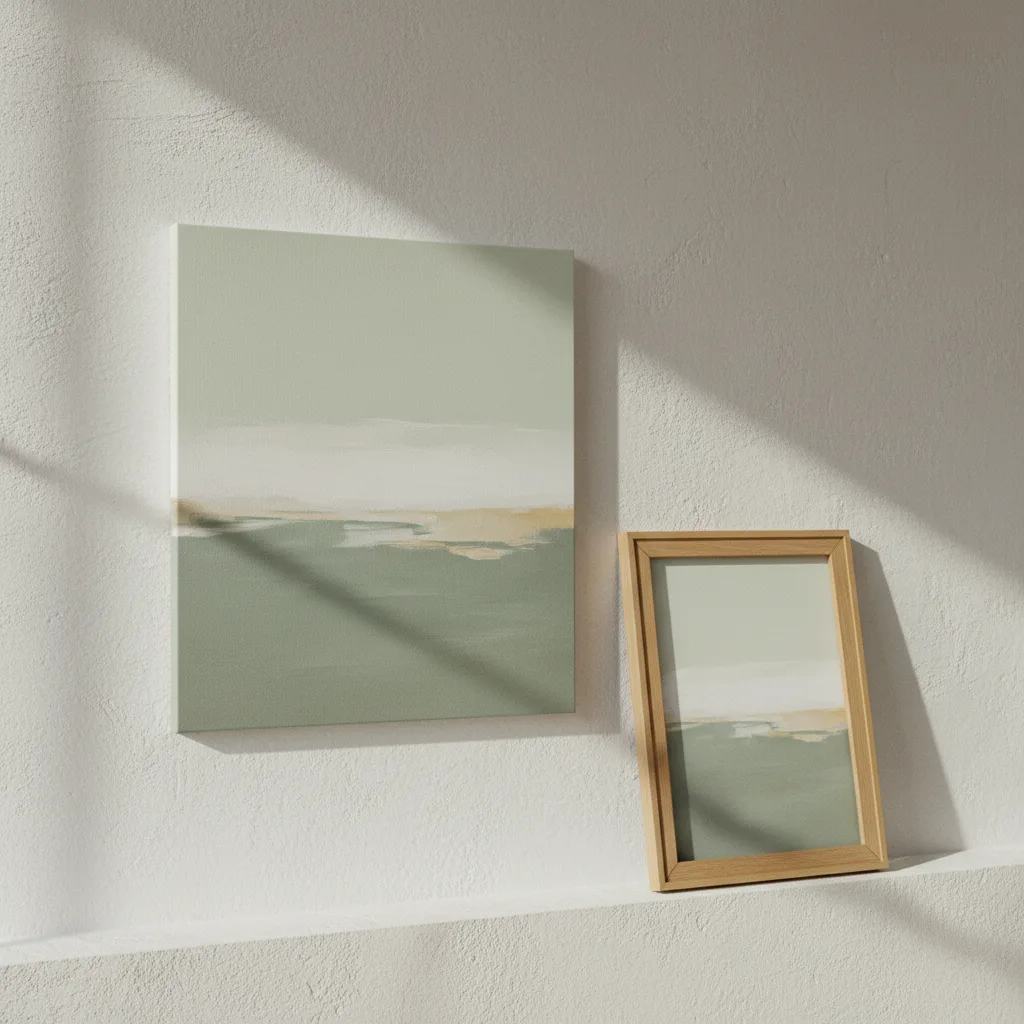
If you're asking should I frame a canvas print, the short answer is: probably not. Gallery-wrapped canvas is designed to hang without a frame, and for most rooms, adding one makes things look heavier and more fussy than they need to be. But there are real exceptions, and they're worth knowing before you put a hole in the wall.
What "gallery wrapped" actually means
A gallery-wrapped canvas is stretched over a wooden frame - usually 1.5 to 2 inches thick - and the image wraps around the sides. The edges are part of the design, or they're a solid color continuation of the background. It's meant to be a finished object on its own. When you add a picture frame around that, you're essentially framing a frame, which rarely looks intentional.
The floating effect - where the canvas appears to hover slightly off the wall - is a big part of why people buy canvas in the first place. A thick outer frame kills that.
Should I frame a canvas print? The cases where yes actually makes sense
There are a few situations where adding a frame is the right call.
First: thin canvas. If you've got a canvas that's only half an inch deep - the kind sold cheap at discount stores - it can look a little limp without support. A simple floater frame (one that wraps around the canvas without covering the face) adds the depth it's missing.
Second: matching a formal room. If you're putting art in a space that already has ornate moldings, antique furniture, heavy drapes - the kind of room where everything has a border - a naked stretched canvas can look out of place. A slim wood or gold frame ties it in.
Third: wrinkled or warped canvas. If the canvas has any slack or the stretcher bars shifted in transit, a frame can mask that. Though honestly, most quality prints won't have this problem.
Outside those cases, skip the frame.
Floater frames vs. traditional frames
If you do decide to frame, use a floater frame, not a standard picture frame. A standard frame is built for flat art - prints, photos, paper. The rabbet (the inner edge) sits flush against the art, which means a 1.5-inch canvas just doesn't fit. You'd have to cut the canvas down or use a frame with a deep enough profile, and that gets awkward fast.
A floater frame is built with a gap between the inner edge and the canvas face. The canvas sits inside it with a few millimeters of air on all sides. It looks clean, it fits properly, and it keeps some of that depth effect. If you're shopping for one, measure your canvas thickness first - not just width and height.
How the art itself should influence your decision
Bold, graphic prints - something like a car art canvas with a dark background, or a high-contrast abstract - usually look best with nothing around them. The edges are part of the impact. Adding a frame shrinks the visual field and softens what should hit hard.
Softer pieces - watercolor style, portraits, anything with a lot of white or cream negative space - can actually benefit from a frame. It gives the eye somewhere to stop. Without one, lighter prints can blur into a white wall.
Browse the full canvas print catalog and you'll see this pattern quickly. The dark, dramatic pieces almost never need framing. The light botanical or portrait prints sometimes do.
A note on cost
A decent floater frame runs $30 to $80 depending on size and material. For a canvas you paid $40 for, that's a significant add-on. For a large statement piece you paid $120 for, it can be worth it. The math matters. Don't spend more on the frame than the print unless you have a specific reason.
The practical test
Hang the canvas without a frame first. Live with it for a week. Most people never go back. If after a week it still feels unfinished, then look at floater frames. But nine times out of ten, the canvas looks exactly right on its own - which is how it was designed.
If you're still deciding on what to order, the wall art section shows how gallery-wrapped prints look styled in actual rooms. That's usually all it takes.