Before everyone had a camera in their pocket
Car meets in the early 2000s were genuinely local things. Word spread through forum threads, printed flyers tucked under windshield wipers, maybe a phone call. You showed up, you looked at cars, you talked to the owner if you wanted to know anything about the build. Knowledge lived in the room. If you missed it, you missed it - someone might post a few grainy photos on a forum the following week, but that was the whole record.
The cars that got known nationally were the ones that made it into magazines. Super Street, Sport Compact Car, Car Craft - an editor had to decide your car was worth the pages. That filter cut both ways. Some genuinely interesting builds never got seen. But it also meant the cars that did get seen had cleared some kind of bar.
That whole structure collapsed, and fast. Not gradually - smartphones crossed a threshold around 2012 to 2014 where the camera quality got good enough and Instagram's reach got wide enough that almost any car, at almost any meet, could be seen by tens of thousands of people by the following morning.
What actually changed at the meets
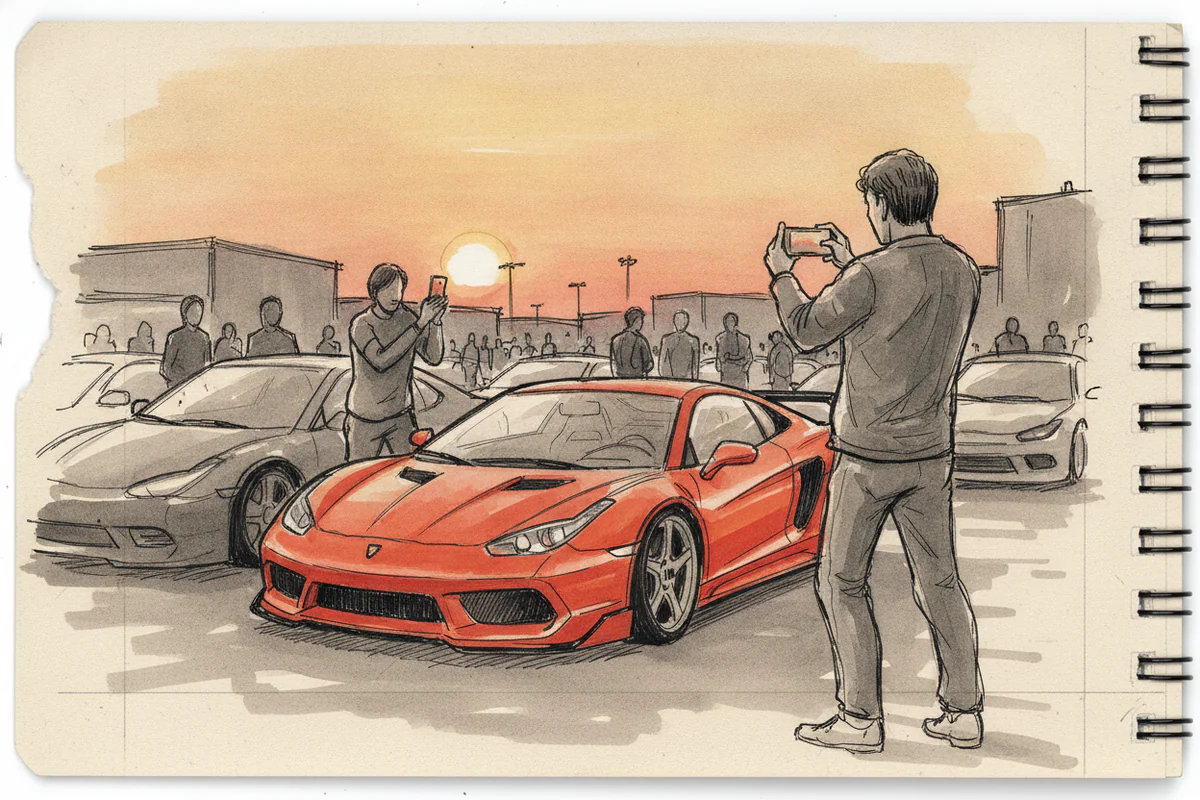
Go to a larger car meet now and watch what people do when they arrive. A lot of them are thinking in frames before they've even looked at the car properly. The phone comes out, they shoot from three angles, they move on. There's nothing wrong with that, exactly, but it changed the atmosphere at events in a way that's hard to argue against if you were around before.
Owners started building differently too - consciously or not. Stance got more aggressive because it reads well in photos. Certain wheel fitments became dominant partly because they photograph dramatically. Color choices drifted toward whatever pops against asphalt in afternoon light. Wideboys, low rides, anything with visual drama at a distance. The actual driving character of the car became almost secondary to how it would look in a 4x5 crop.
And some meets started to feel like they were organized around the content opportunity rather than the cars. That's a real shift. Some events now exist primarily to generate footage, with the cars as backdrop. Anyway - that's not every meet, and there's still a genuine scene out there if you know where to look. But the dynamic changed.
The people it helped
Here's the thing though: social media genuinely democratized who could get noticed. The magazine gatekeepers are mostly gone, and while something was lost there, a lot of people who would never have gotten a feature got an audience anyway. A guy building a first-gen Honda in a one-car garage in a mid-size city can post his progress and end up with 40,000 followers who are actually interested in the work. That wouldn't have happened in 2003.
Niche builds that never had a magazine home found their people. Rat rods, kei trucks, lifted Volvo wagons, whatever you're into - the communities exist online and they're often more technically serious than their size would suggest. Forums didn't fully die either; some of the best technical knowledge in specific marques still lives on boards that look like they were designed in 2007 and that's fine.
Small regional shops got real reach. A restoration shop doing honest work could build a following just by documenting the process, no PR budget required. Some of the best automotive content online is exactly that - someone who actually knows what they're doing, explaining what they're doing, with no performance involved.
The reputation economy, and its problems
The flip side is that car culture social media change brought a reputation economy that can turn on you quickly and isn't always fair. A clip of a car doing something stupid at a meet - or edited to look that way - can define how thousands of people see that owner or that community. Entire meet series have been shut down partly because a few pieces of bad footage circulated and caught the attention of local authorities or venue owners.
The incentive to perform for the camera also brought in people whose primary interest is the content, not the cars. That's not inherently bad - plenty of great automotive journalists started as enthusiasts with cameras - but it shifted the social fabric of events. The person with the most followers in the room carries a kind of status that has nothing to do with their build or their knowledge, and that's a genuinely weird development in a culture that used to organize itself almost entirely around what you'd done to your car.
Clout culture hit car meets the same way it hit everything else. Show up in something visually dramatic, get your shots, post before you've driven home. The depth of a build, the engineering decisions, the years of work - that stuff is harder to communicate in a 30-second reel than a clean wheel gap is.
What's still real
The technical communities held. If you go deep on any specific platform or forum focused on a particular car or discipline, you still find people who care intensely about the mechanical reality. The miata community, BMW E-series forums, the whole time attack and autocross world - these things didn't evaporate because Instagram exists. They're still there, still arguing about suspension geometry and tire compounds with the same energy as ever.
And honestly, the sheer volume of documented builds has created a record that didn't exist before. Techniques that used to live in one shop or one region circulate now. A fabricator posts a clever solution to a problem and someone in another country uses it six months later. The knowledge flow improved even as the surface-level culture got noisier.
The builds that stand out online now are often the ones that are genuinely hard to explain quickly - which means the people doing deep, serious work do eventually find an audience, it just takes longer and requires more than one good photo. There's something to be said for a culture that still rewards that, even if it's buried under a lot of content that doesn't.
Car culture was never one thing. It was always a mix of serious builders and weekend posers and people who fall somewhere in between, and that was true long before anyone had a smartphone. What changed is the ratio, the visibility, and who gets to define what the culture looks like from the outside. Whether that's better or worse probably depends on which part of it you showed up for in the first place.