
The first Fast & Furious film came out in June 2001 and made $207 million worldwide on a $38 million budget. By Hollywood math that's a hit. By car culture math it was something closer to a detonation. Within two years, Honda Civic sales were climbing, aftermarket part suppliers were reporting record quarters, and teenagers who'd never heard the word "turbo" were suddenly debating the merits of a Greddy exhaust. The fast and furious car culture impact didn't trickle - it flooded.
What the franchise actually showed people
Before 2001, the dominant image of a desirable performance car in American pop culture was pretty predictable - a Mustang, a Corvette, something with a V8 and a hood scoop. The muscle car tradition ran deep. Then a movie turned up built almost entirely around a ten-second Civic, an orange Supra, and a purple Eclipse, and suddenly the rulebook looked a lot less authoritative.
The original film was loosely based on a 1998 Vibe magazine article about illegal street racing in New York City, which itself was drawing from a scene that had been quietly developing in California, particularly around the LA import scene in the late 80s and 90s. That world had its own magazines (Super Street launched in 1991), its own events, its own hierarchy. Most people outside of it had no idea it existed. The film basically handed the mainstream a guided tour.
And the cars weren't set dressing. They were the point. Modifications were explained, even if loosely. Characters had opinions about brands. The 1995 Mitsubishi Eclipse that Paul Walker drove in the opening sequence had a Cold Air Intake, a Fmax turbocharger, and NOS - and the film made you feel like those choices mattered. That specificity was unusual. Most movies treat cars like furniture.
The JDM effect
JDM - Japanese Domestic Market - refers to parts and vehicles built specifically for sale in Japan. Before the franchise went mainstream, most American car enthusiasts either didn't know the term or thought it was irrelevant. Why would you want parts from a market you couldn't officially import?
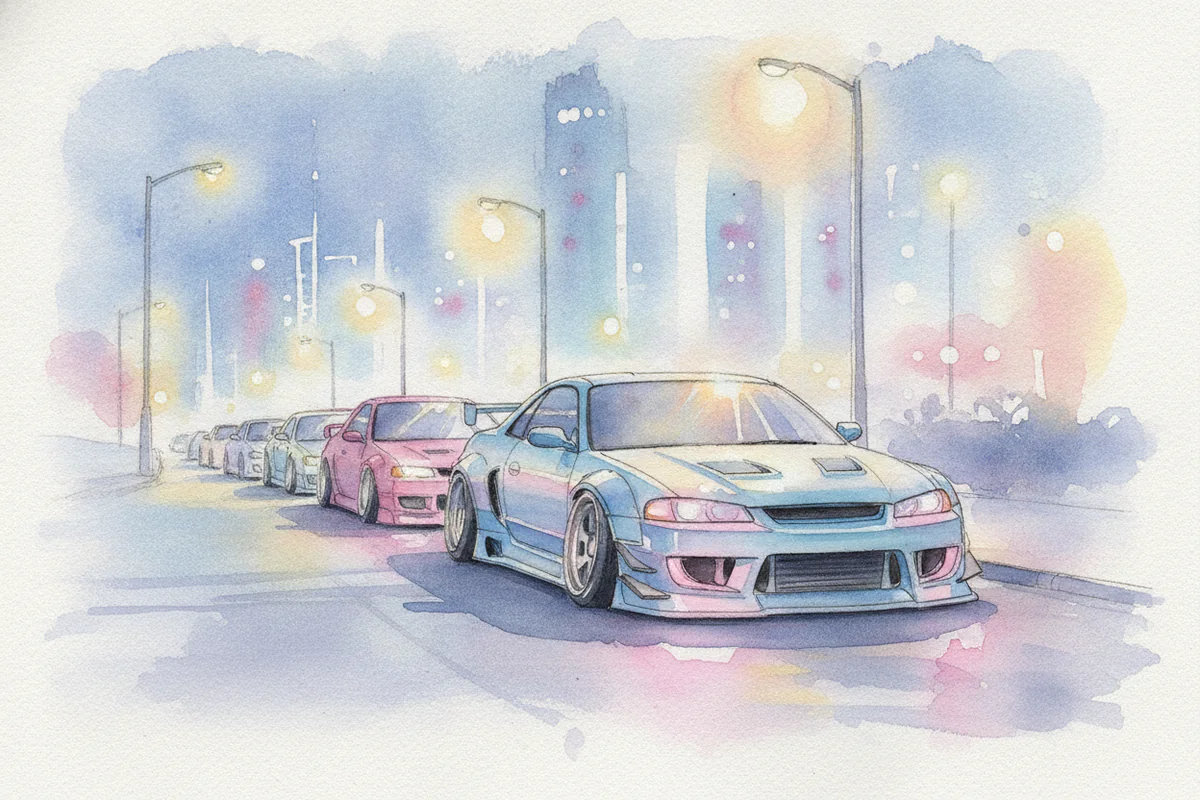
The films answered that question visually, even if they never spelled it out. The aesthetic - low, wide, covered in functional or semi-functional aero, sitting on wheels that looked too good for the car's original price point - was aspirational. It was also accessible in a way that a Ferrari wasn't. A used 1992 Acura Integra was $4,000. A bolt-on intake was $150. You could participate.
That accessibility mattered enormously. The film didn't just inspire admiration - it inspired action. Import tuning shops that had been running on a loyal but small customer base found themselves swamped. SEMA (the Specialty Equipment Market Association) reported that the import performance segment grew significantly through the early 2000s, and most industry observers pointed directly at the franchise as the accelerant. The import street racing scene that had existed in relative obscurity suddenly had a million new people who wanted in, or at least wanted to look like they were.
Manufacturers noticed. Honda leaned into it. Mitsubishi's US marketing shifted. Subaru, which had been a brand associated with sensible all-wheel drive wagons for outdoorsy families, found the WRX becoming a tuner icon partly because the culture the franchise popularised created an audience primed for it.
The Supra effect specifically
The 1994 Toyota Supra Mk IV deserves its own sentence here because what happened to its market value is almost absurd. In 2001, a clean used example might have cost you $15,000 to $20,000. By the mid-2010s, low-mileage Supras were clearing $40,000 to $50,000 at auction. Today a good one with a 2JZ-GTE - the twin-turbo engine that the franchise made famous - regularly sells for $80,000 to $100,000 or more.
Toyota had stopped selling the Supra in the US in 1998 because it wasn't moving. Three years later, Brian O'Conner's orange Supra became one of the most recognisable cars in American pop culture. The car hadn't changed. The audience had.
Anyway - the point isn't just that the franchise boosted prices on specific models. It's that it created lasting cultural weight around cars that had previously been niche enthusiast choices. The Supra, the Skyline (technically illegal to import in standard form for most of the franchise's run, which only made it more mythological), the RX-7 - all of them carry a halo today that has at least some roots in those films.
What it got wrong, and why that matters less than you'd think
The franchise played fast (sorry) with technical accuracy pretty consistently. NOS doesn't work quite like the films suggest. You cannot slap a ten-second motor together in a garage overnight. The "turbo" sound effects are creative fiction. Real tuners will tell you this, usually at length.
But here's the thing: accuracy wasn't really the franchise's job. Its job was to make a certain kind of car feel exciting to people who had no existing reason to care. It did that extremely well. The downstream effect - people who got curious, went digging, joined forums, bought cars, learned the actual mechanics - that's real, regardless of whether the nitrous system in a given scene was plausible.
A lot of people who are now serious, knowledgeable enthusiasts will quietly admit the first film was the crack in the door. That's not embarrassing. Every subculture gets new members through some gateway that insiders consider a bit shallow. The ones who stick around go deeper.
The generation it shaped
The kids who were 12 to 16 when the first film came out are now in their mid-30s. They're the ones buying project cars, running track days, modifying their daily drivers, watching YouTube channels dedicated to engine swaps. The fast and furious car culture impact isn't just a historical footnote - it's still shaping the market right now, through the tastes and spending of a generation that grew up with those films as a reference point.
Car culture was already there before 2001. The import scene, the tuner community, the JDM obsessives - they built something real over decades. But the franchise took what they'd built and broadcast it to an audience of millions who might otherwise never have looked twice at a modified Civic on the street. Whether that was good for the culture, bad for it, or just complicated - depends who you ask. What's harder to argue with is the scale of the change.