Why printed hoodies specifically are harder to judge
A plain hoodie is easy enough to evaluate - you look at the GSM, check the seams, done. A printed hoodie adds a whole extra layer of variables, because the print process itself can degrade an otherwise decent garment. You can start with a solid 400GSM fleece blank and end up with something stiff, cracked, and uncomfortable if the printing was done badly or the wrong ink was used for the fabric type. So when you're asking how to tell good quality hoodie from a mediocre one, you're really asking two separate questions: is the base fabric good, and is the print applied well?
Most buyers focus entirely on the design. That's the wrong place to start.
Start with fabric weight, not the photo
GSM stands for grams per square metre and it's the most honest number a hoodie listing can give you. Under 280GSM and you're looking at something thin - fine for layering in mild weather, not fine if you want the hoodie to feel substantial or hold its shape after washing. 320-360GSM is a reasonable range for an everyday printed hoodie. Anything 380GSM and up is genuinely heavy and will drape well even after a lot of wash cycles.
The problem is that a lot of listings don't state the GSM at all, which tells you something in itself. Brands confident in their fabric weight tend to list it. When it's absent, you're often looking at something in the 240-260GSM range that they'd rather you not think too hard about.
If there's no GSM listed, look for the cotton-polyester ratio instead. A 80/20 cotton-poly blend at a decent weight gives you softness and some structure. Pure 100% cotton at low GSM goes limp quickly. High-poly blends (60% poly or more) can feel synthetic against the skin and tend to pill badly around print edges where the ink sits on top of the fibres.
The stretch test - and why it matters for prints
If you're in a shop, stretch the fabric gently across the print area and release it. Good quality fleece with a decent elastane content (usually 5-10%) will snap back cleanly. Cheap fabric will stay slightly distorted or take a few seconds to recover. That recovery behaviour is directly related to how the print ages - if the fabric doesn't recover well, every time you put the hoodie on and move around in it, you're stressing the print layer. DTG (direct-to-garment) and screen prints both crack faster on fabric with poor elastic recovery.
Buying online, you can't do this literally. But you can ask for it. Any seller with a real product can tell you the elastane percentage. And some product photos, if they're honest lifestyle shots rather than flat lays, will show you whether the fabric is pulling strangely around the print edges - a sign the material is already under stress in normal wear.
How to read print edges like someone who knows what they're looking at
Zoom into the product photos. Specifically, look at where the print ends and the plain fabric begins. This is where cheap printing always shows itself first.
What you don't want to see: a thick ridge of ink sitting on top of the fabric, a hard edge that looks almost like a sticker, or any visible cracking in the photo even before the item has been washed. Screen printing done correctly should feel like it's part of the fabric, not sitting on top of it. DTG printing, when done well with a proper pre-treatment, integrates into the fibres rather than coating them.
What you do want to see: soft gradients where the print meets the fabric, consistent colour density without blotchy patches, and - if there are fine lines or text in the design - clean edges without feathering. Feathering (where the ink bleeds slightly into the surrounding fibres) is fixable to a degree with better pre-treatment, but you'll see it in the photos if it's bad enough to matter.
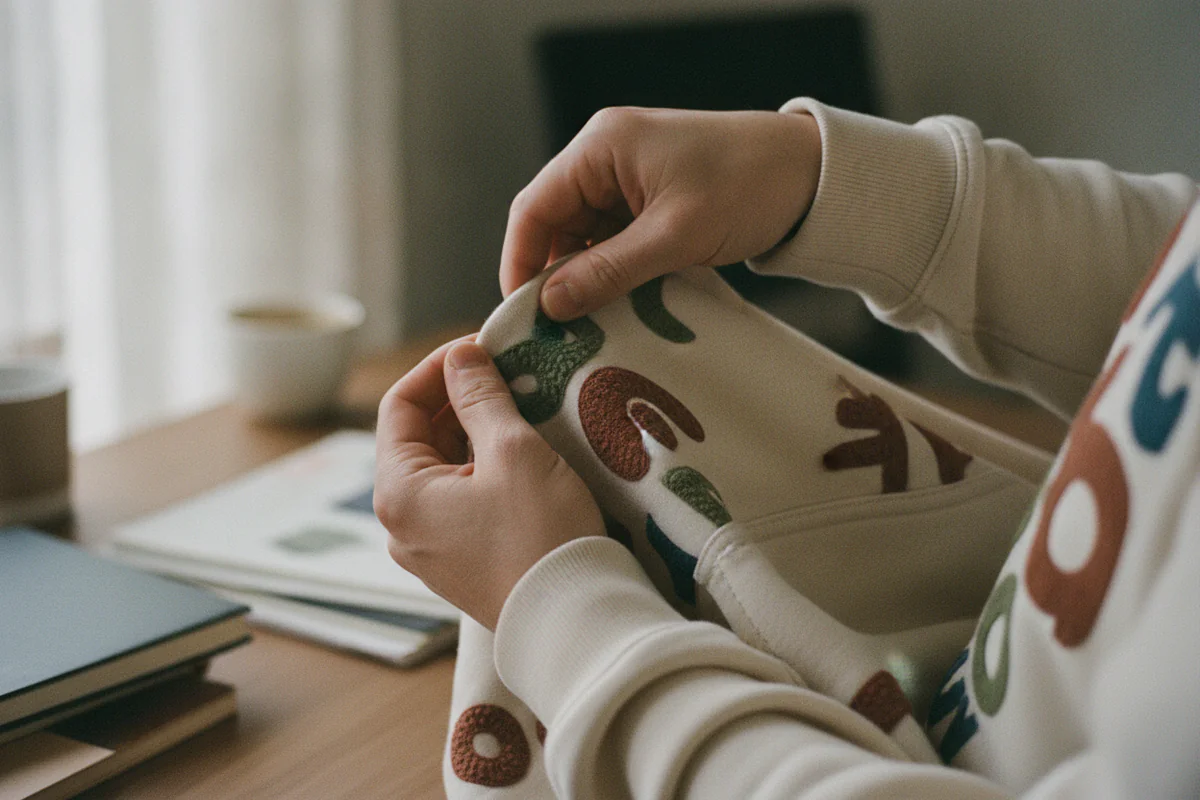
Stitch density around the print border is a separate thing and it's often overlooked. On embroidered prints or applique, look at how tightly the stitching sits along the edges. Loose backing stitches pull the fabric out of shape over time. On pure print hoodies without embroidery, the equivalent check is whether the seams near the print area are lying flat or already puckering - puckering means the fabric is being pulled by poor construction, and that stress transfers directly to the print.
Questions worth asking the seller before you buy
Genuine sellers aren't bothered by specific questions. The ones who are bothered are usually the ones you should avoid. Things worth asking:
- What is the GSM of the blank used?
- What printing method - screen print, DTG, sublimation, heat transfer vinyl?
- Is the print pre-treated before application?
- What ink is used and is it water-based or plastisol?
Water-based inks tend to feel softer and breathe better. Plastisol inks sit on top of the fabric and are more durable in some ways but can feel heavier and crack differently as the garment ages. Neither is automatically better - it depends on the design and the fabric - but a seller who can answer the question clearly is a seller who actually understands their own product.
Wash instructions as a quality signal
This sounds like a minor thing but it's worth checking before you buy, not after. A quality printed hoodie will have specific care instructions - cold wash, inside out, no tumble dry or tumble dry low. Generic instructions that just say "machine washable" with no detail suggest the printer hasn't really tested long-term durability. Turning a hoodie inside out before washing protects the print from abrasion against the drum. If the seller's listing doesn't even mention it, that's a gap.
What the price actually tells you
A well-made printed hoodie, using a decent blank and a proper print method with real pre-treatment, has material costs that don't go below a certain floor. You're not going to find genuine quality at $15. Roughly speaking, $45-80 is where most honestly made printed hoodies sit at retail. Below that and something is being cut - usually the blank weight, the pre-treatment step, or both.
Anyway - none of this means expensive automatically equals good. Plenty of overpriced hoodies use mediocre blanks with a high-margin markup. The checks above cost nothing and take about two minutes, and they'll tell you more than the price tag will.
If you want a starting point for comparison, our printed hoodies list the fabric weight and print method on every product page - partly because we think buyers deserve that information, and partly because we'd rather not field complaints about cracking prints six months after a sale.
The short version: ignore the lifestyle photo, find the GSM, zoom into the print edges, and ask one direct question to the seller. That combination will catch most of the bad ones before they reach your door.