
Why these four?
There were plenty of quick Japanese cars in the 1990s. The Honda Integra Type R was faster around a track than most people expected. The Mitsubishi Lancer Evo and Subaru Impreza WRX turned rally tech into something you could register for road use. But when people talk about iconic JDM cars - the Skyline, Supra and their contemporaries - they mean something slightly different. They mean cars that became cultural objects, not just performance tools.
Each of the four models below got there by a different route. One through motorsport dominance, one through Hollywood, one through an engine concept that should have died in the 1970s and somehow didn't, and one because a supercar company in Italy essentially confirmed it was good. That's a strange collection of origin stories, and it's part of why the era feels so distinct.
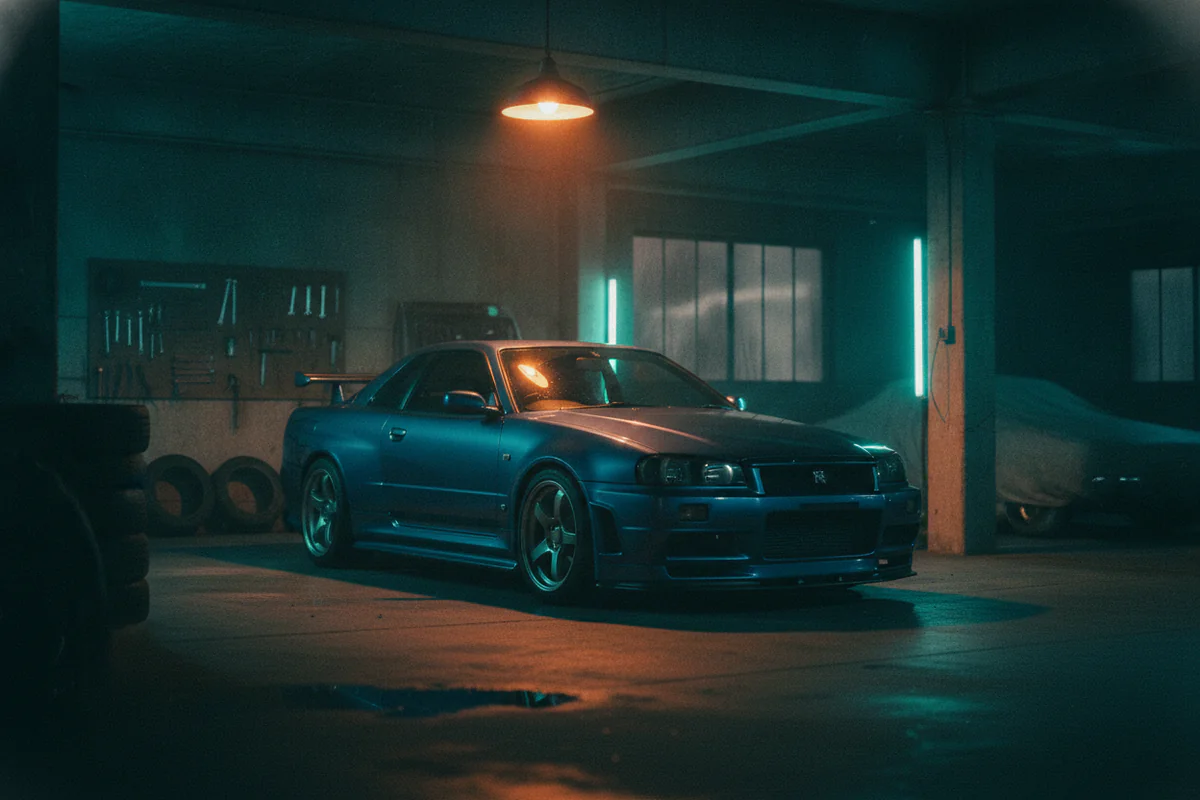
Nissan Skyline GT-R (R32-R34)
The R32 GT-R arrived in 1989 and immediately started embarrassing things it had no business beating. It won the Japanese Touring Car Championship in its first year, then won it every year it was eligible - 29 consecutive victories - until the series banned it. Australian touring car officials did the same thing after it turned up and won straight away. "Godzilla" was a nickname Australian motoring press attached to it, and it stuck because it fit.
The technical reason was ATTESA E-TS, an intelligent all-wheel drive system that sent power rearward under normal conditions and pushed torque forward when it detected slip. Combined with the RB26DETT twin-turbo straight-six - officially rated at 276 hp, though that figure was a polite fiction agreed upon by Japanese manufacturers at the time - the GT-R had traction and balance that very little could match in period.
The R33 gets dismissed unfairly. Yes, it was heavier, but Nissan also cut the Nurburgring lap time by 21 seconds compared to the R32, which isn't nothing. The R34 is the one everyone wants now, partly because of the V-Spec's dry carbon fiber hood and Brembo brakes, partly because of a certain 2001 film franchise that we'll get to in a moment. Legal US imports have started arriving under the 25-year rule - R34s built in 1999 are now eligible - and prices have moved accordingly. A clean R34 V-Spec II Nur sold at auction for over $315,000 in 2022.
Toyota Supra (A80)
The fourth-generation Supra launched in 1993 and sat in something of an awkward middle ground commercially. It was expensive for a Toyota, heavy, and came during a period when insurance costs in the US were discouraging people from buying anything with real performance. Toyota stopped selling it in North America in 1998 after moving relatively modest numbers.
Then The Fast and the Furious came out in 2001, and the orange Supra driven by Paul Walker became probably the single most recognizable car in the history of franchise filmmaking. That's a strange way to build a legacy, but the cultural weight turned out to be real. A whole generation of teenagers watched that film and the 2JZ-GTE became shorthand for tuner credibility before many of them had ever seen one in person.
The engine earned the reputation honestly, to be clear. The 2JZ-GTE was a 3.0-liter twin-turbocharged inline-six with a forged bottom end from the factory and a block strong enough to handle well over 700 hp on stock internals with supporting modifications. Shops were making 1,000 hp 2JZ builds within a few years of the car's release. That kind of headroom is unusual, and the tuning community noticed.
The manual transmission version is the one the market values now, particularly in cleaner original condition. The automatic was more common and is significantly cheaper. If you want to understand the obsession people have with these cars, look at what bone-stock examples in good condition are fetching - low-mileage survivors regularly clear $100,000 at US auctions.
Mazda RX-7 (FD)
Mazda built the FD RX-7 around a twin-turbocharged rotary engine displacing 1.3 liters. On paper that sounds ridiculous. In practice the 13B-REW produced 255 hp in Japanese domestic spec, revved freely to 8,000 rpm, and sat so far behind the front axle that the car's weight distribution was essentially perfect at 50/50.
The rotary is the interesting part. Wankel engines generate power through the eccentric rotation of a triangular rotor rather than reciprocating pistons, which means fewer moving parts, no valve train, and a power-to-weight ratio that conventional engines struggle to match at similar displacement. The tradeoff is fuel consumption, oil consumption, and a sensitivity to heat that punishes neglect. FD owners who skipped coolant flushes and apex seal inspections often found out about it expensively.
Mazda stopped making the FD in 2002. Finding a clean unmodified example now is genuinely difficult because so many were modified heavily, pushed hard, and not always maintained well. A properly sorted example with low miles and clean history commands a significant premium, and specialist rotary shops that can rebuild the 13B correctly have become valuable in a way they weren't 15 years ago.
The FD's influence shows up in industrial design more than people acknowledge. The body was styled by Wu-huang Chin and has aged in a way that most 1990s cars simply haven't - the proportions still look considered rather than dated.
Honda NSX
The NSX's story involves Ayrton Senna, which immediately gives it a different kind of weight. Honda enlisted Senna during development in 1989, and he drove prototypes at Suzuka and flagged that the suspension was too stiff for average drivers to manage at the limit. Honda softened it. The production car was designed, explicitly, to be accessible.
That accessibility became both its selling point and, for some buyers, a complaint. Ferrari owners at the time suggested the NSX was too easy, too predictable, not dramatic enough. This is a bit like complaining that a surgeon's hands are too steady. The NSX was accessible because Honda's engineers, many of whom had Formula One experience by that point, understood chassis dynamics well enough to build in forgiveness intentionally.
It was also all-aluminum at a time when that was genuinely unusual for a production car. The body and frame used a combination of extrusions, castings, and stampings that kept weight to around 1,350 kg. Paired with a mid-mounted 3.0-liter VTEC V6, the balance and steering feel became reference points that sports car journalists used for years afterward.
Ferrari responded by rushing development of the 456 and F355, according to people who were around at the time. Whether that's entirely true or partly myth is hard to verify now, but the underlying point stands: Honda built a car that a serious supercar manufacturer felt it needed to answer.
What they share
None of these cars were cheap. None of them were practical. The RX-7 needed specialist knowledge to keep running well; the Skyline GT-R was technically illegal for US road use for most of its life; the Supra sat unsold on showroom floors before a film franchise rescued its reputation posthumously. And yet the iconic JDM cars of this era - Skyline, Supra, RX-7, NSX - have appreciated faster than almost any other collectible vehicle segment over the past decade, because the things that made them awkward at the time are exactly the things that make them irreplaceable now. Engineers who cared too much, built too specifically, and refused to make the sensible compromise.