The gallery wall had a good run
For about a decade, the aspirational home looked roughly the same: pale walls, a few abstract prints in muted tones, maybe a dried pampas grass arrangement that somehow ended up in every rental from Portland to Glasgow. It photographed beautifully. It also told you almost nothing about the person who lived there.
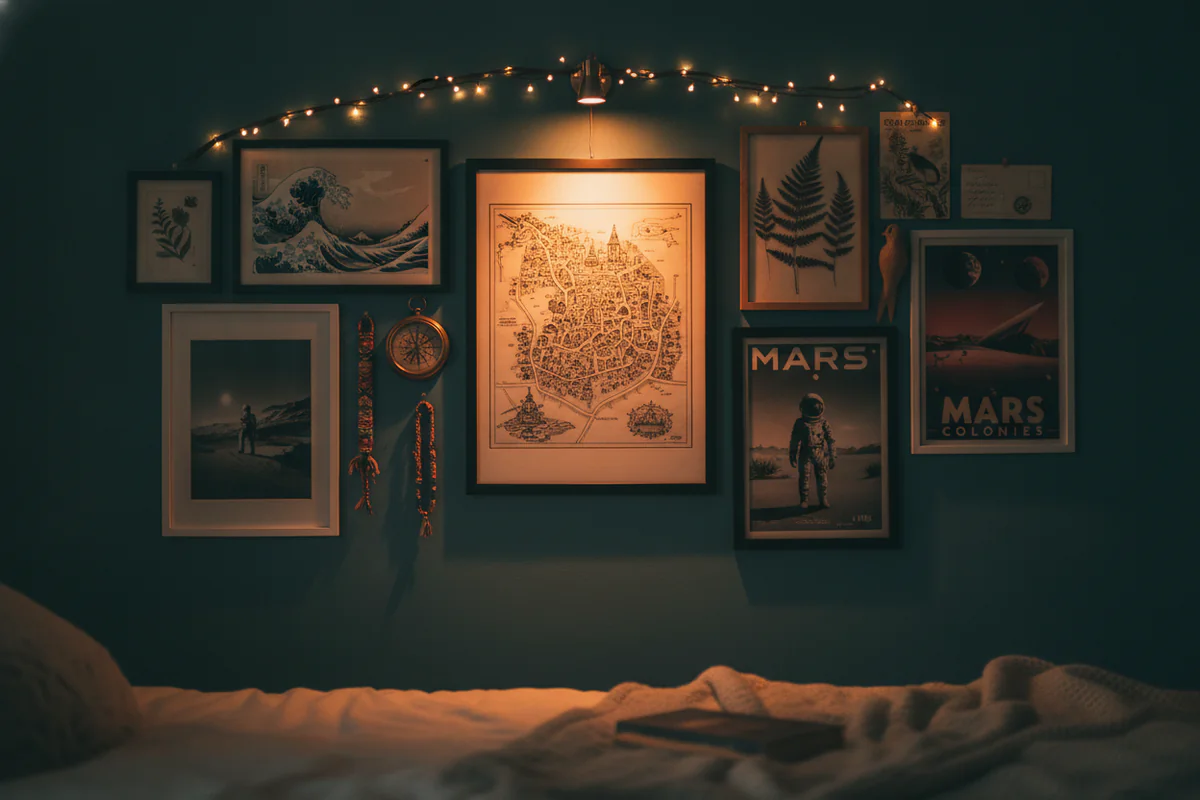
That era is ending. Not dramatically - walls aren't being ripped down overnight - but the direction is clear. People are putting up things they actually care about. A vintage motorsport poster above the record player. A framed setlist from a concert they still think about. A large-format print of the engine bay of a car they will probably never own but love anyway. The identity decor trend of 2026 is, more than anything, a rejection of the idea that your home should look like a hotel you'd find on a travel blog.
What "identity decor" actually means
The phrase is doing real work in interior design circles right now, and it's worth being precise about what it means - because it doesn't just mean "more personal." Plenty of homes have always had family photos or a souvenir magnet on the fridge. This is different.
Identity decor refers to walls (and shelves, and surfaces) that communicate a specific obsession. Not broad interests, but the particular ones. Not "I like music" but "I have seen this band eleven times and here is the proof." Not "I enjoy cars" but "here is a 1970 Porsche 914 rendered in black and white and it is the first thing you see when you walk into my living room." The specificity is the point. It signals depth, not just taste.
Interior designers who work with younger clients are noticing this shift in what people actually ask for. The brief used to be something like "cohesive but interesting." Now it's more likely to be "I want it to feel like me, not like a showroom."
Why now, and why this generation
There's a generational story here that's worth sitting with for a minute. The oldest millennials are in their early forties. A large chunk of them spent their twenties and much of their thirties in rented apartments where they couldn't paint walls, couldn't hang heavy frames, couldn't really do much. They consumed enormous amounts of interior design content - Pinterest, Instagram, later TikTok - and got very good at knowing what a "nice" home looked like. But they didn't have one. Not really.
Now a meaningful portion of that generation either owns property or is in a long-term rental where they've stopped caring about the deposit. And the instinct isn't to finally recreate the beige minimalism they pinned for years. It's to do the opposite - to assert something. After a decade of aesthetic homogeneity online, there's a real appetite for the specific and the idiosyncratic.
Gen Z is doing a version of this too, though the flavour is slightly different. Where older millennials might frame something with a bit of reverence (a limited-edition print, properly matted), younger people are more likely to blue-tack a magazine page next to a $200 art print and feel fine about that. The commitment to self-expression over curation is, if anything, even stronger. The "wrong" things next to each other is sometimes the whole point.
And honestly - the pandemic scrambled things too. Spending years staring at the same four walls does something to your relationship with your home. A lot of people came out of that period with a much stronger sense of what they actually wanted to look at every day, and "a neutral linen texture print from a fast-furniture retailer" wasn't the answer most of them landed on.
The obsession categories running hottest right now
If you spend any time in home decor communities - Reddit's r/malelivingspace and r/femalelivingspace are both useful windows into this - certain categories come up again and again as the things people are putting on walls in 2026.
- Motorsport and automotive art. Not generic "fast car" posters, but specific marques, specific eras, specific races. There's a whole corner of this market around vintage Formula 1 circuits, Japanese domestic market cars from the 1990s, and rally photography from the Group B era.
- Music - but hyper-specific. Album covers are nothing new, but people are going deeper: tour posters for specific years, handwritten lyric sheets, photography from a particular recording session.
- Architecture and cities. Not a tourist photo of a famous landmark, but a technical drawing, a Brutalist building that someone has an inexplicable attachment to, a transit map from 1972.
- Sporting moments. Again, the specificity matters. Not "sports art" but a photograph of one specific moment from one specific match that means something personal.
What connects all of these is that they reward someone who knows the reference. They're not trying to be universally appealing. That's the whole point.
The backlash against the algorithm-optimised room
There's something worth naming here about why the neutrals-and-abstract-prints aesthetic got so dominant in the first place. It was partly social media. Beige reads well on a phone screen. It doesn't clash with anything. It generates broad approval because it offends no one and communicates nothing that someone could disagree with.
The identity decor trend is, in part, a conscious refusal of that logic. A room that looks like you - specifically you, with your weird interests and your particular era of cinema and your inexplicable devotion to a mid-tier football club - is a room that might get a polarised reaction. And people seem more willing to accept that now. Wall art organised by interest rather than aesthetic is one small symptom of this: the shopping behaviour is changing before the living spaces fully catch up.
The magazine-perfect room was always aspirational in a very particular way - aspirational toward a kind of tasteful blankness. The identity-led room is aspirational toward something else: toward being legible as a person, toward having the walls actually earn the time someone spends looking at them.
What this means going forward
Interior design trends tend to overshoot before they settle. The pendulum swings from "everything must coordinate" to "nothing needs to coordinate" and then finds somewhere livable in the middle. My guess is that's where this ends up too - rooms that have a strong personal core (the things that actually matter to the person who lives there) surrounded by whatever practical decisions they had to make about sofas and paint colours.
But the move away from purely aesthetic, content-free walls feels like something stickier than a trend cycle. It's connected to a broader mood about authenticity - about the growing exhaustion with spaces, feeds, and personalities that have been optimised for approval rather than expression. Whether your obsession is land speed records or 1970s Italian cinema or a very specific subset of electronic music, there seems to be more permission than there was five years ago to just put that on the wall and stop apologising for it.