
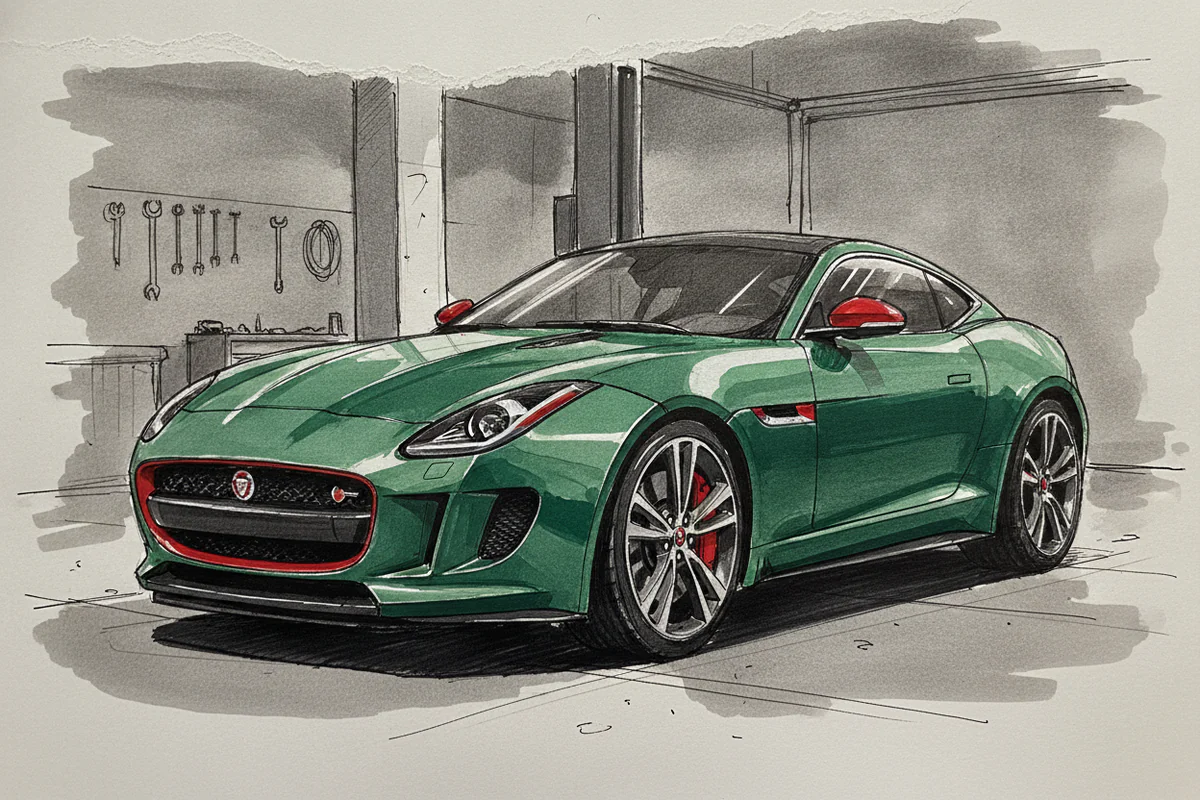
A colour before it was a brand identity
British Racing Green predates Jaguar by decades. The colour entered motorsport through a quirk of early international racing rules - each competing nation was assigned a colour, and Britain drew green, supposedly derived from the Gordon Bennett Cup races of the early 1900s. For years it was just a national designation, the kind of administrative detail nobody thinks much about. Then Jaguar started winning in it, and the whole thing took on a different weight.
The specific shade Jaguar used varied between cars and years - there was never one official hex code, which is part of why arguments about the "correct" green still fill forums today. The D-Type ran in something close to a deep bottle green, sometimes darker, sometimes with a slightly grey-bluish tint depending on lighting. That ambiguity actually helped. It made the colour feel alive rather than corporate.
Le Mans and the XK120 that started it
Jaguar's serious Le Mans story begins in 1951 with the C-Type, though the XK120 had already demonstrated something important when three cars finished 12th, 15th, and 17th at Le Mans in 1950 - barely a year after the road car launched. For a company that had been making SS Jaguars before the war and had deliberately distanced itself from those initials once the war ended, this was a statement about what the brand intended to be.
The C-Type won Le Mans outright in 1951 and again in 1953. Then the D-Type arrived, and things got serious. The D-Type won in 1955, 1956, and 1957. That 1957 win is the strange one - Jaguar had officially withdrawn from factory racing by then, but a privateer team running Ecurie Ecosse entered D-Types and won anyway. Five Le Mans victories in seven years, three of them after the factory had stepped back. That says something about how good the cars were.
The D-Type's aerodynamic bodywork, designed by Malcolm Sayer using aircraft engineering principles he'd developed during the war, looked unlike anything else on the grid. The long nose, the tail fin behind the driver's head, the monocoque construction - it was genuinely advanced, and it aged well in the way that properly engineered things tend to do.
What Jaguar racing history legacy actually means for the brand
This is where it gets interesting, because Jaguar has leaned on those 1950s wins for a very long time. The E-Type launched in 1961 and was directly marketed as a road car descended from the D-Type - which was partly true and partly useful fiction, since the engineering was more distantly related than the press materials suggested. But the visual lineage was real. The long bonnet, the aerodynamic intent, the sense that you were driving something that had been thought about aerodynamically rather than just styled.
For decades, Jaguar's identity rested on that connection. Buy a Jaguar, and you were buying into Le Mans, into Stirling Moss, into a particular idea of British engineering that was fast and refined at the same time. It worked as a brand proposition because the racing record was genuine - you cannot fake five Le Mans wins, regardless of how you narrate them afterwards.
The XJ220 in the early 1990s was an attempt to return to that logic, and it partially succeeded. The car finished second at Le Mans in 1993, which would have been remarkable except the outright winning GT result was annulled due to a technical infringement from the other car. Complicated. The XJ220's story is less clean than the D-Type's, which might be why it occupies a slightly awkward place in the brand mythology - admired but not quite venerated the same way.
The colour as shorthand
Somewhere in the mid-20th century, British Racing Green stopped being a national designation and became specifically associated with a certain kind of English restraint combined with genuine speed. Aston Martin has a claim to it, Lotus has a claim to it, but Jaguar's claim runs through Le Mans and through cars that actually looked the part at racing pace.
It's worth noting that Jaguar's current design language - whatever direction the brand takes - keeps returning to green in limited editions and heritage specials. The Jaguar Classic division, which restores and remanufactures period cars, has used the colour extensively. And if you walk through a Jaguar museum display or look at how the brand presents its own history, the D-Type in green is almost always the centrepiece. That's a deliberate choice about what story to tell.
For people who collect Jaguar memorabilia, prints, or just want something on the wall that captures this specific aesthetic, the combination of that green against the D-Type's bodywork is one of the more photogenic moments in automotive history - which is probably why Jaguar wall art and gifts tends to lean heavily on the racing era imagery rather than modern showroom shots.
The Formula E chapter
Jaguar returned to factory racing in 2016 through Formula E, the electric single-seater championship. It's a genuinely different world from Le Mans in the 1950s - street circuits, regenerative braking strategy, races decided partly by energy management. The car runs in a green that's more vivid and marketing-department than the original bottle green, which irritates some people and delights others.
The Formula E programme has been more successful than most people expected. Multiple race wins, championship points, a visible presence at a time when the broader automotive industry was wrestling with the transition to electric power. Whether this eventually becomes part of the jaguar racing history legacy in the way Le Mans did is genuinely unknowable right now - legacy only gets assigned in retrospect, and usually takes longer than a single decade.
What Jaguar has managed, which is harder than it sounds, is to maintain a consistent through-line in how it presents its racing identity even as the cars and technology changed almost completely. Green, aerodynamic elegance, a particular approach to speed that implies it shouldn't look like hard work. The D-Type did it with a supercharged straight-six and an aluminium monocoque. The I-PACE eTrophy race car does it with battery packs and electric motors. Same story, different engineering underneath.
The Le Mans wins from 70 years ago did more than fill a trophy cabinet. They gave Jaguar a specific visual and emotional vocabulary that the brand has been spending down ever since - sometimes wisely, occasionally by rote. But the original deposit was substantial enough that there's still something real there, and that's rarer in automotive history than the press releases tend to suggest.