
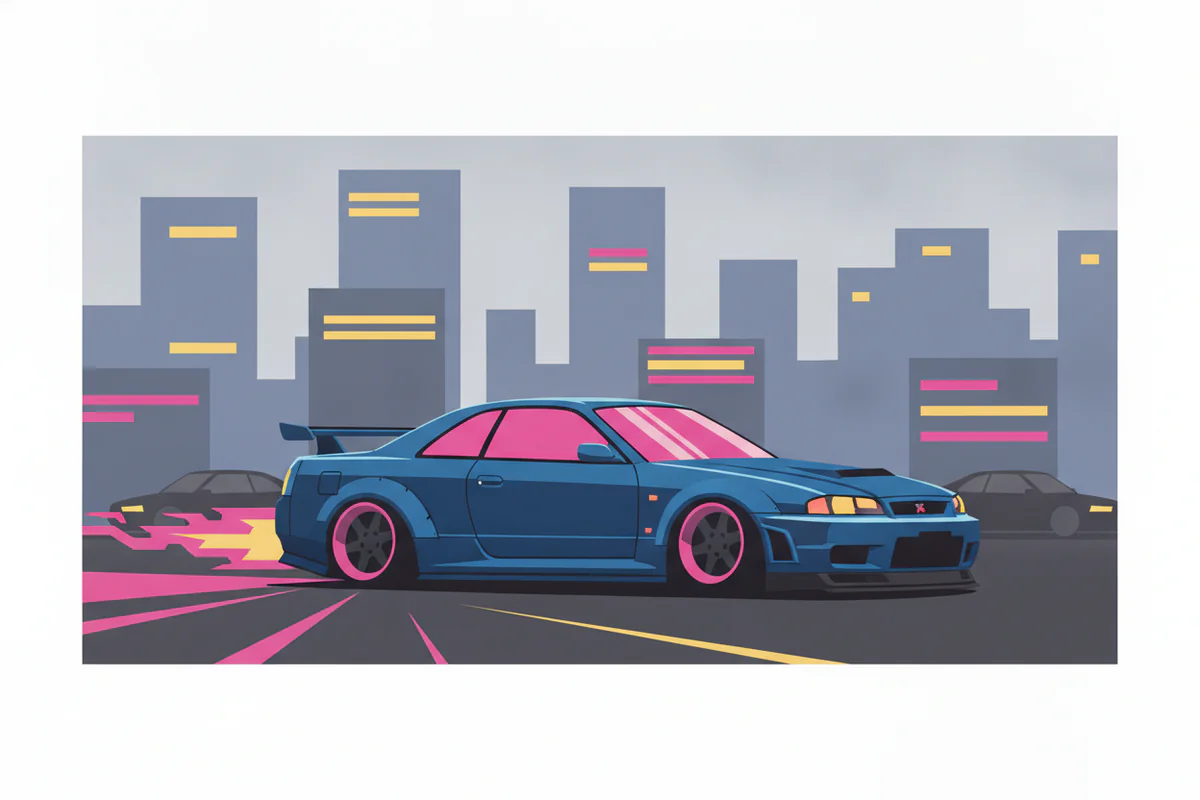
First, what JDM actually means
JDM stands for Japanese Domestic Market - meaning cars, parts, and trim levels that were built specifically for sale inside Japan and never officially exported. A 1992 Honda Civic SiR sold in Japan came with a B16A engine, a limited-slip differential, and factory front seats that most American buyers never saw. That's a JDM spec car. The version sold in North America that same year got a different tune, different safety equipment, sometimes a completely different engine. Same badge, different machine.
Over time the term stretched a bit. You'll hear people call any Japanese car "JDM," which technically isn't right, but the spirit is usually the same - they mean something built with the obsessive engineering detail that Japanese manufacturers were pouring into their home market during the bubble economy years of the late 1980s and through the 1990s.
Where the culture came from
Japan had a motorsport scene long before the rest of the world was paying attention. The Fuji Speedway opened in 1965. Suzuka had been running since 1962. But the more important stuff for JDM culture happened on the roads and the mountain passes - what enthusiasts call touge driving. Narrow, winding passes like the ones around Hakone and Irohazaka became informal proving grounds where people figured out how to get small-displacement, front-wheel-drive cars moving faster than anyone expected.
Manufacturers watched. Engineers at Honda, Toyota, Nissan, and Mitsubishi were enthusiasts themselves, and they started building cars that could actually perform on those roads - not just in the showroom. The late 1980s in particular produced a run of genuinely remarkable machines: the Honda NSX (1990), the Mazda MX-5 Miata (technically an export hit but deeply Japanese in philosophy), the Mitsubishi Lancer Evolution I (1992), the Subaru Impreza WRX (1992), the Nissan Skyline GT-R R32 (1989). These weren't accident - they were the product of a country that had decided to take driving seriously at the manufacturer level.
Alongside the factory cars, a whole parts industry grew up to match. Brands like Cusco, Mugen, TRD, and HKS were selling suspension components, exhaust systems, and engine management tools that made an already sharp car sharper. The domestic Japanese aftermarket was enormous and sophisticated in a way that nothing in Europe or America quite matched at the time.
How it spread outside Japan
The internet did a lot of this. Forums like JDMChat and early Usenet groups let American and Australian enthusiasts swap information about importing parts directly from Japanese dealers and dismantlers, often before the cars were even legal to import. And then something bigger happened: Gran Turismo launched in 1997.
That game put a Skyline GT-R and a Honda NSX Type R in front of millions of teenagers who had never seen either car on a public road. It let you tune them, race them, learn their names. The Fast and the Furious in 2001 brought a different slice of the scene to an even wider audience, though anyone who was already deep in the culture had mixed feelings about that particular movie - anyway, it worked as a gateway for a lot of people regardless of whether the hardcore crowd approved.
Import laws in the United States (specifically the 25-year rule) meant that as each year passed, another generation of JDM-spec vehicles became legal to bring over. The R32 GT-R hit 25 years in 2014 and prices immediately started climbing. The R33 followed. The R34 - still arguably the most wanted JDM car in existence - became legal for US import starting in 2024, and the market reacted accordingly.
What the community actually looks like
People sometimes picture JDM culture as one thing - low cars, loud exhausts, carbon fiber everywhere. But it fragments pretty quickly when you look closer. There's a time-attack crowd obsessed with lap times and data logging. There are people who restore factory-spec vehicles down to correct factory floor mats and won't change a single bolt. There are drift communities, autocross communities, track day communities. There are people who own a 1995 Honda Integra Type R with 180,000 miles on it and consider it their daily driver and also their most prized possession simultaneously.
What ties them together isn't an aesthetic, it's an attitude toward engineering. The cars from this era - roughly 1985 to 2005 - were designed by people who assumed the driver would understand and care about what was happening mechanically. High-revving naturally aspirated engines, hydraulic steering with actual feedback, manual gearboxes as the default rather than the exception. Driving them teaches you something. That's a harder thing to replicate than any particular body kit.
There are also dedicated spaces - both physical and online - where JDM car culture gets documented and celebrated, from show photography to garage art. Owners tend to build environments around these cars, not just drive them.
Why it hasn't faded
Most car cultures tied to a specific era eventually become purely nostalgic - muscle car culture being the obvious American example. JDM culture has nostalgia in it, but it keeps pulling in new people in their late teens and early twenties who weren't alive when these cars were built. The reasons are worth thinking about.
One is accessibility. A clean 1999 Honda Civic Si or a reasonable-condition 1993 Mazda RX-7 is still findable at a price that doesn't require a trust fund. That keeps the entry point real for younger enthusiasts in a way that a 1969 Camaro SS simply isn't anymore.
Another is the parts supply. Because Japan produced so many of these vehicles and the domestic aftermarket was so well developed, finding quality components is still relatively straightforward. There are vendors who stock new-old-stock factory parts. There are machining shops that specialize in rebuilding B-series Honda engines. The infrastructure hasn't collapsed.
And there's something about the specific window these cars came from. Japanese manufacturers were competing ferociously with each other, had serious engineering budgets, and weren't yet under the kind of emissions and safety regulatory pressure that arrived later. They had room to make unusual decisions - the Honda S2000's 9,000 RPM redline, the Mitsubishi 4G63 engine in its near-infinite tunable variants, Mazda's stubborn commitment to the rotary. Those decisions produced cars that don't feel like anything being built now, which means the interest in them compounds rather than fades.
The 25-year import rule will keep unlocking new vehicles for years to come. Every JDM enthusiast in North America already has a list of what becomes legal next and in what year. That's not nostalgia - that's anticipation.