
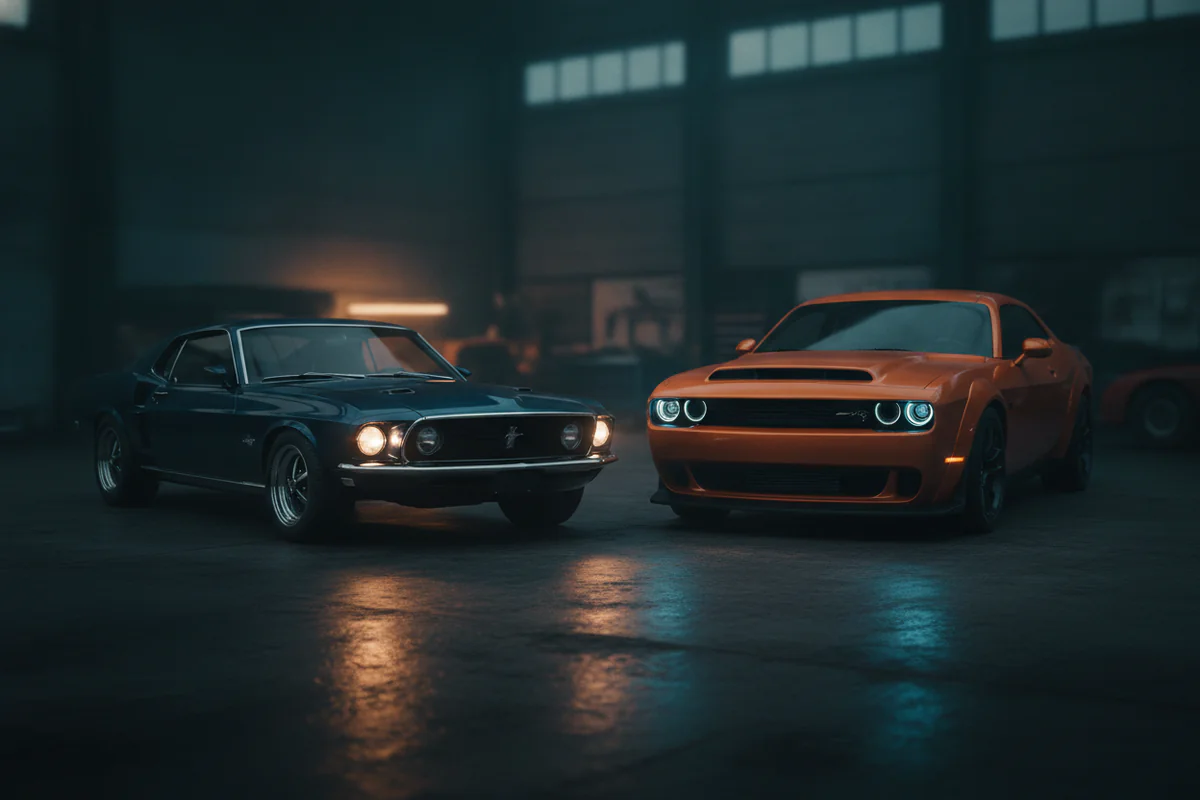
The numbers argument, and why it only goes so far
If you want to settle modern vs classic muscle cars with a stopwatch, it's over fast. A 2024 Dodge Challenger SRT Hellcat Redeye runs the quarter mile in the low 10s. A 1969 Chevelle SS 396 - which was genuinely terrifying for its time - does it in the mid-14s. A stock Boss 429 Mustang, one of the most fearsome things Ford ever bolted together, gets beaten by a modern Camaro SS with the base V8. There's no real contest on paper, and pretending otherwise is nostalgia talking.
But stopwatch numbers have never been the whole story with these cars, and anybody who has driven both knows that.
What classic muscle actually feels like
Drive a first-gen Pontiac GTO or a '70 Plymouth 'Cuda with the 440 and you understand almost immediately that these cars have a kind of physical honesty that's hard to explain to someone who hasn't sat in one. The steering is heavy and slow. The brakes require commitment. Throttle response is tied to a mechanical chain of events you can feel happening under your foot - the secondaries opening on the carb, the rpm climbing in a way that seems almost reluctant before it hits and then really goes. There's a lag and then a surge that modern fuel injection has mostly smoothed away.
The noise is different too. A big-block from that era doesn't just sound loud, it sounds physical. You feel it in the door panels. The whole car shakes at idle in a way that seems slightly alarming if you're used to modern tolerances. That's not romanticization - it's an accurate description of what loose tolerances, high-compression iron, and minimal sound deadening actually produce.
And the handling. Classic muscle handles poorly by modern standards, and I mean that genuinely, not as a complaint. There's a directness to bad handling that makes you work. You learn the car's limits because the car teaches them to you the hard way, with understeer that builds slowly and rear ends that come around if you get greedy. It demands attention in a way that keeps you present.
What modern muscle does differently
The 2024 Mustang Dark Horse makes around 500 horsepower, has Brembo brakes that stop like a wall, magnetic ride control, and a limited-slip differential that a team of engineers spent years calibrating. It goes around corners that would have had a '69 Mach 1 plowing off the road. On a back road in the rain, it is an objectively better tool.
Modern muscle is also, and this matters, much more consistent. A classic car on a cold morning is a negotiation. You might need to pump the accelerator twice, let it warm up for three minutes, hope the choke is set right. A Hellcat on a cold morning starts, idles smoothly, and is ready. That reliability gap is enormous if you want to actually use the car rather than restore it on weekends.
The power delivery in something like a Camaro ZL1 or a Shelby GT500 is also genuinely staggering in a way the old cars weren't, even when they made similar peak numbers. Modern engines make torque everywhere. You're never waiting for the powerband. Downshift, press, go - the response is almost unnervingly immediate.
But here's the thing. All that competence creates a layer of insulation. The car is doing a lot of work to keep you out of trouble, and you can feel it. Stability control, torque vectoring, traction management - these systems are transparent until they aren't, and when they intervene you're reminded that you're in a vehicle that is actively managing your inputs. That's fine. Probably it's good. But it changes the character of the experience.
The feel question - and whether it actually matters
There's a school of thought that says "feel" is something people invoke when they can't defend an objectively inferior product, and I have some sympathy for that view. A classic muscle car from 1970 does not handle as well, stop as well, or accelerate as consistently as a modern one. Claiming otherwise is just wrong.
But feel matters in cars the way texture matters in food - it's not the nutritional content, but it affects the experience completely. Driving a 396 Chevelle hard requires you to be in it, physically and mentally. The feedback loop between driver and machine is noisier, less filtered, and full of information. Some of that information is "this car is about to do something you didn't plan for," which is genuinely useful to know.
Modern cars give you data through tighter, cleaner channels. The steering tells you less but with better accuracy. The chassis communicates grip levels precisely right up until something goes wrong, at which point a computer corrects it. You are safer and faster and more comfortable. The driving experience is better in most measurable ways and somehow slightly less involving.
That gap is real and I don't think it's just sentiment. Car posters from the classic era outsell modern equivalents by a significant margin, which probably says something about which generation captures imagination even if it doesn't capture lap times. People aren't putting Hellcat posters on their walls at the same rate they put up '69 Charger posters, and that's not an accident.
What you actually want depends on the question
If someone asks which is faster, more capable, more reliable, and safer to drive at the limit, the answer is modern muscle, clearly and by a lot. There's no version of that argument where a carbureted 1960s muscle car wins.
If someone asks which one you'll remember driving, which one changes the texture of a Sunday afternoon, which one makes you feel like you're operating something rather than being transported by it - that's a harder question and I'm not sure the modern cars win it automatically.
The honest answer is that these are different objects doing different jobs, and the era that "wins" depends entirely on what you're asking it to do. The classic muscle car is a physical, demanding, slightly unreliable piece of American industrial history that rewards attention and punishes inattention in equal measure. The modern version is a genuinely fast, well-engineered performance car that happens to look like its grandfather. Both are worth driving. They just aren't really the same experience anymore, and the sooner you stop expecting them to be, the more clearly you can appreciate what each one actually is.