
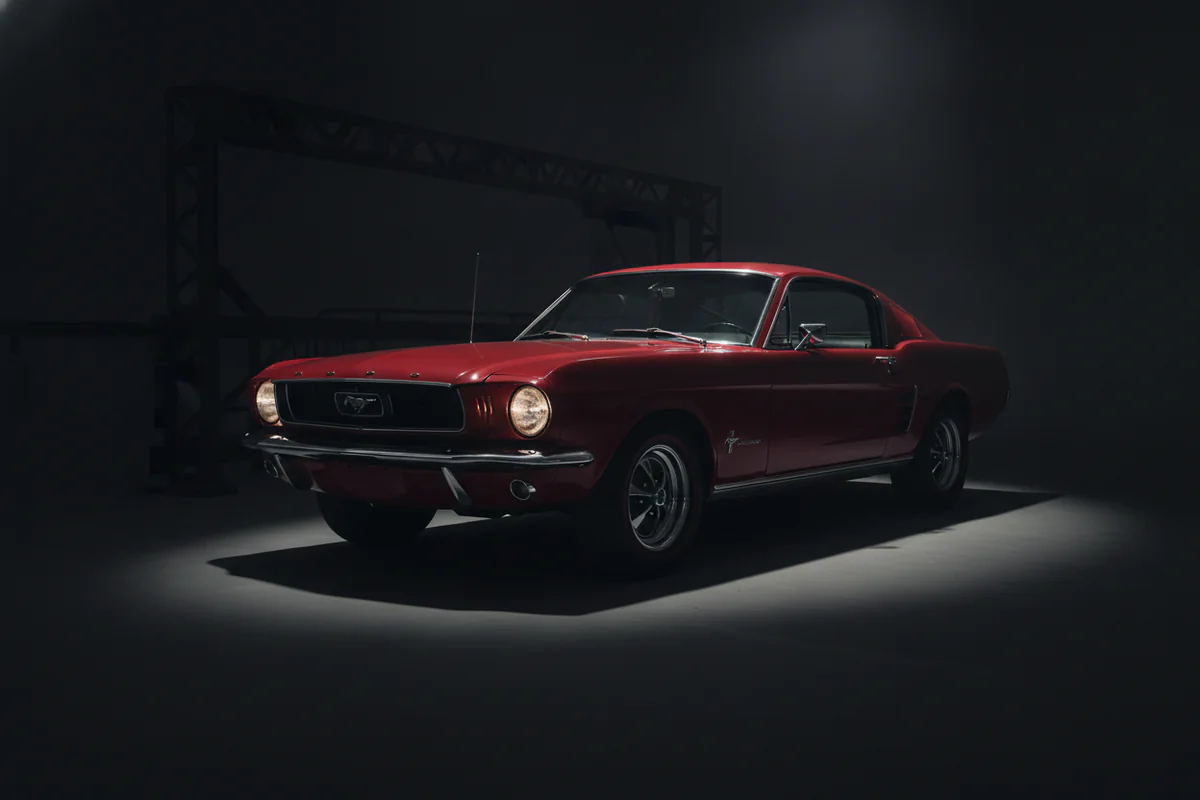
April 1964 and a very long line at the dealership
Ford introduced the Mustang on April 17, 1964 - technically a 1964½ model, a designation that still causes arguments at car shows - and dealers were not ready for what happened next. Some locked the cars behind glass so customers could look without touching. One dealer in Illinois reportedly auctioned off the single car he had on the floor because the bidding got out of hand. Ford sold 22,000 units on the first day alone, and over 400,000 in the first year. Nothing in American automotive history had moved quite like that before.
The car Lee Iacocca championed internally was deliberately modest: a unibody platform borrowed largely from the Falcon, a base six-cylinder engine most people swapped out immediately, and a long hood with a short rear deck that looked more expensive than it was. That combination - affordable entry price, near-infinite option packages, and a silhouette that photographed well - is basically why the Mustang 60th anniversary history exists at all. Without those early sales numbers, there would have been no second act.
When Ford nearly killed it themselves
The first serious threat to the Mustang came from within. Through the late 1960s, responding to the Dodge Charger and the Pontiac GTO, Ford kept adding weight and bulk. The 1971 Mustang was 600 pounds heavier than the 1965. It was sitting on a wider body, offering a 429 cubic inch engine that barely fit under the hood, and it had drifted so far from the original concept that it barely resembled the car people had lined up for in 1964. Sales collapsed.
Then came 1974 and the Mustang II - which almost every enthusiast still reflexively groans about. A small, somewhat underpowered car designed specifically for the fuel crisis era, it had no V8 option at launch and the performance versions were fairly soft. And yet it sold. Over 385,000 in 1974. Ford had read the market correctly even if the car itself was uninspiring, and that decision kept the nameplate alive through a period that wiped out or permanently diminished a lot of American performance cars.
The Camaro survived that era too, but the Pontiac Firebird did not make it past 2002. The Dodge Challenger disappeared for 30 years. The original Plymouth Barracuda is gone entirely. The Mustang came out the other side still on the showroom floor, which is honestly a more significant achievement than it gets credit for.
The Fox body years and why they matter more than people admit
From 1979 through 1993 the Mustang ran on the Fox platform - a light, rear-wheel-drive architecture that Ford used across several models but that fit the Mustang particularly well. The 5.0-liter HO V8 that showed up in 1982 gave the car genuine performance again at a price point that put it in reach of people who weren't buying BMWs. The fox-body GT became a genuine street icon in the 1980s and created an entire aftermarket industry that still exists today.
These cars were not refined. The interior was cheap plastic, the ride was stiff, and the rear axle would step out on you if you weren't paying attention. But they were fast, they were fixable in a driveway, and there were millions of them. They built a new generation of Mustang owners who had no particular nostalgia for the original - they just liked the car in front of them. That matters for long-term brand health in a way that's easy to underestimate.
The identity question Ford kept answering correctly
What's interesting about the Mustang across six decades is that Ford periodically made choices that looked conservative and turned out to be wise. When the fourth-generation car arrived in 1994, styled to evoke the original fastbacks of the 1960s, a lot of analysts called it backwards-looking. It sold extremely well and stabilized the model after a period of middling interest. When Ford chose to keep the solid rear axle on the 2005 retro redesign - another car that pulled heavily from 1960s styling cues - enthusiasts complained. But again, it sold.
The 2015 car is where things got genuinely interesting from an engineering standpoint. Independent rear suspension finally, a turbocharged four-cylinder EcoBoost option (still controversial), and for the first time, right-hand-drive Mustangs sold globally. Ford started treating it as a world car rather than purely an American artifact. Sales in Germany, Australia, and South Korea picked up enough to matter. The Mustang had always been an export curiosity; it became something closer to a real international product.
For anyone who grew up with the car or wants to revisit its various eras, there's a fair amount of Ford wall art and gifts that actually covers the range of generations rather than just the 1960s classics - useful if you're more attached to your 1987 GT than to a vintage Shelby.
Sixty years and an electric question mark
The seventh-generation Mustang, which arrived for the 2024 model year, is still a V8 rear-wheel-drive car - the Dark Horse variant makes 500 horsepower from a naturally aspirated 5.0 - and Ford resisted the pressure to go fully electric with the nameplate itself. The Mustang Mach-E is a separate product despite the badge. That decision, contested as it was, probably reflects a lesson Ford learned from the 1971 bloat era and the Mustang II years: the car has a character, and when you stray too far from it, you lose the people who actually care about it.
Whether a Mustang can survive the full transition to EVs without becoming something unrecognizable is a real open question. The internal combustion engine, the exhaust note, the weight distribution of a front-engine rear-drive layout - those are not incidental to what the car is. But Ford has threaded needles before. The Mustang II looked like a dead end and bought the model a decade. The Fox body looked like a stopgap and became beloved. Betting against the Mustang making it to 70 feels like a mistake, even if nobody quite knows what that version looks like yet.
Sixty years is a long time for any product to stay relevant, let alone a performance car in a market that has spent the last twenty years replacing coupes with crossovers. The Mustang is the last surviving pony car from the original 1960s field. That's not sentiment - it's just the record.