
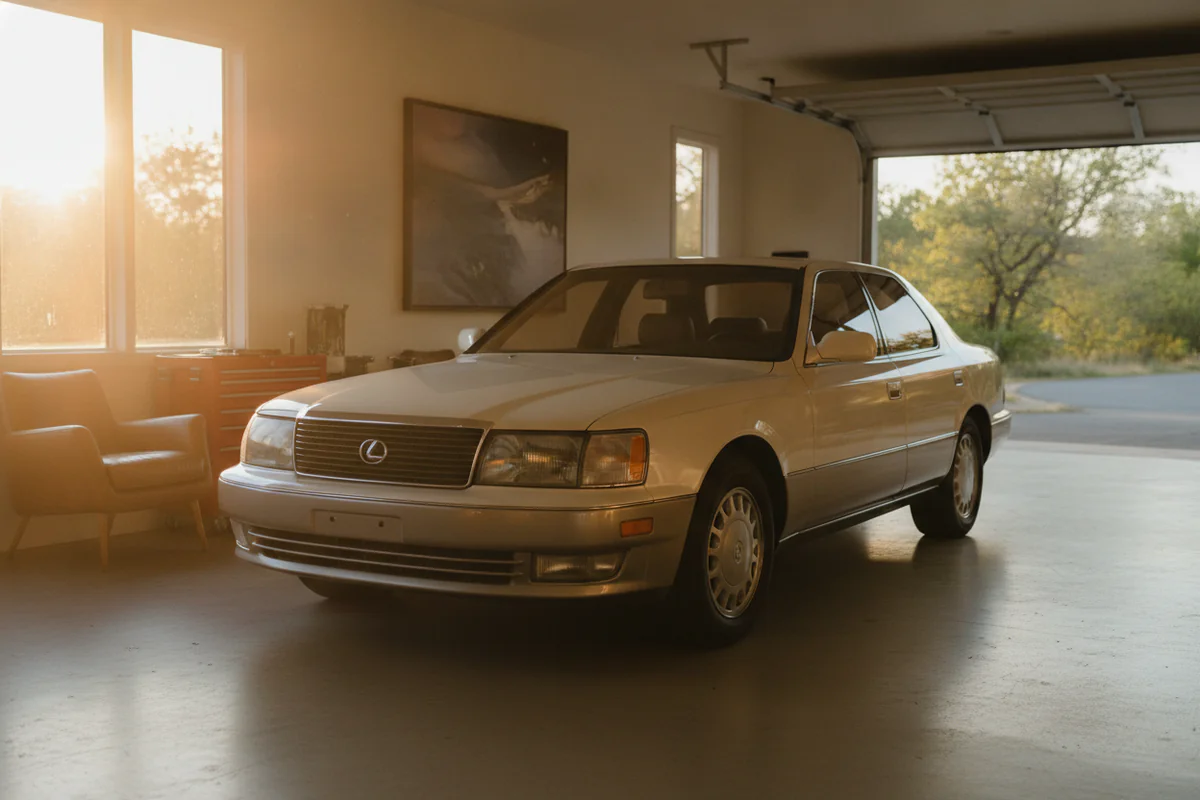
In 1989, a Japanese car company walked into the American luxury market with a sedan that cost around $35,000, ran quieter than a Mercedes S-Class at twice the price, and came with a reliability record that dealers in Stuttgart and Munich had no good answer for. The Lexus LS400 was not a lucky accident. Toyota spent somewhere between $500 million and $1 billion - depending on whose accounting you trust - and roughly a decade making sure it would land exactly that way.
The Lexus LS400 history starts earlier than most people realize, well before the car had a name or even a confirmed production green light.
The brief that started everything
In 1983, Toyota chairman Eiji Toyoda asked a simple question internally: can we build the best car in the world? Not the best Japanese car. The best car, full stop. The project that followed was codenamed F1, which had nothing to do with Formula One racing - it stood for "Flagship One." The team assembled under chief engineer Ichiro Suzuki was told to treat Mercedes, BMW, and Jaguar as the benchmark, then exceed them on refinement, performance, and reliability simultaneously.
That combination was considered essentially impossible at the time. German manufacturers had spent decades arguing, implicitly, that refinement required hand assembly and heritage, that you could not industrialize your way to a great luxury car. Toyota decided to prove otherwise through sheer engineering volume. Over the course of the program, they filed more than 450 patents specifically for the LS400.
The numbers that still seem unreal
Toyota built 900 prototype engines before settling on the final 1UZ-FE V8. Not 900 test cycles on a handful of engines - 900 separate prototype units. They employed roughly 1,400 engineers and 2,300 technicians on the project at its peak. The body was tested in wind tunnels to achieve a drag coefficient of 0.29, which was lower than most sports cars of that era, never mind a full-size luxury sedan.
The noise, vibration, and harshness targets were set at a level so strict that the engineering team had to invent new manufacturing tolerances to meet them. One story that circulates among automotive journalists - and has been verified often enough to trust - is that Toyota engineers balanced each engine component to tolerances tighter than what aerospace suppliers were hitting at the time. A champagne glass was placed on the running engine at idle to demonstrate how little it vibrated. The champagne barely moved.
And anyway, the number everyone remembers is the price tag on development itself. The $1 billion figure appeared in early press coverage and has stuck ever since, though Toyota never confirmed an exact number. What they did confirm was that the project ran for six years of serious engineering work, required building an entirely new dealer network in the United States (Toyota kept Lexus separate from its main dealerships), and involved market research so thorough that Toyota engineers drove hundreds of thousands of miles through California specifically to understand what American luxury buyers cared about during a commute.
What they actually built
The 1UZ-FE V8 displaced 4.0 liters and produced 250 horsepower, which matched the contemporary Mercedes 420 SEL almost exactly. But where the German car weighed more and returned worse fuel economy, the Lexus managed EPA estimates of 18 city / 24 highway - numbers that would be respectable in a small sedan. The engine used aluminum for both block and cylinder heads when most competitors were still running iron blocks, and it achieved those power figures while running so smoothly that the tachometer was the only reliable way to know the engine was on.
Road & Track tested the LS400 against the Mercedes 420 SEL and the BMW 735i in their April 1989 issue and the Lexus won on nearly every objective measure. It was faster, quieter, more fuel efficient, and significantly cheaper. Car and Driver named it to their Ten Best list. The automotive press, which had every incentive to be skeptical of a brand that did not exist eighteen months earlier, largely ran out of criticisms by the end of the first drive.
The Infiniti problem nobody talks about
Nissan launched the Infiniti brand at exactly the same time, with the Q45 as their flagship. The Q45 was a genuinely good car - big V8, rear-wheel drive, sophisticated suspension - but Infiniti's launch advertising became a minor legend for the wrong reasons. The ads showed rocks and trees and water. No car. Just nature. While Lexus ran television spots showing their engineers obsessing over millimeter tolerances and showing the champagne-glass demonstration, Infiniti asked viewers to contemplate tranquility. The Q45 was outsold by the LS400 quickly and never really recovered its footing at the top of the Infiniti lineup. The launch comparison is still used in marketing courses as a case study in saying the wrong thing about the right product.
What it did to the competition
Mercedes and BMW both accelerated their reliability and quality improvement programs in the early 1990s, and people inside both companies have acknowledged in interviews that the LS400's arrival was a direct catalyst. The S-Class that arrived in 1991 was developed partly in response to what Lexus had demonstrated was achievable. That is a significant legacy for a car from a brand that had existed for two years.
For anyone who wants to spend more time with the design and era, the Lexus wall art collection covers the LS and other models in formats worth actually putting on a wall - which is a different impulse than just reading about a car, but an understandable one.
Why the story still matters
The LS400 is not just a data point in automotive history. It demonstrated that luxury, in the sense that actually matters to a buyer sitting in traffic at 7am, is mostly an engineering problem. Prestige and heritage are real things and they carry weight in a showroom, but they do not muffle road noise or prevent a transmission from needing work at 60,000 miles. Toyota bet an enormous sum on the idea that if you solved the engineering problem completely enough, buyers would follow. In 1989, they were right.
The original LS400 is now old enough to be a legitimate collectible. Clean early examples are being preserved with the same seriousness once reserved for European classics, which would have seemed absurd to European manufacturers in 1989. It turns out the best answer to "can we build the best car in the world" was yes, and the receipts are still out there if you know where to look.