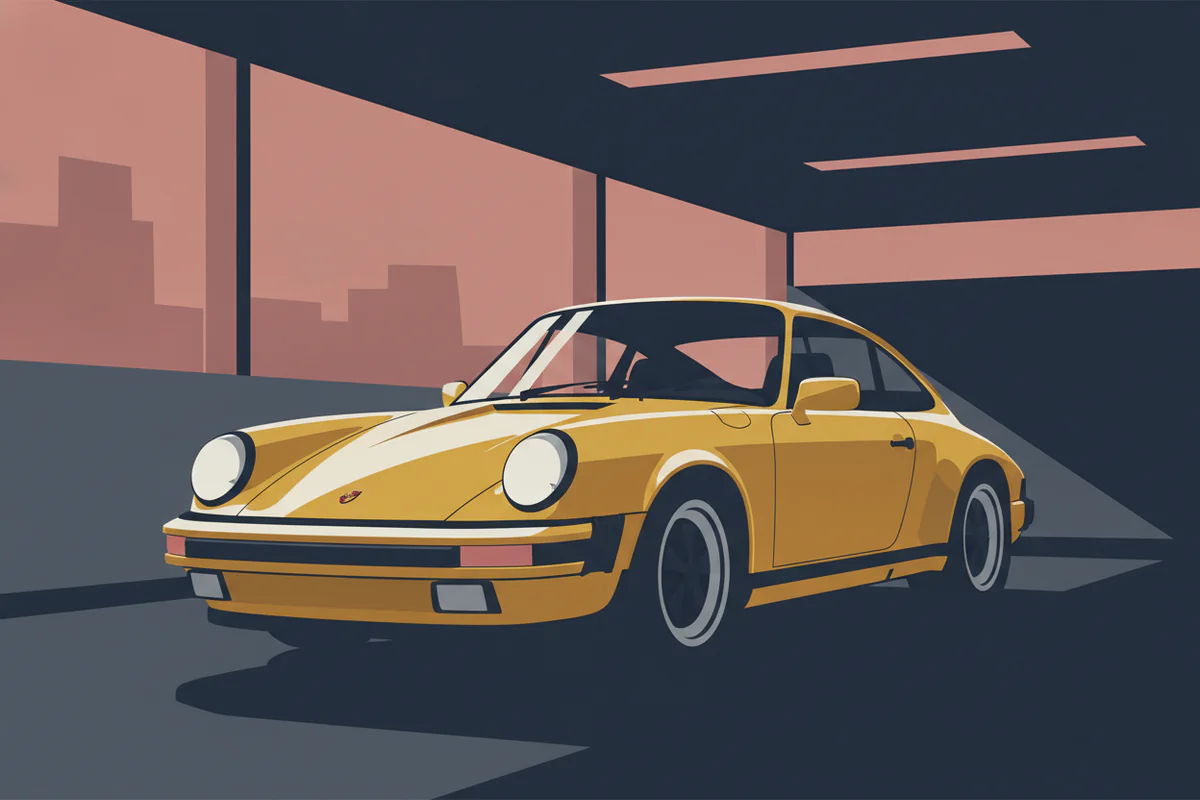
Put a 1964 911 and a 2024 911 side by side. The roofline slopes back the same way. The fenders bulge over the rear wheels the same way. The headlights sit in roughly the same position, and the whole thing still looks like it was inflated rather than designed. Sixty years of engineering progress, emissions regulations, pedestrian-safety standards, and changing consumer tastes - and the silhouette barely moved. That is either a miracle of design foresight or a very specific kind of corporate stubbornness, and the honest answer is probably both.
Where the shape came from
Ferdinand "Butzi" Porsche drew the 911 in the early 1960s as a replacement for the 356, which itself was already a pretty compact, rounded car. The brief was essentially: make it bigger inside, keep it light, keep the engine where it is. That last constraint mattered enormously. The rear-mounted flat-six forced a particular weight distribution and, by extension, a particular body shape - the rear deck had to cover the engine, which pushed the roofline rearward, which created the long, sloping fastback. The shape was not purely aesthetic. It was the physical solution to an engineering decision.
And that's actually why it has been so hard to abandon. Every time Porsche engineers have revisited the platform, they've kept the rear-engine layout. Keep the layout, you keep the constraints. Keep the constraints, you keep the proportions. The silhouette is almost load-bearing in a conceptual sense - change it and you're no longer making the same argument about what a sports car should be.
The 993 and the moment Porsche almost broke the streak
The late 1980s and early 1990s were rough. The 928 was supposed to be the future of Porsche - front-engine, water-cooled, arguably more rational in every measurable way. It sold fine but never replaced the 911 in people's minds, and Porsche quietly retired it in 1995. Meanwhile the 911 itself was going through an identity crisis. Sales had slumped badly by the early 1990s, the company nearly went bankrupt, and there were serious internal discussions about whether the 911 should be fundamentally redesigned.
Instead they produced the 993 in 1994 - the last air-cooled 911 - and it's widely considered one of the best-looking cars the company has ever made. The silhouette was refined rather than rethought. Smoother, slightly wider, cleaner glasshouse. It looked modern without looking like it was trying to. That generation probably saved the shape more than any other, because it proved the form still had somewhere to go without being abandoned.
Water-cooling didn't change the outline
The switch to water-cooling with the 996 in 1997 caused more uproar among enthusiasts than almost anything else Porsche has done. The engine changed fundamentally. The mechanical character changed. People to this day argue about whether a water-cooled 911 is a "real" 911, which is a debate I find slightly tedious but also completely understandable given how much of the car's identity was tied to that air-cooled sound.
But look at the 996 from the side. The silhouette held. The roofline, the rear haunch, the overall stance - recognizably the same car. Which is interesting because if you were going to break the visual covenant, the moment you're changing the core mechanical identity seems like the logical time. Porsche didn't, and the result is that the shape outlasted the mechanical argument for it. The form had become its own justification.
Why consistency at this level is actually difficult
It's tempting to look at the 911's design continuity and assume it happened passively - that Porsche just kept photocopying the same template. The opposite is true. Each generation involves thousands of engineering hours, regulatory compliance work, and aerodynamic simulation. The 992 (current generation) has active cooling air intakes, a wider body, and a drag coefficient that would have been unimaginable in 1964. The windshield angle is different. The rear overhang has changed. The car is larger in almost every dimension.
Maintaining recognizability through all of that requires active design decisions at every step. Someone in every generation had to look at a proposal and say "that reads as something else, bring it back." That is harder than it sounds when you're trying to also satisfy modern safety legislation, which tends to push car designs toward taller hoods and more vertical front ends. Porsche has had to fight that pressure explicitly with regulators in some markets.
Anyway - the point is that the consistency was chosen, repeatedly, over sixty years. That's different from it just happening.
What the shape does for the brand
Most car brands have to tell you who they are. Porsche, at this point, mostly just has to show you the outline. That is an extraordinarily valuable position to be in. Brand recognition studies consistently show the 911 silhouette as one of the most instantly identifiable vehicle shapes in the world, alongside things like the VW Beetle and the original Mini. Those are cars that stopped production decades ago. The 911 is still being sold, updated, and raced.
The practical effect is that every new generation of 911 arrives pre-loaded with the emotional equity of every previous one. A 25-year-old buying their first 911 today is buying the same shape their father pointed at when they were kids, which their grandfather might have seen in a magazine in 1965. The car earns that continuity fresh with each generation, but it also inherits it.
For people who love this stuff - the design history, the generational thread, the specific way the car looks from a three-quarter rear angle - there's a whole corner of the internet devoted to it, and Porsche wall art and gifts is one place where that visual obsession gets a physical form. Which makes sense. If any car has earned the right to be on a wall, it's one that's looked this consistent for this long.
The electric question
The Taycan exists. It's a genuinely impressive car. It is also not a 911, and Porsche has been careful not to call it one. But the pressure to electrify the 911 itself is coming, and when it does - probably sometime in the 2030s - it will be the most significant test the silhouette has ever faced.
An electric 911 doesn't need a rear-mounted engine. The constraint that created the shape in 1963 simply evaporates. Porsche could, in theory, put motors and batteries wherever packaging allows and design the body around pure aerodynamic and aesthetic priorities. They probably won't, because the brand logic of keeping the 911 looking like a 911 is now stronger than any engineering argument. The shape has become the product. It would take a specific kind of courage - or recklessness - to walk away from that.
My guess is they won't. The 911 will go electric and it will look, from the side, more or less the same as it did in 1964. And that will be a design decision in the most complete sense - not a failure of imagination, but a very deliberate choice about what the car actually is.