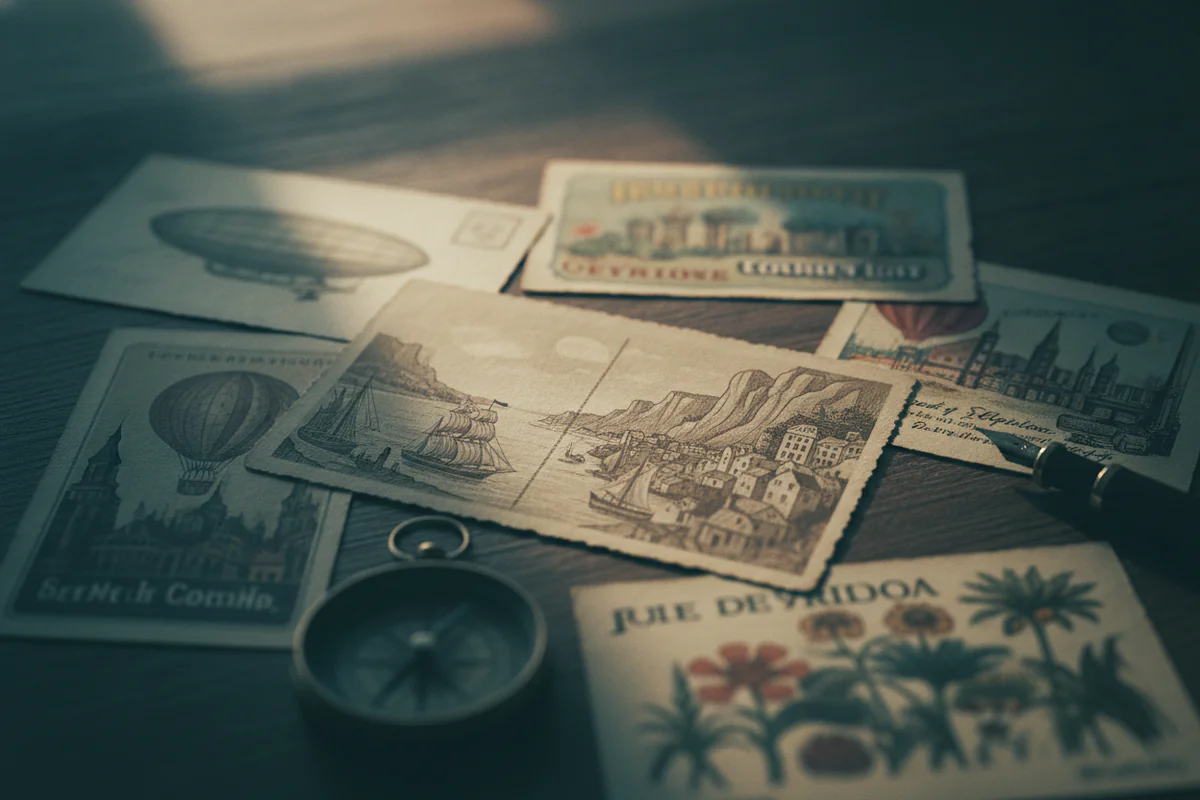
Somewhere in a drawer or a shoebox, most of us have at least one postcard we never threw away. A faded photograph of a coastline, a badly printed cathedral, maybe a cartoon bear holding a sign with a city name on it. The history of postcards as souvenirs stretches back further than most people realise, and the impulse behind them - to compress a place into a small rectangle of card and hand it to someone - turns out to be surprisingly hard to kill.
Before the picture postcard existed
The first postcards were not souvenirs at all. Austria issued the world's first official postal card in 1869 - plain, utilitarian, designed to carry a brief message at a lower postage rate than a sealed letter. Britain followed in 1870. For the first couple of decades, these were essentially the text messages of their day: quick, cheap, slightly impersonal. No pictures. No wish-you-were-here sentiment.
The shift happened in the 1890s, when European printers started producing illustrated cards to sell at exhibitions and tourist sites. The 1893 World's Columbian Exposition in Chicago is often credited as a turning point for America - vendors sold picture cards of the fairgrounds, and visitors bought them in enormous quantities. Something clicked. People liked sending a picture of the place they were standing in. They still do.
The golden age, roughly 1900-1915
The period that collectors call the Golden Age of postcards was genuinely remarkable by any measure. By 1908, Britain alone was handling around 860 million postcards a year. There were two postal deliveries a day in many cities, which meant you could send a card in the morning and reasonably expect your friend to receive it by the evening. People used postcards the way we use texts - "meeting you at 4, changed our plans" - but the illustrated souvenir card was its own distinct genre, bought specifically to document where you had been.
Printing technology was the engine behind all of this. German printers, particularly in Saxony, dominated the market for quality colour lithographs, and their work was exported everywhere. A postcard of Blackpool or Brighton or the Swiss Alps might well have been printed in Leipzig. The cards from this era have an odd luminous quality - slightly unreal colours, skies too blue, seas too green - that makes them look more like memory than photograph.
Collecting became its own obsession. "Deltiology" (the formal term for postcard collecting, coined much later) was a serious hobby, with albums sold specifically for the purpose. Women in particular were documented as avid collectors, trading duplicates and building themed sets. The postcard rack at a resort shop was not just a convenience; it was a kind of publishing industry.
The long decline, and what caused it
The First World War disrupted the German printing trade, and British and American producers never quite filled the gap at the same quality. Postage rates crept up. The telephone spread. And by the time affordable colour photography made every amateur a documentarian, sending someone a picture of where you were felt slightly less urgent.
The 1950s and 60s kept the postcard alive on pure habit and holiday ritual - the rack outside the gift shop, the stamp bought at the hotel desk, the card that arrived home three days after you did. But the cultural weight had shifted. It was something you did because you were supposed to, not because it was the primary way to share where you'd been.
By the 1990s, email had arrived. By the 2000s, you could post a photo to a website from your phone. The received wisdom was that the postcard was done.
Why it didn't actually die
And yet. Walk into any decent museum shop or independent bookshop today and there will be a postcard rack. Small stationery brands do brisk business in illustrated cards. Artists sell postcard prints at markets. The Postcrossing project, which connects strangers to exchange postcards internationally, has facilitated over 70 million cards since it launched in 2005. That is not a dying medium.
Part of what survived is the object itself. A postcard is physical in a way that a photo on a screen simply is not. It takes up space. It has a weight. Someone handled it, wrote on it, stuck a stamp on it, and put it in a box. That chain of small deliberate actions is what gives it meaning now, arguably more meaning than it had when sending one was entirely ordinary.
There's also the fact that the illustrated souvenir card never fully separated from art. The best vintage postcards are genuinely beautiful graphic objects - designed by artists, printed with care, carrying the visual language of their moment. The current revival leans into this. Contemporary postcard illustrators know exactly what they're doing aesthetically; there's a self-awareness to it that the Edwardian holidaymaker buying a Blackpool card probably lacked.
What the postcard actually does
The history of postcards as souvenirs is really a history of a particular human need: to mark that you were somewhere, and to bring someone else into that experience even at a distance. Photography does this, obviously. Social media does it relentlessly. But the postcard does it with an intimacy that neither of those quite matches, because it requires you to single someone out. You don't send a postcard to your followers. You send it to one person, and you write something on the back just for them.
That specificity is probably why the format has more staying power than anyone in 1999 would have predicted. It's also why old postcards are so compelling to look at - the printed image on the front is public and generic, but the handwriting on the back is completely private, a small window into a relationship and a moment that no algorithm sorted or recommended.
Anyway - the shoebox full of old cards sitting in your parents' attic is a more interesting archive than most of us give it credit for. Someone thought of someone else, bought a rectangle of card with a picture on it, and sent it across a distance. A billion people did exactly that in 1908, and a fair number are doing it right now.