
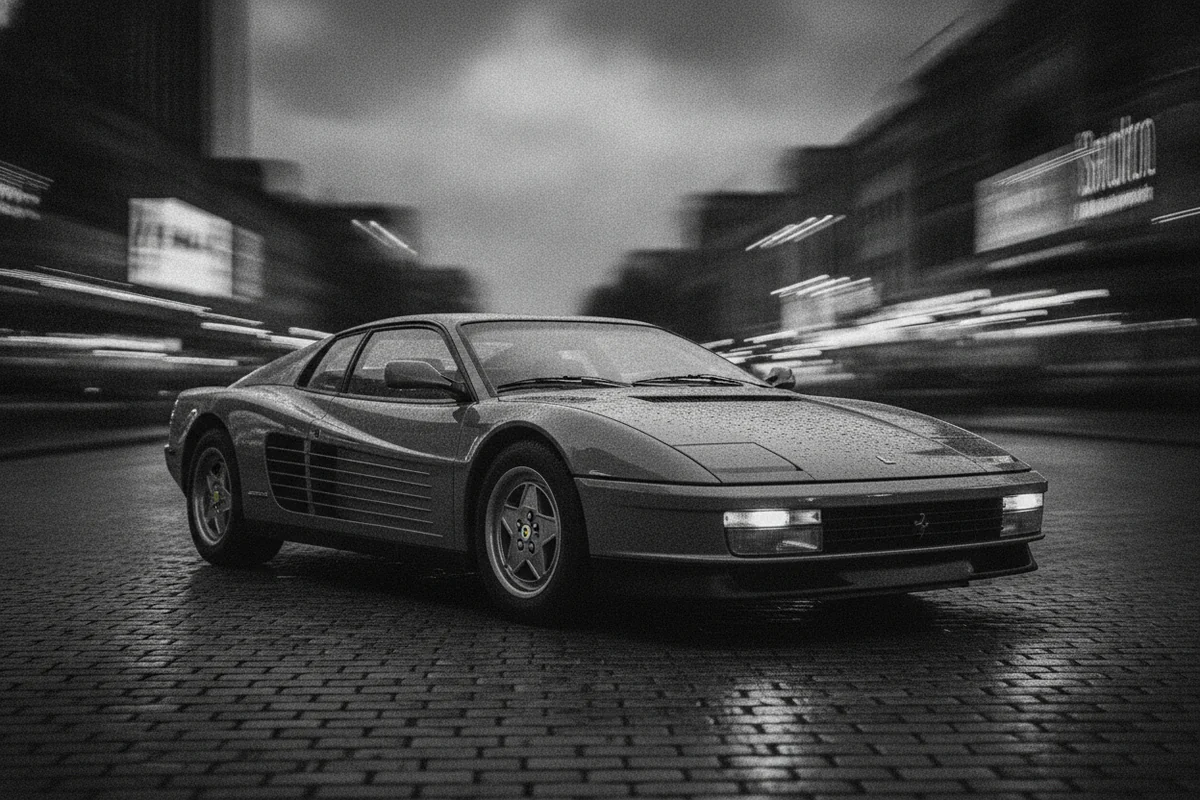
The 1980s were a weird decade for cars. Fuel economy mandates were strangling American V8s, Japanese manufacturers were quietly getting very good at things Detroit hadn't noticed yet, and European sports cars were hitting a kind of peak weirdness that nobody has really replicated since. Out of all that noise came a surprisingly long list of cars that still matter - cars people restore, argue about online at 11pm, and pay genuinely stupid money for at auction.
This list isn't trying to be exhaustive. It's the cars I'd actually want in a garage, plus a couple of wildcards that tend to get overlooked when people talk about the best cars of the 1980s.
1. Ferrari Testarossa (1984)
Start with the obvious one, get it out of the way. The Testarossa was on every bedroom wall for a reason - those straked side intakes, the wide flat body, the 4.9-litre flat-12 sitting behind the driver. It made 390 horsepower in stock form, which felt like a lot in 1984 because it was. Miami Vice did more for this car's cultural footprint than any Ferrari press event, and honestly the show's version (a white '86) is still one of the most visually arresting cars ever put on television. Values have climbed hard since around 2015 and a clean example now runs $120,000 to $200,000 depending on history. The market is not getting cheaper. Worth knowing.
2. Porsche 911 Carrera 3.2 (1984-1989)
People who know Porsches tend to land on the 964 as the last "pure" 911, but the 3.2 Carrera that preceded it is the one I keep coming back to. It solved most of the handling drama of earlier 911s without losing the rawness, ran a 3.2-litre air-cooled flat-six making 231 horsepower, and came in enough body styles - coupe, targa, cabriolet, Speedster - that you could find one for almost any mood. The Speedster especially has aged spectacularly. Low, raked, a little impractical, exactly right.
3. Toyota MR2 AW11 (1984-1989)
Here's where the list gets more interesting. The first-generation MR2 was a mid-engine two-seater that Toyota sold for around $13,000 in 1985. It weighed under 2,100 pounds, made 112 horsepower from a 1.6-litre twin-cam four, and handled in a way that embarrassed cars costing three times as much. Gordon Murray - the man who designed the McLaren F1 - reportedly called it one of his favourite small sports cars. Clean examples are genuinely hard to find now, and the supercharged version especially has developed a following that keeps pushing prices up year on year. A proper AW11 in good condition is worth hunting for.
4. BMW E30 M3 (1986-1991)
The E30 M3 was a homologation special - BMW built it to go racing in the DTM and European Touring Car Championship, which meant the road car got a 2.3-litre high-revving four-cylinder (unusual for M division), wide arches, a ducktail spoiler, and a chassis balance that still gets talked about by people who've driven every generation since. It won a lot of races. It also looks completely right in a way the later M3s, much as I like some of them, never quite recaptured. Prices have gone from "bargain" to "genuinely painful" - a clean Sport Evolution now trades above $150,000. But the standard road car can still be found in the $40,000-$70,000 range if you're patient.
5. Lamborghini Countach 25th Anniversary (1988-1990)
I'll be honest: the Countach is almost too much. The 25th Anniversary edition especially, with its additional bodywork designed by Horacio Pagani (yes, that Pagani), is a car that seems to exist at the extreme limit of what a vehicle is allowed to look like. Five-litre V12, scissor doors, zero practical visibility, a driving experience that reportedly requires both arms and genuine optimism. None of that matters. The Countach defined what a supercar was supposed to look like for an entire generation, and 35 years later it still stops people cold. Respecting that is not optional.
6. Volkswagen Golf GTI Mk1 / Mk2
The Mk1 GTI technically started in 1976, but the car really found its audience through the early 1980s - especially in the US, where the 1983 model year introduced it to a much wider market. The Mk2 that followed in 1984 refined everything without losing the point. Both generations are the origin of the hot hatch as a category, and both have aged in a way that feels totally natural - they look correct, they're the right size, and driving a good one is still genuinely fun in a way that a lot of more powerful modern cars aren't. The GTI community is vast and still actively producing quality restoration parts, which matters if you want to actually use one.
7. Ford Sierra RS Cosworth (1986-1992)
This one's more of a UK and European phenomenon, though American readers who know about it tend to react strongly. The Sierra Cosworth used a 2.0-litre Cosworth-developed turbocharged four-cylinder making 204 horsepower - substantial for 1986 - in what looked from a distance like a fairly ordinary Ford Sierra family car. The whale-tail rear spoiler gave it away up close. It dominated touring car racing, became the car of choice for a certain type of very fast (and occasionally very criminal) British driver, and developed a mythology that has only grown as clean examples become rarer. If you see a genuine RS500 variant, stop and look at it properly.
8. Mazda RX-7 FC (1985-1992)
The second-generation RX-7 doesn't always get the credit the FD (third-gen) does, but the FC was the car that proved the rotary engine concept could survive long-term. It looked genuinely excellent - pop-up headlights, a long hood, proper sports car proportions - and the turbocharged version made 200 horsepower from an engine with essentially no pistons, which still feels like a magic trick. Reliability reputation has improved a lot as the restoration community has gotten better at addressing the known issues. The FC is currently at the point in its appreciation curve where prices are moving but haven't gone vertical yet. Probably not for long.
Why these cars still land
Looking at this list, most of these cars share something: they were built before manufacturers fully optimised for insurance ratings, crash test scores, and focus group feedback. That's not nostalgia talking - it's a real design constraint that got removed somewhere in the 1990s, and the cars that existed before it tend to have a visual and mechanical directness that's hard to get now. They were built to do something specific, and you can see it.
The best cars of the 1980s were products of a decade that couldn't quite decide what it wanted - and the uncertainty produced some genuinely strange, genuinely great machines. The ones on this list are the ones that came out the other side still worth caring about.