
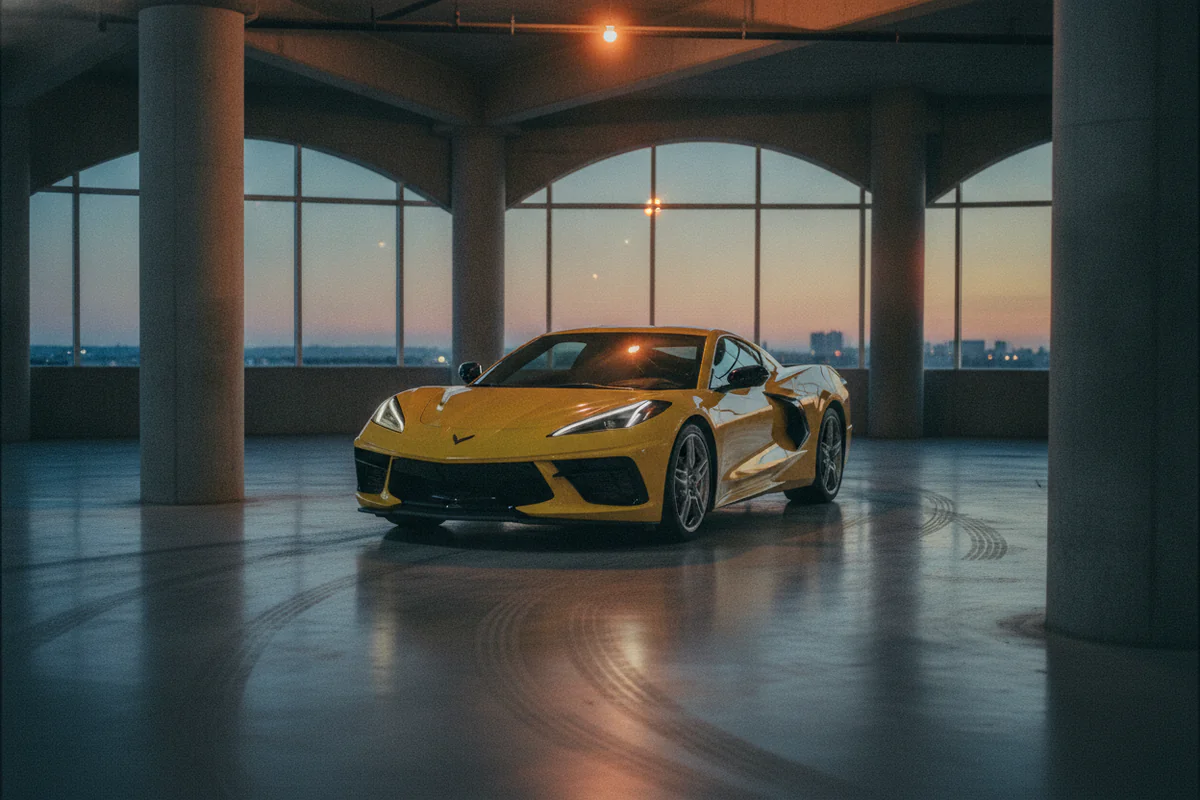
Seventy years is a long time for any car to survive, let alone stay relevant. The Corvette has done something rarer still - it arrived as a bit of a joke, spent decades clawing its way toward credibility, and then, right around its 65th birthday, pulled off a redesign that genuinely shocked people who thought they'd seen everything from Detroit. That arc across corvette history 70 years is worth slowing down to look at properly.
The 1953 original was not a great car
This is worth saying plainly because the mythology tends to sand the rough edges off. The first Corvette, shown as a concept at GM's Motorama in January 1953 and rushed into production that June, was a six-cylinder roadster with a two-speed automatic transmission. A sports car with a slushbox. Enthusiasts at the time were baffled, and sales reflected that - GM built 300 of them in 1953 and sold fewer than half before the year was out.
The fiberglass body was genuinely novel, and the styling had real flair, but the mechanicals were embarrassing by any sporting standard. Ford's two-seat Thunderbird arrived two years later and immediately outsold it. There were serious conversations inside GM about canceling the whole program.
What saved it was Zora Arkus-Duntov, a Belgian-born engineer who joined GM in 1953 partly because he wanted to work on the Corvette. He understood what the car was supposed to be even when the people building it didn't, and he spent the next two decades dragging it toward that vision. The small-block V8 arrived for 1955. Fuel injection came in 1957. By the time the C2 Sting Ray appeared in 1963, the car had actual sporting credentials.
The generational structure that kept it evolving
One thing that distinguishes Corvette history from most American cars is how cleanly it breaks into generations - each one a genuine rethink rather than a facelift. Eight generations across 70 years, which averages to a new architecture roughly every eight or nine years. That's a faster reinvention cycle than most people realize.
The C2 (1963-1967) gave the car its most iconic shape and introduced the independent rear suspension that finally made it handle. The C3 (1968-1982) stretched that body language almost too far and suffered badly through the emissions and fuel-crisis years - a 1975 Corvette made 165 horsepower, which tells you everything about that era. The C4 recovered some dignity in the 1980s, and then the C5 in 1997 arrived as a serious engineering achievement, with an all-aluminum LS1 V8 and a backbone frame structure that was both stiffer and lighter than what it replaced.
The C6 and C7 pushed output figures that would have seemed deranged to anyone at those 1953 showings - the C7 ZR1 made 755 horsepower from a supercharged 6.2-liter V8, enough to run 0-60 in under three seconds. By that point the Corvette was already a supercar in most of the ways that matter. But it still had a front engine and a rear transaxle, same basic layout as always, and that stuck in certain people's craws.
Why the mid-engine move was such a big deal
Duntov had actually drawn up mid-engine Corvette concepts as early as 1968. Several show cars followed over the decades. GM kept threatening to do it and then pulling back, usually for cost reasons. When the C8 finally arrived for the 2020 model year with the engine behind the driver, it felt like a 52-year-old promise getting kept.
The engineering argument for mid-engine placement is straightforward: putting the heaviest component close to the center of the car improves weight distribution and rotational inertia, which makes the car more responsive and more forgiving at the limit. Every serious supercar from Ferrari, Lamborghini, and McLaren is built this way. The Corvette had always been compared to those cars on a price-per-performance basis, and now it finally shared their fundamental architecture.
The base C8 Stingray starts around $67,000 - still less than a loaded Porsche 911, never mind a Ferrari. The Z06 version, which uses a flat-plane crank 5.5-liter V8 that revs to 8,600 rpm and sounds genuinely exotic, sits around $110,000. A Ferrari 296 GTB starts at $322,000. These aren't equivalent cars in every way, but the gap has narrowed enough that the comparison is no longer absurd.
Anyway - the reception was interesting. Some longtime Corvette owners hated the change on principle. The car doesn't look like a Corvette to them, and the front trunk (frunk, as everyone now calls it) is disorienting if you've spent decades lifting a hood and seeing an engine. But most critics and track reviewers came away genuinely impressed, and a new generation of buyers showed up who had never considered owning one before.
What the 70 years actually added up to
Looking at corvette history across all eight generations, the consistent thread is overreach followed by correction. The original car overreached stylistically while underdelivering mechanically. The C3 overreached on style again while the powertrain regressed. The C5 and C6 probably overreached on raw power before the chassis could fully exploit it. Each time, the next generation came back and addressed what the previous one got wrong.
That's an unusual pattern for an American car. Most platforms either stagnate or get killed. The Corvette kept getting another chance, partly because of its symbolic weight to GM and partly because there was always an engineer or a product manager somewhere inside the company who cared too much to let it slide. Duntov retired in 1975. Dave McLellan and Dave Hill followed him. For the C8, the chief engineer was Tadge Juechter, who had been working on Corvettes since 1984.
For anyone who follows the car closely, or just has a soft spot for American automotive history, Chevrolet and Corvette wall art is an easy way to put a specific generation on the wall - the C2 Sting Ray and the C8 both photograph beautifully, for very different reasons.
Where it goes from here
A hybrid C8 E-Ray arrived for 2024, adding an electric motor to the front axle for all-wheel drive. A fully electric Corvette has been discussed but not confirmed. The idea of a silent Corvette is uncomfortable for people who grew up associating the brand with a specific exhaust note, but then again, a Corvette with a six-cylinder automatic was uncomfortable for people in 1953 too.
What the last 70 years suggest is that the nameplate is more resilient than any particular configuration of it. The car has survived bad decades, corporate near-cancellations, emissions regulations, a mid-engine controversy, and the slow death of the manual transmission. At each inflection point it came out on the other side still recognizably itself - which is about the best thing you can say about any 70-year-old.