A postcard from Cologne, 1872
Gottlieb Daimler was not yet building engines when he drew a star on a postcard to his wife. He had marked their house on a map of Cologne with a three-pointed star and written something to the effect that the same star would one day rise over his factory, bringing prosperity. It reads now like the kind of thing you say without knowing you mean it. He meant it.
Daimler went on to co-found what became Daimler-Motoren-Gesellschaft, and his sons Wilhelm and Paul formally registered the three-pointed star as a trademark in 1909, three years after their father died. The symbol they chose was taken directly from that old postcard sketch. Whether that's a touching piece of corporate mythology or a genuinely documented fact, it has been confirmed through historical records held by the Mercedes-Benz archives in Stuttgart - so it seems to be both.
What the three points actually meant
The original meaning was stated plainly when the star was registered: dominance of motorization on land, at sea, and in the air. That sounds grandiose now, but Daimler-Motoren-Gesellschaft in 1909 was already supplying engines for aircraft, boats, and automobiles. This wasn't vague aspiration. The company had legitimate commercial operations across all three domains, and the star was meant to communicate exactly that scope.
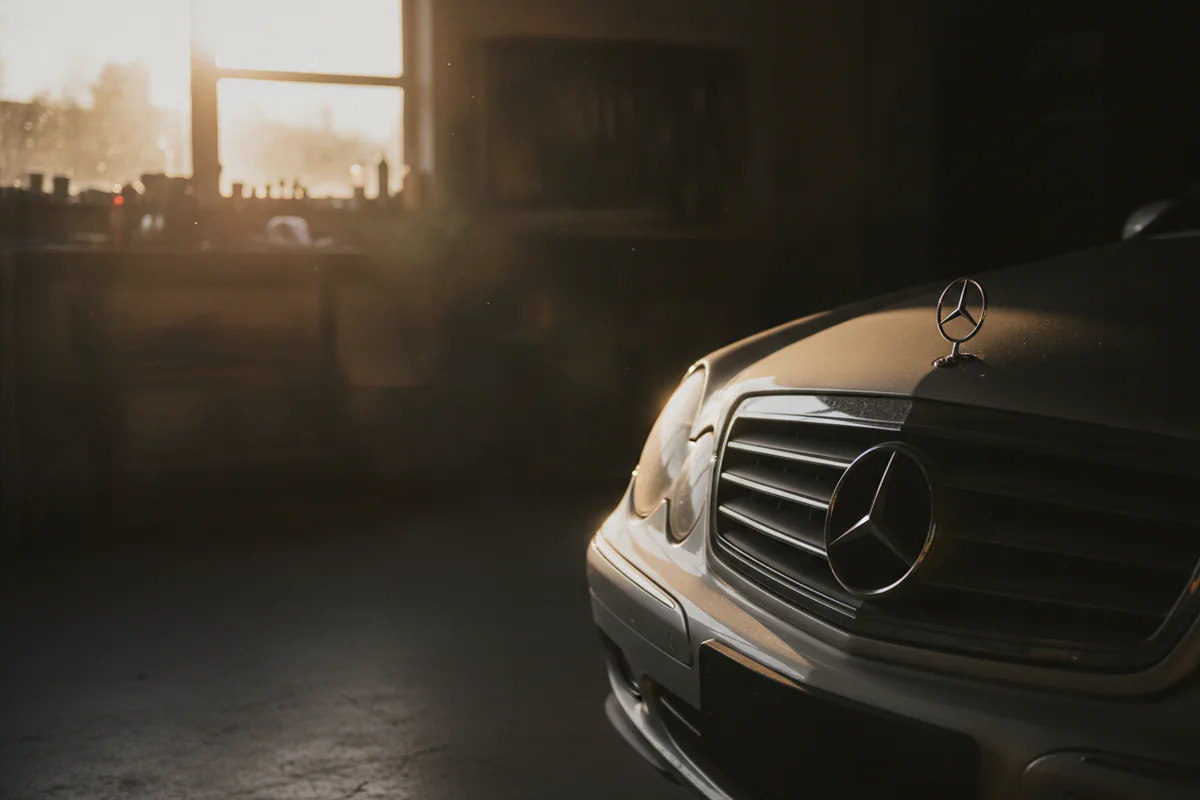
Karl Benz, whose company Benz and Cie ran separately at the time, used a different emblem - a circular wreath design with the Benz name. The two companies were fierce competitors through most of the early twentieth century, which makes the eventual merger stranger to look back on. They combined in 1926 to form Daimler-Benz AG, and when they did, the three-pointed star absorbed the Benz laurel wreath into a single badge. The star went in the center; the wreath framed it. That version, with minor refinements, is essentially what sits on the hood today.
The name "Mercedes" and where it came from
The Mercedes part of the name has its own separate story, and it's one of the more human moments in the whole history. Emil Jellinek was an Austrian diplomat and businessman who became one of Daimler's biggest customers and race promoters in the early 1900s. He had a daughter named Mercedes. He liked racing his Daimler cars under the pseudonym "Monsieur Mercedes" - partly because entering races under his real name would have been awkward given his diplomatic position.
When he negotiated with Daimler for a new, faster car in 1900, he ordered 36 of them on the condition that the model be named after his daughter and that he receive exclusive sales rights for several territories. The 1901 Mercedes 35 HP was the result, and it was such a radical departure from anything previously built - lower, faster, with a pressed-steel frame and a proper throttle pedal - that contemporaries called it the first modern automobile. The name stuck. Benz didn't adopt it until the merger, which is why the full name "Mercedes-Benz" only appears from 1926 onward.
How the star moved through the twentieth century
Through the 1930s, the three-pointed star appeared on some of the most technically ambitious racing cars ever built - the Silver Arrows, so called because the German racing team stripped white paint from their cars to meet a weight limit and raced in bare aluminum. Mercedes dominated Grand Prix racing in 1934 and 1935, and again from 1954 to 1955 before withdrawing from motorsport after the Le Mans disaster of 1955, in which a crash killed more than 80 spectators. The company didn't return to Formula 1 as a constructor until 2010.
The star itself went through a long evolution visually. Early badges were flat and relatively ornate. By mid-century the three-pointed star had become simpler, more geometric. The standalone hood ornament - the three-dimensional star on a pin - became a fixture on postwar models and eventually became such a recognized object that people started stealing them. In the 1980s and early 90s, particularly in the United States, a detachable Mercedes hood star was a minor status item in certain urban subcultures. The company eventually moved toward recessed or integrated badges partly for that reason, though they've never fully abandoned the ornament.
Why it reads as "luxury" now
The star's association with luxury happened gradually and wasn't inevitable. Through much of the 1950s and 60s, Mercedes also made utilitarian vehicles - the W115 diesel sedans of the 1970s were famously unglamorous workhorses, popular with taxi fleets across Europe. The 240D was not a prestige object. But the S-Class, introduced in 1972, set a consistent standard of engineering and interior quality that positioned the brand firmly upmarket over the following decades, and the star on the hood came to carry that weight.
There's also the sheer duration of it. The three-pointed star has appeared on vehicles for over a hundred years without significant interruption. Repeated exposure across generations, combined with consistent quality at the top end of the range, creates the kind of recognition that's genuinely hard to manufacture. Luxury branding researchers sometimes call this "heritage equity" - the idea that time itself becomes part of what the symbol means. The Mercedes star has a lot of it.
For anyone who appreciates the design and history of the star, there's a reasonable amount of Mercedes-Benz wall art and gifts that captures the iconography well, from vintage racing imagery to clean graphic treatments of the badge itself.
The star in its current form
The version most people see today - the clean, three-dimensional star inside a circle - was refined through several updates in the 1980s and 2000s. Daimler's designers have kept it remarkably stable compared to the logo churn that affects most car brands. BMW has updated its roundel twice significantly in recent memory; Volkswagen flattened its logo for a flat-design era. Mercedes has mostly left the star alone, which is itself a design decision - restraint as a form of confidence.
The company did introduce an "EQ" sub-brand for its electric vehicles with slightly different badging, and there's been ongoing discussion internally about how the star translates to a future without combustion engines. The land-sea-air dominance that the three points originally represented maps awkwardly onto an era of battery packs and software updates. But the star has survived stranger transitions - from a diplomat's racing pseudonym to a global luxury emblem - so it's probably not going anywhere. Daimler's postcard doodle turned out to have some endurance in it.