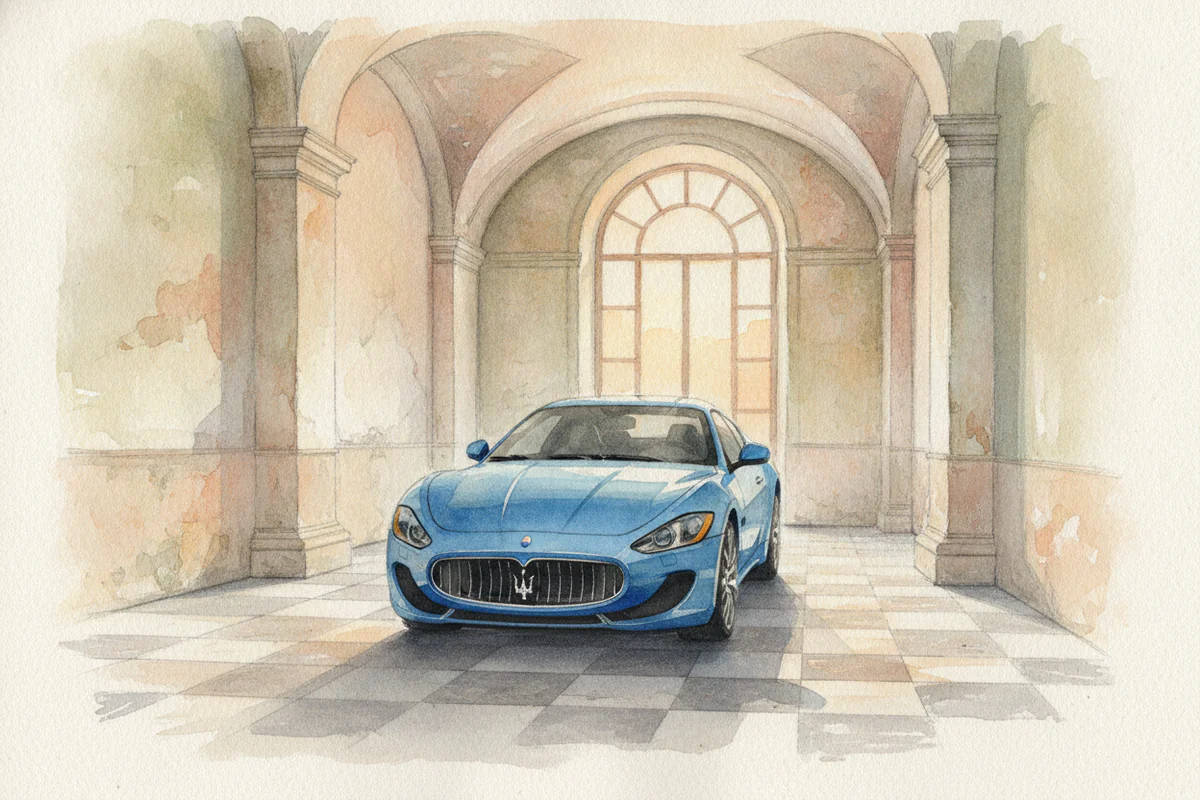
A trident from the Neptune fountain in Bologna
Most car brand symbols get a tidy origin myth. Maserati's is genuinely good. Mario Maserati borrowed the trident directly from the Neptune fountain in Bologna's Piazza Maggiore in 1926, and the family thought it had the right combination of aggression and classical weight. That decision - lifting a civic landmark's symbol and putting it on a racing car - tells you something about how the brand would operate for the next century. Confident, a little theatrical, deeply Italian in the way that treats beauty as a serious engineering value rather than decoration.
The early Maseratis were racing cars that occasionally got road versions built around them, not the other way around. The 250F that Juan Manuel Fangio drove to the 1957 Formula One championship is probably the peak of that era. Fangio himself said that car was the one he drove closest to the limit of what was physically possible for him. High praise from someone who also drove for Ferrari, Mercedes, and Alfa Romeo. Anyway - the point is that Maserati started life as a competition brand, which makes the later reputation for grand touring over lap times an interesting evolution rather than a founding character.
When the brand chose a different lane
The pivot happened gradually through the 1950s and 60s. The Maserati 3500 GT, launched in 1957 and bodied by Touring of Milan, was the moment the company decided that wealthy drivers who wanted to cross Europe quickly and look good doing it were a more sustainable market than pure racing. It was the right call commercially. It also set up the identity tension that defines maserati brand identity history to this day - a brand that came from motorsport but whose most devoted customers often cite the way a car looks and sounds over what it does at a track day.
The Ghibli name appeared first in 1966 on a Giorgetto Giugiaro design so clean it still looks contemporary. Then the Bora, the Merak, the Khamsin. Maserati named cars after winds and deserts, which sounds like a marketing department having fun, but it also signals something real: these were cars for distance, for atmosphere, for the experience of the drive rather than the result at the end of it. German manufacturers were doing something quite different. Porsche was building the 911 into a precision instrument. BMW was constructing the reputation for handling that would eventually become its entire identity. Mercedes was refining engineering quality to a degree that made reliability almost boring. Maserati looked at all of that and kept doing Maserati.
The Citroën years and what they cost
Citroën acquired Maserati in 1968, which is one of the stranger chapters in automotive history. French company, hydropneumatic suspension, the Maserati SM - it produced some genuinely odd and interesting cars. It also nearly destroyed the brand. When Citroën ran into financial trouble in 1975, Maserati went bankrupt, and the Italian government effectively kept it alive because letting it die was politically unthinkable. De Tomaso took over in 1976, then Fiat in 1993, then Ferrari (under Fiat's ownership structure) took operational control in 1997.
Each ownership era left marks. The Ferrari period produced the 3200 GT and eventually the early Quattroporte revival, which was a genuine statement of intent - a four-door saloon using a Ferrari-derived V8, styled by Pininfarina, aimed squarely at the 7 Series and S-Class. The 3200 GT especially had a rear light design featuring a distinctive curved boomerang shape that people either loved or found a bit much. Classic Maserati, really. The engineering was mostly good. The drama was the point.
Why "less precise than German" became a selling point
Here's the thing that confuses people who approach Maserati from a value-for-money or performance-per-pound angle: the customers who stay loyal to the brand often know exactly what they're trading. They know a 911 will probably be tighter to drive. They know a well-specced BMW M car will likely have fewer electrical quirks. Some of them have owned those cars. They buy a Maserati anyway because what it offers - the sound of a naturally aspirated V8 in an older Quattroporte, the proportions of a GranTurismo, the sense that the thing was designed by someone who cared about the visual result - isn't replicated elsewhere at any price.
The GranTurismo, which ran from 2007 to 2019 with only modest updates, is probably the clearest example of this dynamic in modern form. Pininfarina designed it, and the proportions are close to perfect - long bonnet, short tail, a roofline that drops with genuine elegance. The Ferrari-derived 4.7-litre V8 makes a sound at full throttle that is, without exaggeration, one of the better sounds a road car has produced in the last twenty years. It was never as fast as a comparable 911 Turbo. The interior quality was inconsistent depending on exactly which year and specification you found. None of that stopped it from becoming one of the most-photographed cars of its generation, or from retaining a following long after production ended.
The current chapter and the EV problem
Maserati under Stellantis is trying to do something ambitious and risky: go fully electric across the range by the mid-2020s. The GranTurismo Folgore is the first sign of what that looks like, and the reviews are broadly positive on performance. Whether an electric Maserati can carry the same emotional charge is a genuinely open question, and not one the brand's history gives you a confident answer to. The sound of those engines was load-bearing, in the identity sense.
The Grecale, their mid-size SUV, is selling well. SUVs are how brands stay solvent. But the buyers who care most about maserati brand identity history are probably watching the GranTurismo lineage more carefully than the Grecale numbers.
What the devoted fans are actually defending
Spend time in Maserati owner communities and you notice they talk about their cars differently from how Porsche owners talk about theirs. Porsche owners discuss suspension setups, track times, model-year differences in roll stiffness. Maserati owners are more likely to describe how a particular road felt on a particular morning, or mention that someone stopped them at a petrol station to ask what the car was. That's not a criticism of either group. It's just a different thing being valued.
The brand built that preference deliberately, over decades, by consistently choosing drama over discipline when forced to pick. It's a narrower market than the German alternative, obviously. But narrow and devoted is a defensible position, and Maserati has survived bankruptcy, six ownership changes, and the full weight of German precision marketing to still be making cars that people argue about with genuine feeling. That's its own kind of engineering achievement.