
Before the showroom, there was the track
The 300SL that appeared at the New York Auto Show in February 1954 looked like nothing else on the floor. But to understand why it existed at all, you have to go back two years to a racing programme that Mercedes-Benz almost didn't bother with.
After World War II, the Stuttgart factory was in ruins. Mercedes spent the late 1940s rebuilding from scratch - production cars first, racing ambitions later. By 1952 they were ready to put something on a circuit again, and the W194 was what they built. A tubular spaceframe chassis wrapped in a lightweight aluminum body, powered by a 3.0-litre straight-six borrowed from the 300 sedan. It won Le Mans that year. It won the Carrera Panamericana. It was, by any measure, a serious car.
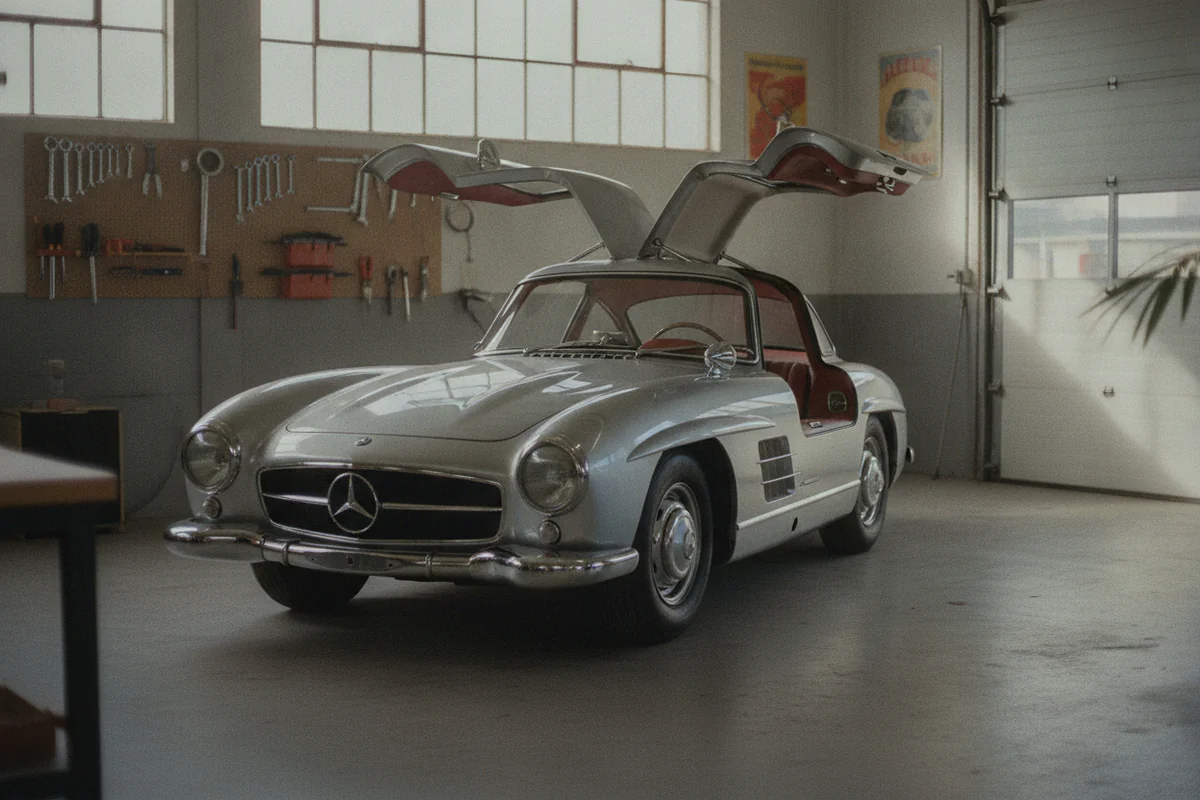
The problem was that spaceframe. The tubes ran high along the sides of the car to give the structure enough rigidity, which left almost no room for a conventional door sill. Engineers tried a few solutions, none of them satisfying. What they landed on - a door that hinged at the roofline and swung upward - turned out to be both a practical answer and the most recognizable silhouette in postwar automotive design.
Why the doors actually work
People sometimes assume the gullwing doors were a marketing decision, a way to make the street car look dramatic and exotic. That gets the story backwards. The racing W194 had them because there was no other clean solution, and when Max Hoffman - the Austrian-American importer who pushed Mercedes hard to build a road-legal version - convinced the company to do it, the door design came with the engineering. You couldn't change it without redesigning the whole chassis.
The production 300SL (W198) debuted in 1954 with a base price of around $6,820 in the United States, which was steep. For comparison, a new Chevrolet Corvette that year cost under $3,000. What you got for the money was the fastest production car in the world at the time - a top speed of roughly 160 mph depending on the final drive ratio ordered - and a fuel-injected engine at a moment when fuel injection on a production car was essentially unheard of. Bosch mechanical injection replaced the carburettors from the racing version and pushed output to about 215 horsepower. The engineers weren't sure it would survive real-world use. It did.
The things that made it difficult to live with
Not everything about the 300SL was elegant in practice. Getting in required a specific sequence: sit on the sill, swing your legs in, lower yourself down into a cockpit that sat very low. Taller drivers had genuine complaints. The steering wheel tilted to help, but it was still a production car asking for a degree of athleticism from its owner every time they went to the shops.
Heat was another issue. The engine sat canted 50 degrees to the left to keep the hood line low, which meant the exhaust manifold ran close to the footwell. On a warm day, in traffic, the interior got uncomfortable in a way that no amount of enthusiasm fully excused. Early cars also had a rear suspension geometry that could snap oversteer on the wrong road, fast. Mercedes addressed this in later production years, but it was a real thing, not a myth.
None of this stopped people from buying them. About 1,400 gullwing coupes were built between 1954 and 1957, when the body style was replaced by the open roadster. Owners at the time included celebrities, racing drivers, and people who simply wanted the most advanced road car money could buy. The roadster that followed was in many ways more usable - conventional doors, revised suspension - but it never had quite the same presence.
Why the gullwing became a reference point
Automotive history has a few cars that designers and engineers keep returning to, not because they were perfect but because they solved problems in ways that were visually and mechanically coherent. The 300SL is one of them. The doors are the obvious draw, but underneath them is a car that pioneered fuel injection for road use, demonstrated that a spaceframe chassis could work in a production context, and proved that a German manufacturer could compete at the absolute top of the market just a decade after the war had ended.
That last point mattered more than it sometimes gets credit for. Mercedes-Benz's decision to go racing in 1952 and then translate that directly into a showroom car was a statement about where the company was going. The 300SL carried a lot of weight beyond its own specifications.
Today the car shows up everywhere - in museum collections, in Mercedes-Benz classic wall art, in the background of countless automotive references as shorthand for a certain kind of postwar European engineering confidence. Auction prices have reflected that status for years; a well-documented gullwing regularly clears a million dollars, and exceptional examples go considerably higher.
The detail that still surprises people
For all the attention the doors get, the feature that tends to stop people when they actually study the car is the engine installation. Tilt that hood and the straight-six sits at such a dramatic angle - nearly on its side - that it looks like something went wrong during assembly. It didn't. It was the only way to keep the long engine low enough to maintain the hood line, and to offset the weight far enough back for reasonable balance. Functionality pushing form, again, the same logic that produced the doors.
That consistency is probably what keeps the mercedes 300sl gullwing history relevant to anyone who thinks about car design seriously. The car doesn't have a single flourish that was purely decorative. Every dramatic element came from a constraint that engineers turned into a solution. That's rarer than it sounds, and it's why the 300SL still gets drawn, photographed, argued about, and occasionally driven very fast on German roads by owners who understand exactly what they have.