
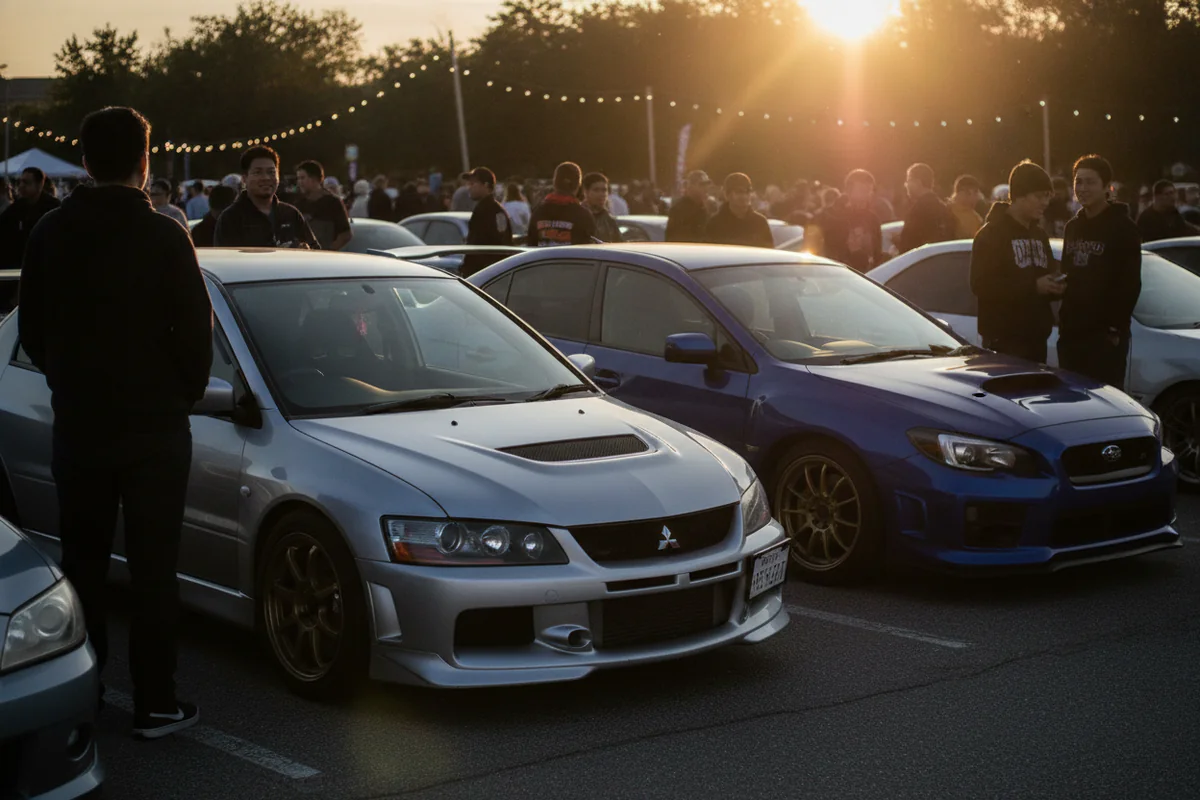
Two cars, one argument that never ends
Ask anyone who was paying attention to motorsport in the 1990s and early 2000s which side they were on, and you'll still get a strong answer. The Mitsubishi Evo vs Subaru WRX rivalry is one of those arguments that didn't stay confined to race stages or tuner forums - it leaked into car parks, magazine covers, and the kind of pub debates that somehow last three hours. It produced genuine tribal loyalty, and honestly, that loyalty hasn't really softened much.
What made it stick wasn't just performance numbers. Both cars were credible on tarmac and gravel, both were driven by people who actually won things, and both were cheap enough that a regular person could buy one and imagine, however briefly, that they were Colin McRae or Tommi Makinen. That accessibility is a big part of why the rivalry hit so hard.
Where it actually started - the WRC, not the street
The World Rally Championship is the real origin point here. Subaru arrived first with serious intent, signing Richard Burns and then McRae, who brought the kind of sideways, crowd-pleasing driving style that made Subaru feel like the people's team. The blue with yellow livery became iconic fast - it was on bedroom walls and screensavers well before anyone cared about brand loyalty in an abstract sense.
Mitsubishi came at it differently. Makinen won four consecutive WRC drivers' titles from 1996 to 1999 in the Lancer Evolution, which is an almost absurd run that sometimes gets underplayed in nostalgia discussions. He was clinical rather than spectacular, which probably cost Mitsubishi some of the romanticism fans attached to McRae, but the results were undeniable. Four in a row. That's the kind of record that should settle arguments, and yet somehow it didn't.
The manufacturers' championship complicates things further. Subaru took that title multiple times, so depending on which metric you prefer - driver or constructor - you can make a case for either side. This is, of course, exactly why the argument persists.
The road cars and what they actually were
Both manufacturers used the WRC program to justify selling homologation-derived road cars, and the road cars are where most people actually engaged with the rivalry. The WRX STI and the Lancer Evolution (from the fourth generation onward, which is roughly when people started caring) were sophisticated rally-bred machines sold at prices that, in relative terms, were astonishing for what you got.
The Evo was sharper, more clinical, a car that rewarded precision. Its Active Yaw Control system on later generations was genuinely impressive engineering - it could redistribute torque between the rear wheels mid-corner in ways that felt almost like the car was anticipating what you wanted. The STI was more raw, more communicative in the way a traditional driver's car is communicative, meaning it told you more about what it was doing through the wheel and the seat rather than quietly managing everything for you. Neither description is an insult. They're just different philosophies.
There's a version of this argument that runs endlessly on forums: Evo owners say the STI is rough and old-fashioned, STI owners say the Evo is too sterile and that driving one doesn't feel like an event. Both groups are slightly right and mostly wrong, which is the correct outcome for a good rivalry.
The tuner culture dimension
This is where the rivalry spread beyond people who watched rally stages. Through the late 1990s and into the 2000s, both cars became central to the street tuning scene in a way that wasn't really planned by either manufacturer. The turbocharged AWD platform on each car responded well to modification - a tune, an upgraded intercooler, better tyres - and the gap between what you bought and what you could achieve on a relatively modest budget was genuinely exciting.
Games like Gran Turismo and the early Need for Speed titles put both cars in front of millions of people who'd never been near a rally stage. The visual rivalry got encoded early: if you picked Subaru, you were probably also picking blue. Mitsubishi people went for a certain aggressive front-end look that the later Evo generations leaned into hard. Anyway - the point is that a generation of enthusiasts formed their identity around one of these two cars, and that kind of early imprinting doesn't go away.
The car poster market in the mid-2000s moved a lot of Evo and STI prints. That might sound like a small detail, but it's a decent indicator of cultural weight - when a car ends up on walls next to band posters and film stills, it has crossed into something beyond just transport enthusiasm.
Why Mitsubishi's exit stings differently now
Mitsubishi stopped selling the Evo in 2016. No direct successor has come. Subaru kept the WRX going, updated it, kept it alive even through periods when the market wasn't especially interested in turbocharged sports sedans. This created an asymmetry in the rivalry that still feels a bit unresolved - one team walked off the pitch, and the other kept playing.
Evo owners tend to treat this as a kind of vindication. The car became a fixed point, a thing you can look back at without worrying that a newer version will complicate your view of it. The final Evo X, particularly in its Final Edition trim, now trades at prices that reflect genuine collector interest rather than just used car depreciation curves. WRX STI values have moved similarly, though the ongoing production of the WRX line muddies the water slightly.
There's also the competitive record to sit with. Subaru's WRC involvement wound down too, eventually, and neither brand is a current force in the championship. But the Makinen era and McRae's championships live in a specific moment in rally history that doesn't get revisited or rewritten - it's settled, which paradoxically keeps the debate about which car was better alive and unsettled.
What people are actually arguing about in 2024
Search any car forum or subreddit that covers this topic and you'll find threads from the past year still running the same arguments from 2003. Some of that is internet nostalgia. But some of it is that the question genuinely doesn't have a clean answer, and car people are not good at leaving clean-answer-less questions alone.
The honest position is that the Mitsubishi Evo vs Subaru WRX rivalry produced two excellent cars that each expressed a different idea about what a performance machine should feel like, backed by a real motorsport contest between two manufacturers who were genuinely trying to beat each other. You don't get that kind of authentic tension very often. Most rivalries are constructed by marketing departments. This one was built on gravel stages in Scandinavia and sealed by the drivers who had to actually deliver results under pressure.
Pick a side if you want. Most people already have.