
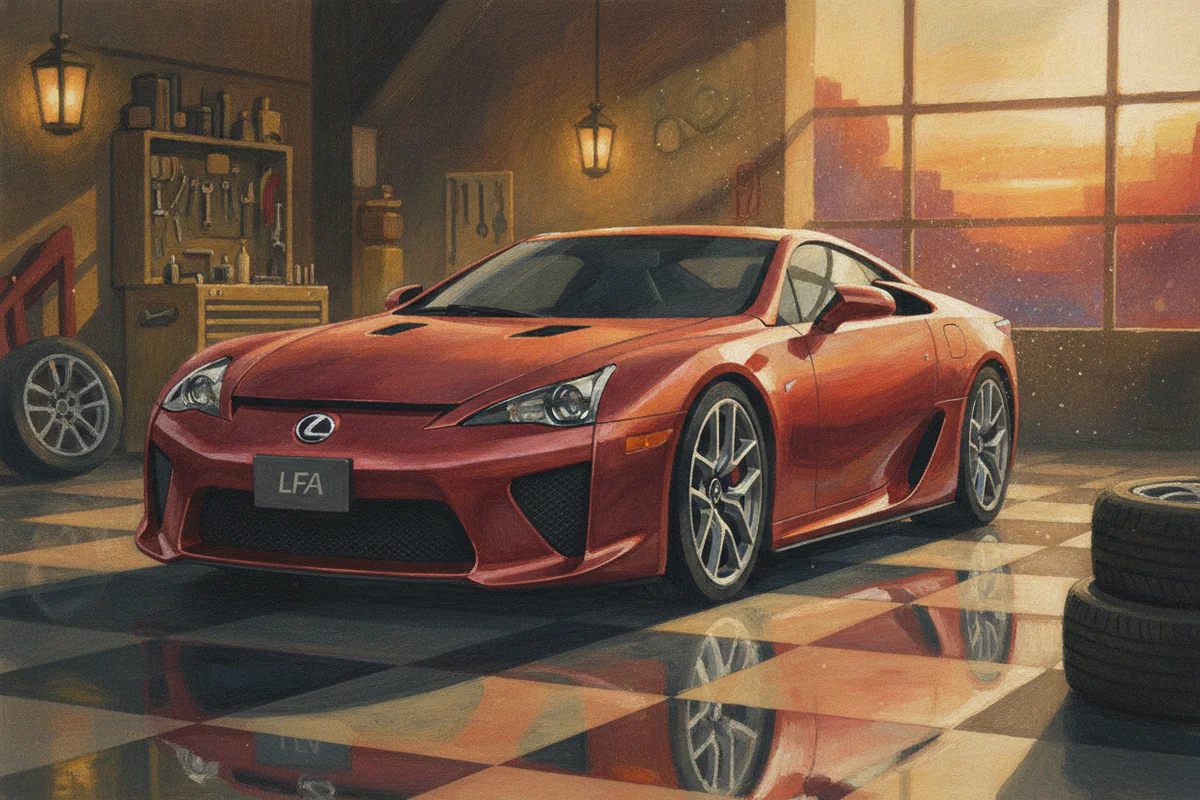
Most conversations about performance Lexus start and end with the LFA, which is fair - it is one of the greatest cars ever built anywhere, full stop. But that laser focus on one car means a handful of genuinely special models have been quietly aging in garages and auction listings without getting the credit they earned. Some of these deserve real discussion, and a few have been mispriced for years because buyers keep walking past them.
Lexus IS F - the one people underestimate most
The IS F arrived in 2008 with a 5.0-litre V8 producing 416 horsepower, an eight-speed automatic with paddle shifters that could do manual sequential shifts faster than most people expected, and a body that looked only slightly different from a standard IS. That last part hurt it. Visually it was subtle - wider fenders, quad exhaust, a small boot spoiler - and subtle does not photograph well for YouTube thumbnails. So it got ignored while the M3 and C63 fought for the spotlight every year from 2008 to 2014.
What the IS F actually delivered was a rear-wheel-drive car with a free-revving V8 that pulled cleanly to 8,300 rpm, a chassis tuned by Yukihiko Yaguchi (who also worked on the LFA program), and a sound that genuinely surprised people the first time they heard it at full throttle. The 0-60 time of around 4.6 seconds sounds modest now, but the character of how it got there - the way the power built through the rev range rather than slamming in low down - made it feel different from its competitors.
Used examples started below $25,000 for a while. They have climbed a little, but compared to what a clean E92 M3 commands now, the IS F still looks like an oversight. Reliability is generally strong, though the torque converter and rear differential are worth checking on high-mileage cars.
The SC 400 and SC 300 - older than most people want to admit caring about
The Z30 SC coupe ran from 1991 to 2000 and it represented something Lexus only briefly revisited afterward: a proper grand tourer with genuine sporting intent. The SC 400 came with a 1UZ-FE 4.0-litre V8, the same engine family that powered LS 400 sedans to legendary reliability status. The SC 300 used a 2JZ-GE inline-six, which is where things get interesting for a certain kind of enthusiast - the same block architecture as the Supra's 2JZ-GTE, though naturally aspirated in stock form.
The interior was a genuine attempt at luxury for its era. The dashboard design won awards when it launched. Toyota's chief engineer Ichiro Suzuki said publicly that the team studied every European grand tourer on sale at the time and tried to beat them on build quality and refinement. The result was a car that drove with more weight and purpose than Lexus sedans of the same period, and it aged better than most people expected.
And yet. You can still find clean SC 400s for under $10,000. The 2JZ SC 300 in manual form - a rare configuration only offered in certain markets - has become a genuine cult car and prices reflect it, but the automatics still sit undervalued relative to what they are. If you wanted a late-1990s coupe that would embarrass most of the competition on build quality and still has a serious engine under the bonnet, the SC is hard to argue against.
LFA: technically celebrated, emotionally misunderstood
The LFA gets mentioned constantly, but usually in ways that miss the point slightly. It was a production run of exactly 500 cars built between 2010 and 2012, with a 4.8-litre V10 developed with Yamaha that produced 552 horsepower and revved to 9,000 rpm. The carbon fibre body was so specific that Lexus built dedicated manufacturing equipment just for it. The exhaust note was tuned with an acoustic engineer, not just optimised for dyno numbers.
What gets lost is how it changed the people who built it. Engineers who worked on the LFA program went back into the broader Lexus lineup and pushed for higher standards in NVH, material quality, and chassis tuning. The IS F benefited. The RC F that came later benefited. The LFA is usually discussed as a halo car that proved Lexus could do performance - and that is accurate - but it was also genuinely influential on the cars that followed it internally, which rarely gets mentioned.
Prices have climbed well past the original $375,000 list price now, so it sits in a different category from the SC and IS F. But as an object of serious study rather than just a talking point, it rewards more attention than it usually gets in enthusiast circles where it has become shorthand rather than a real subject.
RC F and GS F - the ones everyone forgot about immediately
Both launched to modest critical reception around 2015-2016 and both used a version of the IS F's 5.0-litre V8 producing around 467 horsepower in later tune. The RC F in particular attracted complaints about weight - it came in around 1,840 kg, which compared poorly to an M4 on paper. The GS F was a proper rear-wheel-drive sport sedan, competing with M5 and E63, and it barely registered in buying conversations.
Both of these have aged better than their reviews suggested they would. The V8 is still one of the better-sounding engines in its class. The RC F Track Edition, limited to 60 units in the US market, shaved weight aggressively with carbon ceramic brakes and a carbon roof, and it made the chassis argument much more convincingly. Find one of those and you have something that will be genuinely collectable in ten years. The standard RC F and GS F, meanwhile, sit at prices that suggest buyers still have not forgiven them for not being European.
Why any of this matters
Enthusiasts who follow Lexus closely enough to care about these cars often end up collecting more than just the cars themselves - manuals, press kits, the occasional piece of artwork that captures something about what made a particular model memorable. If that sounds like you, there is decent Lexus wall art and gifts worth browsing for the cars in this list, particularly the LFA and SC which photograph exceptionally well.
The broader point is that Lexus has produced genuinely interesting machinery across four decades and most of it has been measured against BMW and Mercedes benchmarks that were not always the right comparison. The IS F was not trying to be an M3. The SC was not trying to be an SL. Once you stop grading them against the European default, a lot of what makes these cars worth owning becomes clearer, and the prices start to look like the actual opportunity they are.