
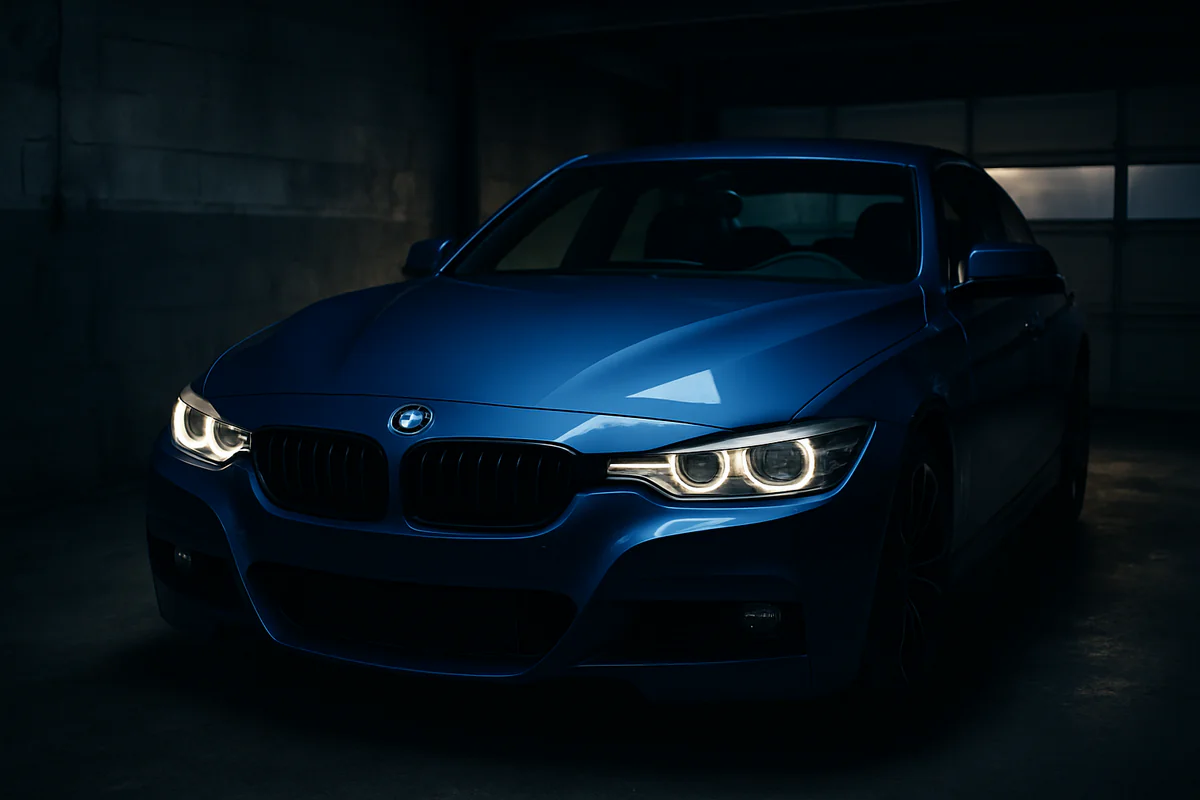
Ask someone why they love their BMW and they'll probably talk for twenty minutes. Ask a non-BMW person why BMW owners love their cars and you'll get a smirk and something about turn signals. Both reactions are, honestly, pretty accurate.
The brand has this strange gravitational pull that goes well beyond the vehicle itself. People don't just own BMWs - they track them, modify them, argue about chassis codes on forums at midnight, and display them like art. Understanding why requires looking at a few different things at once: how the car actually feels to drive, how the company positioned itself over decades, and what happens to a person once they fall into the community.
The "Ultimate Driving Machine" thing is not just marketing
BMW started using that tagline in 1974 and it stuck because the cars earned it - at least for a while. The rear-wheel-drive layout, 50/50 weight distribution, and relatively communicative steering gave BMW sedans a responsiveness that front-wheel-drive competitors genuinely couldn't match at the time. A well-set-up 3-series from the late '90s or early 2000s would telegraph road texture through the wheel in a way that felt almost old-fashioned, which turned out to be the point.
Driving enthusiasts tend to want feedback from a car, not isolation from it. BMW understood that and engineered specifically to that preference for years. The E46 3-series - built from 1998 to 2006 - is still held up as the benchmark by a lot of people who drove one and then spent the next decade trying to find something that felt as good. Some of them just bought another E46.
And that's where the obsession starts. One good driving experience at a formative age, and certain people are basically locked in.
Chassis codes and the language of belonging
One thing outsiders find baffling is how BMW fans talk. The E30. The E46. The F80 M3. These are internal BMW chassis codes, not model names, and using them correctly is a form of fluency that signals real knowledge. Someone who says "I have a 3-series" is a BMW driver. Someone who says "I picked up a clean E30 325i" is a BMW person. The distinction matters to the community.
It's similar to how vinyl collectors talk about pressings or sneakerheads know production years. The specificity is the point. It filters for people who actually care.
The E30 (1982-1994) gets particular reverence because it was light, simple, and available with a proper inline-six. The E46 is idolized for its balance. The E39 5-series, from the late '90s, is frequently called one of the best-looking sedans ever made by people who sound very serious when they say it. Each generation has its defenders, and the arguments about which era was best keep forums alive years after the cars are out of production.
BMW has made this somewhat complicated by transitioning to an alphanumeric chassis system (F-series, G-series), which some older fans find less romantic. Whether that's meaningful criticism or just nostalgia is genuinely hard to say.
M division - the serious part
BMW Motorsport GmbH - everyone just calls it M division - was set up in 1972 primarily to handle racing. The road cars it started producing were essentially racing derivatives wearing street clothes, built in small numbers with serious engineering attention. The original M1 supercar, the E28 M5 from 1985 (which was, at the time, the fastest production sedan in the world), the E30 M3 built to homologate a touring car racer - these weren't badge-engineered performance trims. They were distinct machines.
That heritage means M-badged cars carry real weight in the community. An M3 or M5 owner isn't just buying a faster car - they're buying into a lineage that serious driving enthusiasts actually respect. The current G80 M3 is faster than any previous M3 by a significant margin. Whether it's as characterful is a whole other conversation, one that BMW forums have been having at high volume since it launched.
The M division mystique also extends to people who will never own an M car but still care deeply about what those cars represent. They set the standard that justifies taking the whole brand seriously.
The reliability jokes (we're not pretending they don't exist)
BMW ownership culture has a self-deprecating streak that is, genuinely, one of its more endearing qualities. The jokes about German electrical gremlins, VANOS issues, cooling system failures on the M54 engine, and the running cost of anything with an M badge are told most enthusiastically by the owners themselves. There's a certain pride in accepting the trade-off.
This is probably a real psychological thing. If you love driving a car enough to put up with its expensive quirks, that love feels more legitimate than if it were trouble-free. The commitment is the proof. It also creates genuine community bonding - shared suffering is a social glue, and "the coolant expansion tank blew again" is a sentence that BMW owners say to each other with a kind of weary camaraderie that is hard to explain to people who drive Camrys.
None of this means the reliability concerns are imaginary. Modern BMWs, especially post-2010 models, have improved considerably, but the reputation lingers and some of it is still earned. The community just decided a long time ago that this is part of the deal.
Meets, forums, and what happens after you buy one
BMW clubs and meet-up culture are genuinely well-organized compared to most marques. The BMW Car Club of America has been running since 1969. Regional chapters do track days, autocross events, driving tours. The European delivery program - where you take possession of your car at the factory in Munich and drive it around Europe before it's shipped home - has its own devoted following of people who've done it multiple times.
Online, the community is dense. Bimmerforums, E46Fanatics, and a dozen subreddits mean that whatever strange problem your car has developed, someone has documented it in exhaustive detail including part numbers and torque specs. This matters practically, but it also keeps people engaged with the brand in a way that pure reliability would actually undermine. If the car always fixed itself, you'd never need the community.
And the aesthetic side of it spills into everyday life too. People who are deep in BMW culture tend to want the cars around them visually even when they're not driving. There's a whole world of prints and artwork around specific models and eras - things like BMW wall art and gift collection pieces that actually look good rather than just being merch - and that's a reasonable signal of how far the identity piece goes.
Anyway - the real answer to why people love BMW is that the first one they drove did something to their brain that stuck. The community, the chassis codes, the M division history, the forums - all of that is infrastructure that formed around an experience that was hard to forget. Some brands sell transportation. BMW, at its best, sold something that felt like it was worth caring about. People responded accordingly, repair bills and all.