
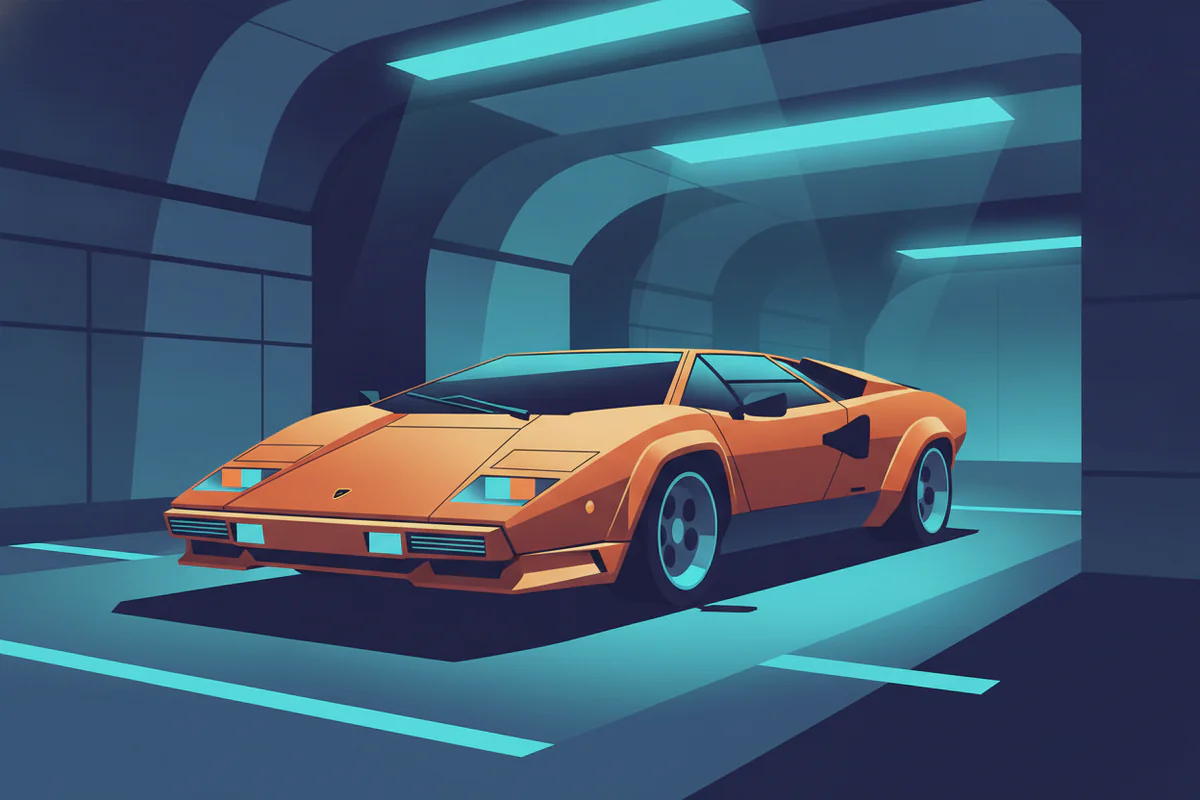
The car brand that treats restraint as a failure
Most car manufacturers eventually learn to dial things back. Aerodynamic compromises get smoothed out for fuel economy, wild concepts get watered down before production, and design teams get overruled by cost accountants. Lamborghini has spent roughly sixty years refusing that trajectory, and the Lamborghini brand identity philosophy is more or less built on that single refusal.
The Countach came out in 1974 with lines so aggressive that automotive journalists spent years arguing about whether it was beautiful or absurd - as if those were opposites. The Diablo pushed it further. The Murcielago further still. And then the Aventador arrived looking like something a military contractor designed after a fever dream, and people lost their minds all over again. Each generation, the temptation to mature, to settle, to produce something more palatable must have been enormous. They didn't take it.
Where it actually started
There's a version of this story that gets told as mythology - Ferruccio Lamborghini, tractor magnate, tells Enzo Ferrari his clutch is defective, gets dismissed, and decides to build his own sports car out of spite. It's a good story and it's roughly true, but the spite theory undersells what actually happened after 1963.
The early Sant'Agata engineers, particularly Gian Paolo Dallara and Paolo Stanzani, were genuinely trying to out-engineer Ferrari on a technical level first. The 350 GT was fast but relatively conventional-looking. What shifted things permanently was hiring Marcello Gandini at Bertone to design the Miura in 1966. Gandini was 27. The Miura looked unlike anything road-legal, with its mid-mounted transverse V12 and bodywork that seemed to have been drawn by someone who had decided that proportion rules were suggestions. It became the template for what a supercar was supposed to look like, and Lamborghini has been chasing that same feeling of "this shouldn't work but it does" ever since.
Excess as a genuine strategy, not just showmanship
Critics have sometimes framed Lamborghini's extremity as marketing theatrics - a way to get attention in a crowded field by simply being louder. That reading misses something. The decisions that look the most theatrical often reflect a real engineering philosophy about what driving a supercar should feel like, which is specifically: overwhelming.
The Aventador's naturally aspirated 6.5-litre V12, kept in production until 2022 despite every trend pointing toward downsized turbocharged units, is the clearest example. On pure numbers, a smaller turbocharged engine can match the power output. But the sound, the throttle response, the way the car builds to its 8,500 rpm redline - none of that transfers. Lamborghini held onto that engine for a decade longer than was financially logical because abandoning it would have meant admitting that efficiency mattered more than experience. That's a brand identity call, not an engineering one.
The Urus is worth addressing here, because it looks like the obvious counterexample - a practical, profitable SUV from a company that was supposed to be above such things. But even the Urus was made with a 641-horsepower twin-turbo V8 and a body designed to look vaguely threatening in a school pickup line. They compromised on format and refused to compromise on character. Whether that worked depends on your tolerance for SUVs, but the internal logic is consistent.
What "sensible" rivals actually look like in comparison
Ferrari's modern lineup, for all its brilliance, has progressively embraced hybrid systems, more refined interiors, and designs that reward longer acquaintance rather than immediate shock. The SF90 Stradale is a technical marvel that most people walking past it on the street might mistake for an expensive sports car rather than a 986-horsepower hypercar. That's a choice Ferrari made intentionally, and it produces world-class cars - but it's the opposite of the Lamborghini instinct.
McLaren has gone even further toward engineer-brained restraint: minimal visual drama, optimized everything, a driving experience calibrated within an inch of its life. Again, excellent cars. But nobody hangs a McLaren poster on their teenage bedroom wall. And there's something to that - the brands that have consistently inspired the most fervent, almost irrational attachment tend to be the ones willing to look excessive, even if that means looking slightly ridiculous to the wrong audience. Fans of the Lamborghini brand identity philosophy will tell you that being ridiculous to the wrong people is basically the point.
If you want a sense of why this visual intensity translates beyond the cars themselves, the Lamborghini wall art collection shows how well these shapes hold up as pure images - the angular bodywork and aggressive stances work as art in a way most car designs don't.
The Revuelto and whatever comes after
The Aventador's replacement, the Revuelto, is a hybrid - which caused predictable handwringing among purists. But the hybrid system was added to increase power to 1,001 horsepower and improve throttle response, not to add a meaningful electric range or lower emissions in any practical sense. The V12 stayed. The noise stayed. The gearbox is still a sequential single-clutch unit rather than the smoother dual-clutch that every competitor uses, because Lamborghini's engineers apparently decided that a slightly more violent gear change was more honest to what the car is.
That's a small detail, but it's the kind of detail that shows the philosophy running all the way through the organization rather than sitting in a marketing brief somewhere. Plenty of brands have "brand values" written on walls in their headquarters that have no relationship to actual product decisions. The Lamborghini version seems to genuinely influence what gets built.
Whether this remains viable as the industry moves toward electrification is a real question. A fully electric Lamborghini will face an identity problem that the Urus and the Revuelto didn't - you can add hybrid systems without losing the V12, but you can't add a V12 to a battery. The company has said its first pure EV will arrive by 2028, and how they handle that transition will say more about whether the philosophy is structural or just circumstantial than anything else they've done. My instinct is they'll find a way to make it unnecessarily extreme. That tends to be their answer to most problems.