
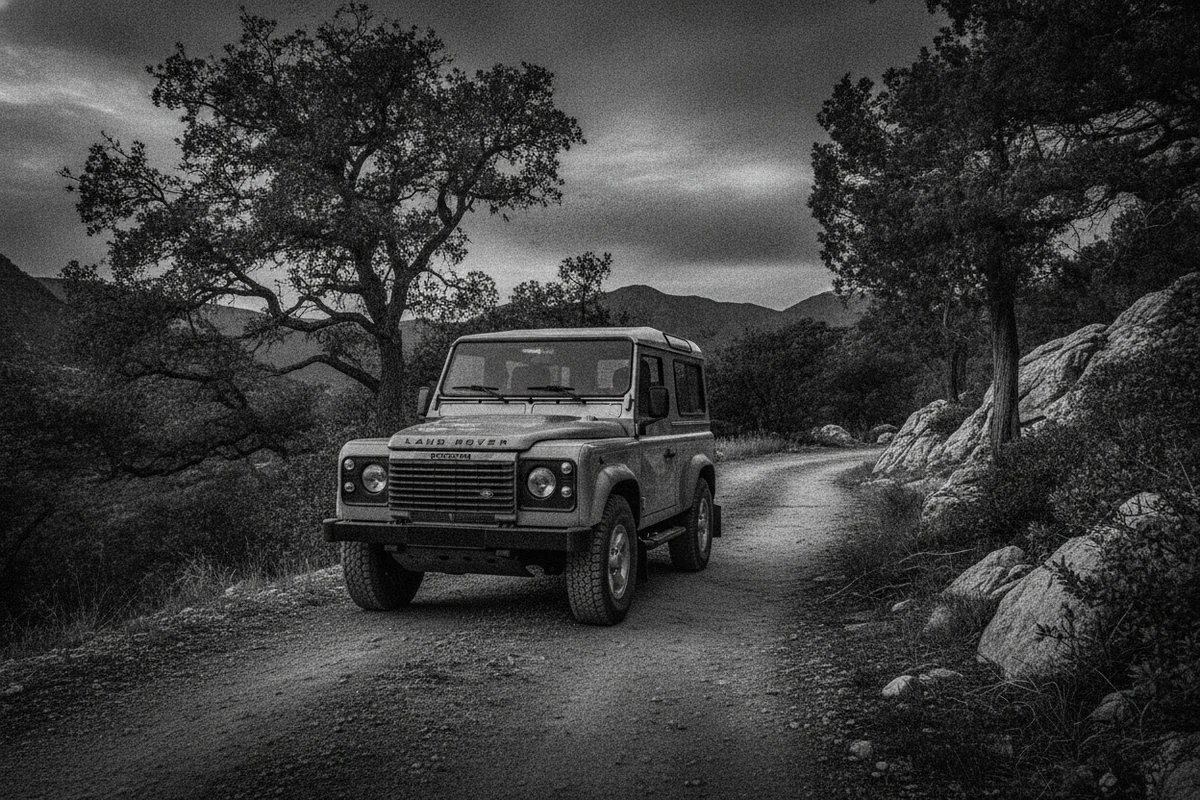
Ask a Defender owner when they plan to sell, and most of them will give you a look. Not hostility - more like you've asked something that doesn't quite compute. The truck sitting on their drive has usually been there for years, sometimes decades, and the idea of replacing it with something else rarely gets serious consideration.
Land Rover Defender owner loyalty is one of those things that automotive journalists mention but rarely explain properly. So here's an attempt at actually explaining it.
The capability thing is real, but it goes further than spec sheets
Every manufacturer claims their 4x4 can go anywhere. The Defender is one of the handful that made you believe it before the marketing department existed to tell you so. The Series I launched in 1948 was designed for farmers and the military, people who needed a vehicle that would keep working in conditions that would strand anything else. That original brief never really changed - the ladder frame, the high ground clearance, the short overhangs that let you pick your line on a rocky descent. When Land Rover finally stopped making the original Defender in January 2016, the basic architecture still traced back to 1983.
Owners will tell you about river crossings in Scotland, about sand driving in Morocco, about pulling caravans out of waterlogged fields for strangers. These aren't fantasies - Defenders genuinely go places that require a recovery plan if you take anything else. That experience bonds a person to a vehicle in a way that a comfortable motorway cruiser simply can't replicate. When your truck has helped you out of a genuinely bad situation, you don't forget it.
The design that refused to move
Between roughly 1983 and 2016, the visual change to the Defender was minimal. A revised grille here, a different badge there, a mild facelift in 1990. The slab sides and the external hinges and the square headlights stayed. At the time some people found this embarrassing - automotive journalists would note, usually with some exasperation, that the interior felt like a tractor and the refinement was somewhere below a budget hatchback.
But here's the thing: owners didn't care, and that indifference eventually became pride. The Defender aged into an icon precisely because it didn't chase trends. By the late 2000s, when every other SUV had been smoothed into a rounded blob of cladding and chrome, the Defender looked exactly like itself. Unmistakable at a glance. There are very few vehicles you can say that about.
That consistency also meant something practical. A mechanic who knew a 1990 Defender could largely figure out a 2010 one. Parts crossed over. There was a community of knowledge built up over generations of owners who had fixed the same problems on the same vehicles and documented all of it. That depth of support is genuinely rare.
The community that forms around it
Defender owners tend to find each other. There are clubs across the UK, Europe, and North America that organise trips, share technical knowledge, and meet up at events like the Billing Aquadrome show - which has been running for over 40 years and draws tens of thousands of people. This isn't small-scale. It's a proper subculture, and it keeps people in the vehicles because selling the Defender would mean, in a small but real way, stepping back from that world.
Some owners go deep into modification - Defender prints and artwork are a genuine corner of the enthusiast market, which tells you something about how far this extends beyond just driving. People build their identity around these trucks. That's unusual. Most car owners don't name their vehicles or photograph them at golden hour on a hillside, but Defender owners often do.
Then the new one arrived, and opinions split hard
Land Rover revealed the new Defender - the L663 - at Frankfurt in 2019, and the reaction among existing owners was complicated in a way that corporate launch coverage didn't fully capture.
On paper, the new truck is a serious achievement. Genuine off-road ability, a stiff monocoque that outperforms the old body-on-frame in almost every measurable way, proper wading depth, configurable air suspension. The 2020 Defender received strong reviews, and it sells well. But a lot of people who owned the original version looked at it and felt something was missing.
The complaint wasn't purely about aesthetics, though that was part of it. The new Defender is large, expensive, and technologically complex in ways that make home maintenance difficult. The original's simplicity - the thing you could fix in a field with a basic toolkit - is largely gone. Prices for the new 110 start around £55,000 and climb quickly from there, which puts it in a different conversation entirely from a working vehicle.
And the design, while clearly referencing the original's squared-off proportions, reads to some long-term owners as a premium reinterpretation rather than a continuation. Which is probably what it is. Land Rover made a calculated decision to move the Defender upmarket, toward the Range Rover buyer who wanted off-road credibility as part of the package. That's a legitimate choice. But it left a gap where the original used to sit.
Predictably, values for pre-2016 Defenders went upward. A clean 110 in good condition that might have sold for £12,000 in 2015 can comfortably reach £25,000-£35,000 now, and earlier Series vehicles trade for significantly more. The old owners who were thinking about selling decided to keep them. New buyers looked at the appreciation and started treating them as investments. It created a feedback loop.
What actually holds people
When you talk to long-term Defender owners - and I mean people who've had one for ten-plus years - the loyalty comes down to something harder to measure than off-road ratings. It's the accumulated history with a specific machine. The modifications they've made over the years, the places it's taken them, the repairs they've done themselves or with help from someone they met at a show. The truck becomes a record of experiences in a way that a more anonymous vehicle simply doesn't.
There's also a stubbornness to it that feels honest. Defender owners generally know the vehicle's faults better than anyone. They know about the leaks and the rust and the wind noise and the questionable electrics on later models. They'll tell you about all of it, usually with some affection. That's different from the blind loyalty some brands inspire. It's more like the relationship you have with something genuinely imperfect that has never let you down when it mattered.
That combination - real capability, real history, real community - is hard to walk away from. Which is why most owners don't.