
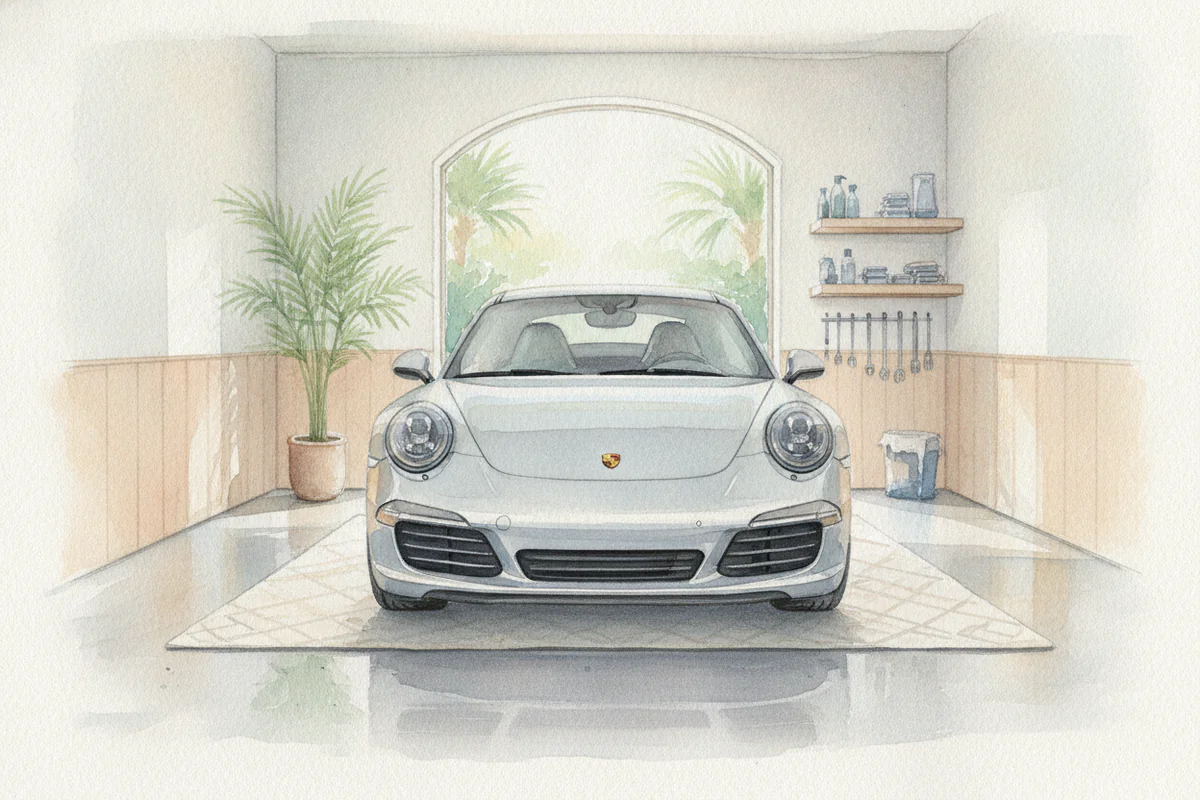
Spend ten minutes in any Porsche forum, Facebook group, or trackday paddock and you'll notice something: these people talk about their cars in a very specific way. Words get repeated. Certain phrases appear almost like sacred text. And there's a seriousness underneath it that you don't always find with, say, a Mustang club or even a Ferrari owner.
This isn't accidental. Porsche ownership culture has developed a vocabulary over decades, and understanding that vocabulary tells you a lot about what these cars actually mean to the people who buy them.
The phrase "everyday supercar" and why it matters
Ask a Porsche 911 owner what their car is and there's a reasonable chance they'll say something like "it's an everyday supercar" without a trace of irony. They mean it literally. The 911 has a rear luggage shelf, decent visibility, a front trunk that fits carry-on luggage, and a ride stiff enough to feel the road without beating you up on a commute. People genuinely drive them to work, then to the track on Saturday.
This concept - usability as a virtue, not a compromise - is almost unique to Porsche among the prestige performance brands. Ferrari owners rarely position their cars as practical. Lamborghini owners certainly don't. The whole appeal of those cars is partly how impractical they are, how much attention they demand, how theatrical the experience is. Porsche owners tend to find that framing slightly embarrassing. They'd rather tell you about luggage capacity.
The "everyday supercar" phrase also does something subtle: it lets owners feel they're getting away with something. They're not buying frivolous machinery. They're buying a fast car that happens to also be sensible. Whether or not that justification is entirely honest is another question - but it's a genuinely different psychological relationship to the purchase than you see elsewhere in this segment.
The flat-six sound, and how owners describe it
No single mechanical detail gets discussed more obsessively in Porsche circles than the air-cooled flat-six - and even among water-cooled 911 owners post-1999, the engine note remains a kind of benchmark that everything gets measured against. People don't just say "it sounds good." They say it has a mechanical rawness, a raspy top-end, a particular note at 6,500 rpm that newer turbocharged cars have softened or lost.
You'll hear the phrase "the sound of a flat-six" used as shorthand for an entire set of values: analog feel, driver connection, reward for revving. It's become almost poetic in Porsche circles. GT3 buyers talk about the naturally aspirated engine with the same reverence that audiophiles reserve for vinyl records. And the people who track their 992 GT3s will tell you - with genuine passion - exactly what the car does between 4,000 and 9,000 rpm, in that order, with specifics.
Compare this to how, say, a muscle car owner might describe their engine. Horsepower, torque, quarter-mile times. Those are real measures of performance and there's nothing wrong with caring about them. But the Porsche conversation is almost never about those numbers first. It's about feel. Sound. The sensation of the car communicating with you through the steering wheel.
The 911 as a daily driver - a point of pride, not a compromise
There's a specific pride that Porsche 911 owners take in using their cars as primary transport. Not weekend cars. Not show cars. Actual daily drivers. You'll see this mentioned constantly: "I drive mine every day, rain, highway, everything." For some owners this is almost competitive - a signal that they bought the car to drive it, not to keep it pristine.
This connects to something real in the 911's design history. Ferdinand Porsche's original concept involved a car that could handle the Autobahn on Monday and a rally stage on Sunday. That dual-use DNA got baked in early and the culture around the car still reflects it. When Porsche engineers talk about the 911, they mention NVH levels that allow comfortable long-distance touring alongside lap times that beat purpose-built sports cars. Both things matter. Both things are part of the point.
Other performance car communities do celebrate daily drivers, obviously - this isn't exclusive territory. But in Porsche circles there's a slightly disapproving attitude toward people who baby their cars, who won't drive in rain, who trailer to the track rather than drive there. Driving it is considered proof of respect, not risk. Anyway, that might sound precious from the outside, but it does produce owners who actually know their cars deeply because they spend real time in them.
Trim level literacy as a social currency
Walk into a conversation between two 911 owners and within two minutes you'll hear model designations rattled off with an ease that borders on fluency: Carrera, Carrera S, Targa 4S, GT3, GT3 RS, Speedster, Sport Classic. Each suffix carries meaning - engine size, drivetrain, suspension tune, weight, production volume. Knowing these distinctions and their implications signals membership in the community.
The Porsche wall art and gifts you see in owners' garages and home offices often reflects this too - people tend to choose specific models, specific eras, not just "a Porsche." That level of specificity is itself a tell. It's not brand loyalty in the abstract; it's model-by-model conviction.
This literacy extends to the used market. Porsche owners talk knowledgeably about IMS bearing issues on early 997s, about which production years had which updates, about the value of matching-numbers cars versus modified examples. The conversation is detailed in a way that requires real investment of time to participate in.
Why the culture feels slightly different from the inside
If you ask most Porsche owners what draws them to the brand over, say, a faster car for the same money, they'll eventually circle back to something intangible: engineering philosophy. The sense that every decision in the car has a reason, that the reason is usually performance-related, and that the engineers who made those decisions probably drove the car themselves. Whether this is entirely accurate is debatable - Porsche is a corporation, not a monk's workshop - but the belief is widely held and shapes how owners relate to their cars.
This produces owners who are interested in the engineering, not just the result. Who read about development decisions. Who notice when a new model has changed a component and have opinions about whether that's progress or drift. It's a more analytical relationship than you often see in performance car culture, which tends to reward spectacle. Porsche ownership culture rewards knowing things.
That might be why the vocabulary sounds different. These owners have spent real time learning the language of the cars, and the cars have given them enough to talk about to keep the conversation going for decades.