There is something quietly strange happening in an era of same-day delivery and read receipts. People are buying stamps again. Not ironically, not as a novelty - they are actually mailing postcards to friends, family, and sometimes strangers across the country. The physical postcards comeback trend has been building for a few years now, and it is worth looking at what is actually behind it, because it is not nostalgia alone.
What changed (and what did not)
Postcards never fully disappeared. You could always find a spinning rack of them at gas stations near national parks, or in airport gift shops next to the overpriced candy. But for a long time, buying one felt like a performance of being a tourist rather than a genuine way to communicate. You bought it, maybe wrote a few words on it, then forgot to mail it until you were already home.
What shifted is how people feel about their phones. There is a growing, low-grade exhaustion with digital communication - not enough to make anyone delete their apps, but enough to make a handwritten card feel like a genuine gesture instead of extra effort. A text disappears into a feed of hundreds of other texts. A postcard sits on someone's kitchen counter for three weeks.
That staying power is a big part of the appeal. People are increasingly aware that physical objects occupy space in a way that a screenshot never will.
The slow-mail movement, briefly explained
Slow mail is exactly what it sounds like: correspondence that takes days to arrive and requires you to think, even briefly, before sending it. It shares some DNA with slow food and slow travel - the idea that friction is not always a bug. The delay is the point. You write something, put it in a mailbox, and then it is out of your hands. There is a finality to that which feels almost relieving.
Communities around pen pals and postcard exchanges have grown steadily on platforms like Reddit and Instagram. The subreddit r/penpals has over 600,000 members. Postcrossing, a site that connects strangers to exchange postcards internationally, has facilitated over 70 million cards since it launched in 2005 - a significant chunk of that traffic came in the last few years. These are not huge numbers by social media standards, but they represent a real and growing behavior.
Why postcards specifically, not letters
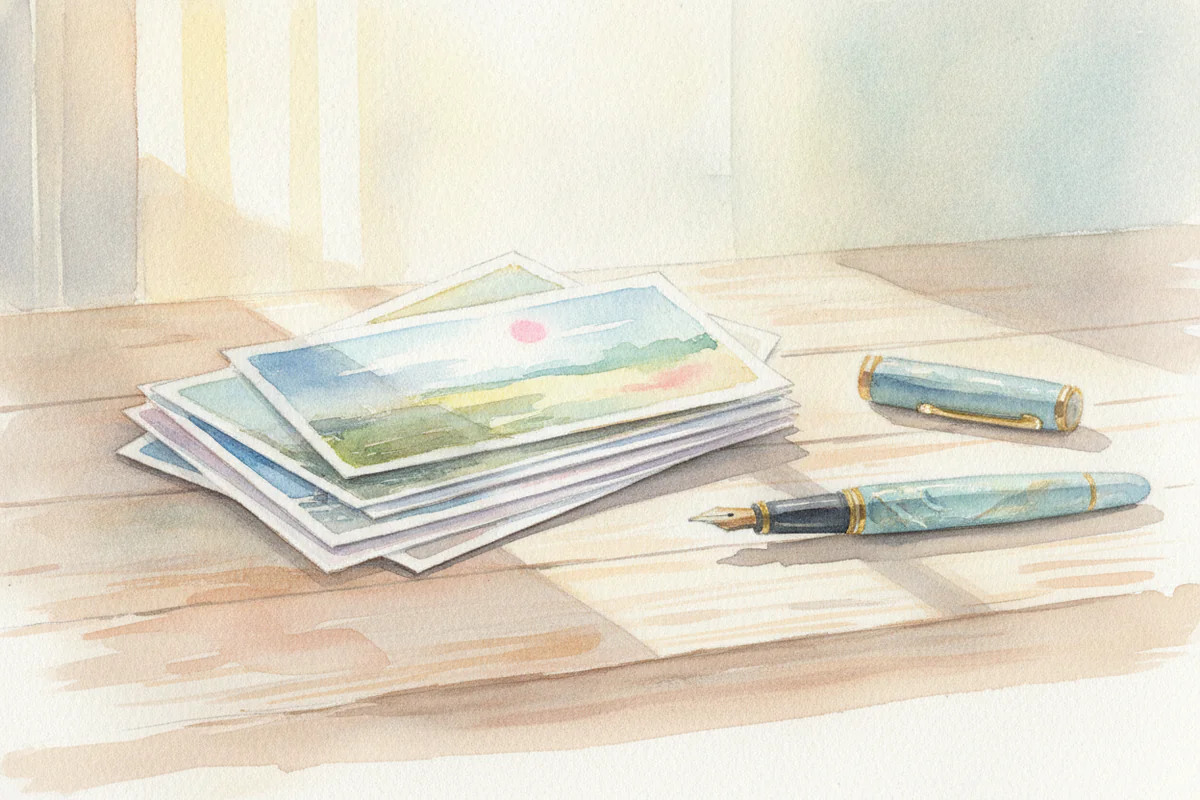
Letters take more time and feel higher-stakes. A postcard has a built-in constraint: you have maybe six lines of usable space, and the image does half the communication for you. That low barrier matters. People who feel anxious about writing "enough" or saying the right thing find the postcard format forgiving. You pick an image that says something, you add a few sentences, done.
And the image side is doing more work than it used to. People are moving away from generic tourist shots toward cards that actually reflect something personal - a specific painting they love, a photograph from a trip that meant something, an art print that looks like it belongs on a wall rather than in a spinner rack. Which is, anyway, part of why art print shops have started seeing postcards as something worth taking seriously again.
The keepsake factor
Ask someone if they have kept old birthday cards and most will say yes, even if they feel a little embarrassed about it. Physical things accumulate meaning in a way that is hard to replicate digitally. A postcard someone sent from Portugal in 2019 is a physical record of a friendship at a specific moment in time. You can pin it to a board, tuck it in a book, tape it to a mirror.
This is the part of the trend that connects to the broader interest in tangible keepsakes - printed photos, scrapbooking, physical photo albums. After years of storing everything in the cloud, a lot of people are printing things again. Postcards fit neatly into that impulse because they are already formatted for display. They are small enough to go anywhere and sturdy enough to last.
What people are actually sending
The content has shifted noticeably. Travel postcards still exist, but a lot of people are now sending cards just because - no trip required. Someone sees an art print they think a friend would love, and instead of texting a screenshot, they order it as a card and mail it. Some people send them as low-key ways to check in on someone going through a hard time, because a text feels too small and a letter feels too large.
There is also a growing practice of sending postcards as thank-you notes, which is a smart move honestly - it is more memorable than an email and less formal than a handwritten letter. And for people who travel, actually mailing postcards from the destination has come back around. Part of that is a reaction against the travel-content cycle on social media, where everything becomes content for an audience. A postcard goes to one person. That feels different.
If you are looking for cards worth actually sending - images that hold up as something the recipient might pin to their wall rather than throw away - art postcards printed on quality stock are worth a look. The image matters more than people think when the whole point is that the card sticks around.
Is this trend going to last
Probably not at the same intensity - these things tend to find a floor rather than sustain a peak. But the underlying reasons people are drawn back to physical postcards are not going away. Screen fatigue is real and is not getting better. The desire to give someone something they can hold is not new, and it is not going to be solved by a better messaging app.
What the current moment has done is remind a lot of people that sending a postcard is actually easy. You do not need a special occasion. You do not need to be somewhere exotic. You just need something worth looking at and a few honest sentences. That is a low bar, which is probably why more people are clearing it.