A car that made Maranello nervous
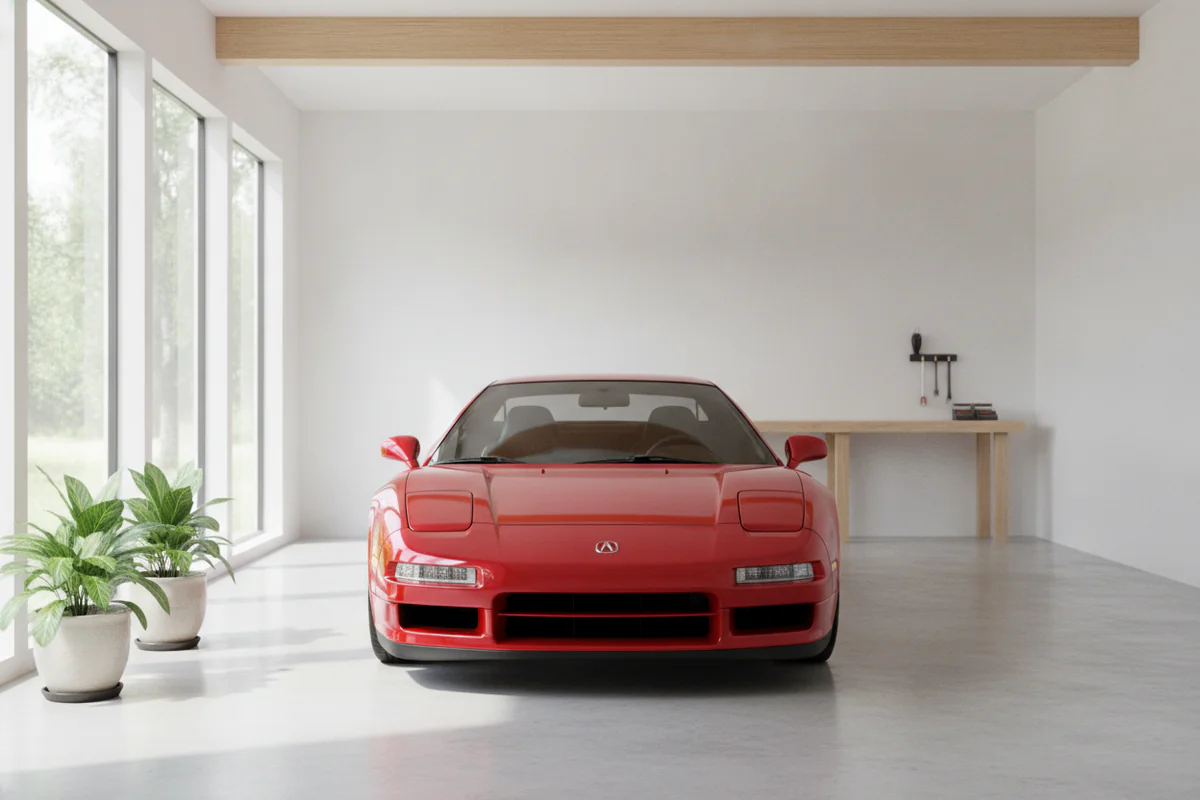
When Honda unveiled the NSX at the Chicago Auto Show in February 1989, the reaction from Ferrari's engineers was not dismissal - it was concern. The story that circulates, and which has enough sourcing behind it to be credible, is that Luca di Montezemolo walked into Ferrari's development department not long after and told them to do better on reliability and daily usability. A Japanese manufacturer had just called Ferrari's bluff on what a mid-engine supercar was supposed to be.
That's a remarkable thing to happen. Ferrari had decades of mystique, a racing pedigree most brands can only dream about, and a customer base that treated inconvenience as part of the charm. Honda, with the NSX, quietly argued that none of that inconvenience was actually necessary.
Where Ayrton Senna fits in
The development story of the original NSX is bound up with Senna in a way that goes beyond marketing. Honda's relationship with the Brazilian driver was already deep by the late 1980s - he was winning championships in Honda-powered McLarens, and the company genuinely valued his feedback. So when the NSX prototype went to the Nurburgring for testing in 1989, Senna drove it.
His assessment was direct. The chassis was too stiff in the wrong places, the car communicating road imperfections as harshness rather than information. He reportedly said the steering needed more feel and the suspension more compliance if the car was going to be honest with its driver. Honda listened and revised the chassis before production. That's not a typical celebrity endorsement situation - that's a racing driver actually influencing the engineering outcome of a road car.
What resulted was a car with aluminum monocoque construction (a first for a production car at the time), double-wishbone suspension front and rear, and a 3.0-liter VTEC V6 producing around 270 horsepower. Not wild numbers for a Ferrari competitor, but the point was never raw output.
The usability argument
Ferrari's cars in the late 1980s and early 1990s were spectacular and temperamental in roughly equal measure. The 348, which arrived the same year as the NSX, was criticized for oversteer that could genuinely catch drivers out, throttle-on handling that required real skill to manage, and the usual Italian supercar rituals around starting, warming up, and maintenance intervals.
The NSX started every time. The air conditioning worked properly. It could sit in traffic. The visibility was good enough that you didn't need a spotter to park it. And yet it still did 0-60 in under six seconds, handled with a precision that journalists kept reaching for superlatives to describe, and sounded - with that VTEC engine climbing through its rev range - genuinely exciting.
Gordon Murray, who designed the McLaren F1, called it the best sports car in the world. That quote got around.
For a lot of buyers, particularly in the United States, this was exactly the proposition they had been waiting for. You could use the NSX as a daily driver in a way that the Ferrari 348 simply didn't allow. And it held together. The reputation for reliability was earned, not assumed.
Why the acura nsx history ferrari rival framing still holds up
It would be easy to overstate the case - Honda didn't destroy Ferrari, obviously - but the influence ran in a specific and measurable direction. Ferrari's subsequent cars, beginning with the F355 in 1994, addressed almost everything the NSX had exposed. Better build quality, more manageable handling, improved ergonomics. The 348's successor was a much more polished machine, and automotive journalists at the time noted openly that the NSX had raised the standard Ferrari was being held to.
That's a legacy most cars never achieve. Influencing a competitor's product roadmap is about as real as automotive influence gets.
The cult that formed anyway
Production of the first-generation NSX ran until 2005, which is an unusually long run. Honda updated it modestly along the way - a six-speed manual replaced the earlier five-speed, power crept up slightly, some cosmetic changes - but the fundamental car stayed consistent. By the end of its run it was something of an anachronism, a naturally aspirated mid-engine sports car in a world increasingly chasing horsepower through forced induction and electronics. It didn't matter. The people who wanted one knew exactly what they were getting.
Today the original NSX sits in an interesting place in collector culture. Values have climbed significantly over the past decade. Clean first-generation cars, especially early Type R variants imported from Japan, regularly trade above $100,000. The combination of Senna's involvement, the Ferrari story, the genuine engineering achievement of the aluminum chassis, and the relative scarcity of well-kept examples has made the NSX exactly the kind of car that enthusiasts build whole identities around.
If you're that kind of enthusiast - someone who has a proper opinion on the VTEC engagement point or who knows the difference between the 1991 and 1995 suspension revisions - you probably already have some version of the NSX living on a wall or a shelf. There's good reason for that. Acura wall art and gifts tend to attract exactly the crowd that cares about this history, not just the badge.
The second-generation question
Honda brought the NSX nameplate back in 2017, this time as a hybrid supercar with three electric motors and a twin-turbocharged V6. It's a genuinely fast, genuinely sophisticated machine. It also never quite captured the same feeling, and Honda discontinued it in 2022 after modest sales. The reasons are debated endlessly in forums - pricing too high, styling too anonymous, the hybrid drivetrain too isolating, the competition too fierce by 2017 standards. Probably some of all of those things.
What the second-generation NSX didn't have was the original's specific context. In 1990, a Japanese manufacturer proving that supercars could be usable and reliable was a radical act. By 2017 that argument had already been won, by Porsche and others, and the NSX was arriving to a fight that was mostly over.
The original, though - the car that Senna shaped with his feedback on a cold Nurburgring morning, that made Ferrari engineers rethink their assumptions, that ran reliably for fifteen years while looking exactly like nothing else on the road - that one earned its reputation the hard way. It's the rare case of a car that actually changed something, not just competed in the same space as the cars it was chasing.