
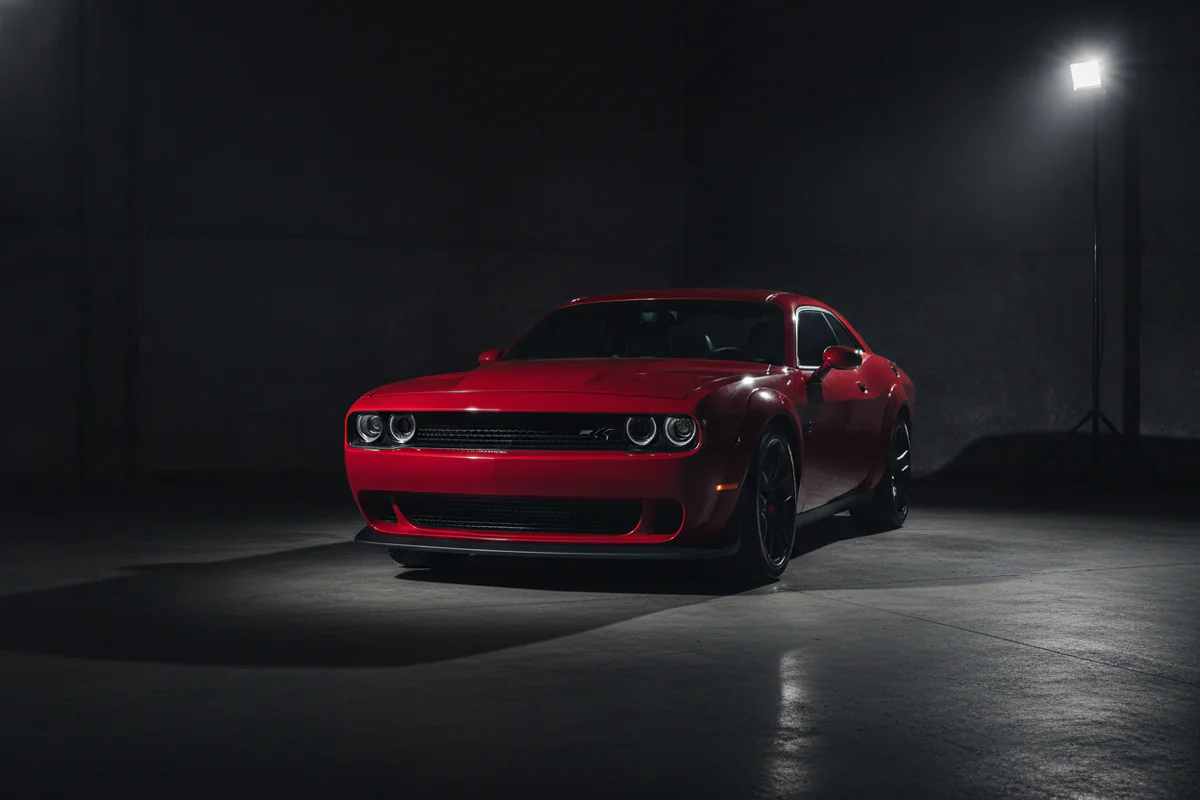
The Dodge Challenger ran until the 2023 model year on what was essentially the same basic platform it launched on in 2008, which itself borrowed heavily from a 2004 Mercedes-Benz architecture. That sounds like a liability on paper. A decade and a half of the same bones, the same wide hips, the same 70s-throwback face. But somewhere in that stubbornness, Dodge stumbled into something that neither Ford nor Chevrolet managed to hold onto: the last mainstream V8 muscle car standing in the American market in the way the genre originally meant it.
What "muscle car" actually means, and why it got complicated
The original definition is pretty simple - a large, rear-wheel-drive American coupe with a big V8 dropped in it, sold at a price ordinary people could afford. That was the Chevelle SS, the Road Runner, the original Challenger. The formula didn't require sophistication. It required displacement and attitude.
By the 2010s, Ford's Mustang had gone in a very different direction. The 2015 redesign was genuinely impressive engineering, with an independent rear suspension and eventually a 2.3-litre EcoBoost four-cylinder as the base engine. The Camaro followed a similar path - shrinking the exterior, improving the dynamics, chasing European sports car comparisons. Both are still great cars. But they stopped being muscle cars in the original, blunt sense of the term and became something more like American pony cars with real handling credentials. That's not a criticism. It's just a different thing.
Dodge kept making the Challenger wider. They made it heavier. They kept offering a 5.7-litre Hemi V8 as a mainstream option, not a premium one, and above it they stacked a 6.4, and above that a supercharged 6.2 in the Hellcat, and then they apparently got bored and built the 807-horsepower Redeye, and then the 840-horsepower Super Stock, and eventually the 1,025-horsepower Demon 170 as a final send-off. The engineering priorities were obvious and they were consistent throughout.
The retro styling decision that looked risky and aged well
When the 2008 Challenger came out, plenty of automotive writers called the design lazy. Dodge had basically looked at the 1970 original and traced it. The long hood, the wide rear haunches, the nearly vertical rear window, the strake lines running back through the doors - it was all there, scaled up slightly for modern crash standards and lane widths.
The Mustang's 2005 retro redesign had done something similar, but Ford kept iterating aggressively away from it. The Challenger barely changed its face for 15 years. And what seemed like inertia turned out to be identity. You can identify a Challenger from a block away, from behind, from a parking garage photo taken at a bad angle. The car became a visual icon in a way that very few modern vehicles manage, partly because Dodge never got anxious about it and tried to modernize it into something blander.
There's a reason Dodge Challenger wall art has actual demand - the car photographs like something that belongs on a wall, because it was designed with that kind of deliberate visual weight. The proportions are almost cartoonishly correct for what a muscle car is supposed to look like.
While competitors went smaller, Dodge went the other way
Ford introduced the EcoBoost Mustang in 2015 and it was, honestly, a clever product decision - better fuel economy, still quick, easier to sell in markets outside the US. Chevrolet's turbocharged four-cylinder Camaro followed. Both companies were reading the regulatory environment and positioning for a future with tighter emissions standards and, eventually, electrification.
Dodge did not do this. The base Challenger kept the Pentastar 3.6-litre V6, which is a decent engine, but the car's character was never really about the V6. The Hemi V8 was the point. And Dodge kept selling it in volume while its rivals were treating V8s as increasingly exotic, increasingly expensive optionals.
This matters because muscle cars were always supposed to be accessible. A 1969 Road Runner started at around $2,900 - less than a Corvette, less than a 442, less than most things with comparable performance. The Challenger SXT started under $30,000 for most of its run, and you could get into a Hemi for somewhere in the mid-30s. The Hellcat was expensive, but it was also 717 horsepower. The value math was strange in the best way.
The electrification moment changed everything, retroactively
Dodge announced the end of the Challenger's production run and the forthcoming Charger Daytona EV in 2022. Whatever you think about the Daytona - and there are things to like about it, the exhaust sound simulation notwithstanding - it is a fundamentally different object. It's a four-door. It runs on batteries. It was designed to appeal to people who may not have previously considered Dodge at all.
That shift reframed the Challenger's entire final era in hindsight. Those last few years of Hellcat production, the Jailbreak packages that let buyers mix and match colors and stripes, the Demon 170 with its drag radials straight from the factory - all of that reads now as a deliberate, somewhat theatrical farewell. Dodge seemed to know exactly what it was doing, and the limited-edition final-year cars sold out almost immediately. The Demon 170 allocation was reportedly exhausted within hours of ordering opening.
Anyway - the point is that the nickname stuck because the circumstances made it literally true. The Camaro was discontinued after 2024. The Mustang went partly electric with the Mach-E, though the coupe carried on. The Challenger ended on a combustion engine making four-digit horsepower numbers. There's no other car in recent American production history that closes that chapter in quite the same way.
Why "last" might matter more than "true"
The "true muscle car" framing is always going to invite argument. Purists will say real muscle cars cost $3,000 in 1968 and weighed 3,400 pounds, and a $100,000 Demon doesn't qualify. That's a fair point. But the Challenger's legitimacy was never really about the halo models. It was about the fact that for 15 years, an ordinary person could walk into a Dodge dealership and buy a wide, loud, rear-wheel-drive coupe with a V8 engine and a Hemi badge, and nobody was trying to talk them into a turbocharged four-cylinder instead. That option just existed, plainly and without apology, longer than it did anywhere else.
That's what the nickname is really about. Not that the Challenger was the best muscle car ever made - it wasn't the most dynamically capable, and the interior took a long time to stop feeling like it was designed in 2007 because it largely was. It earned the label by being the most persistent. It stayed in the lane while everything around it moved.