
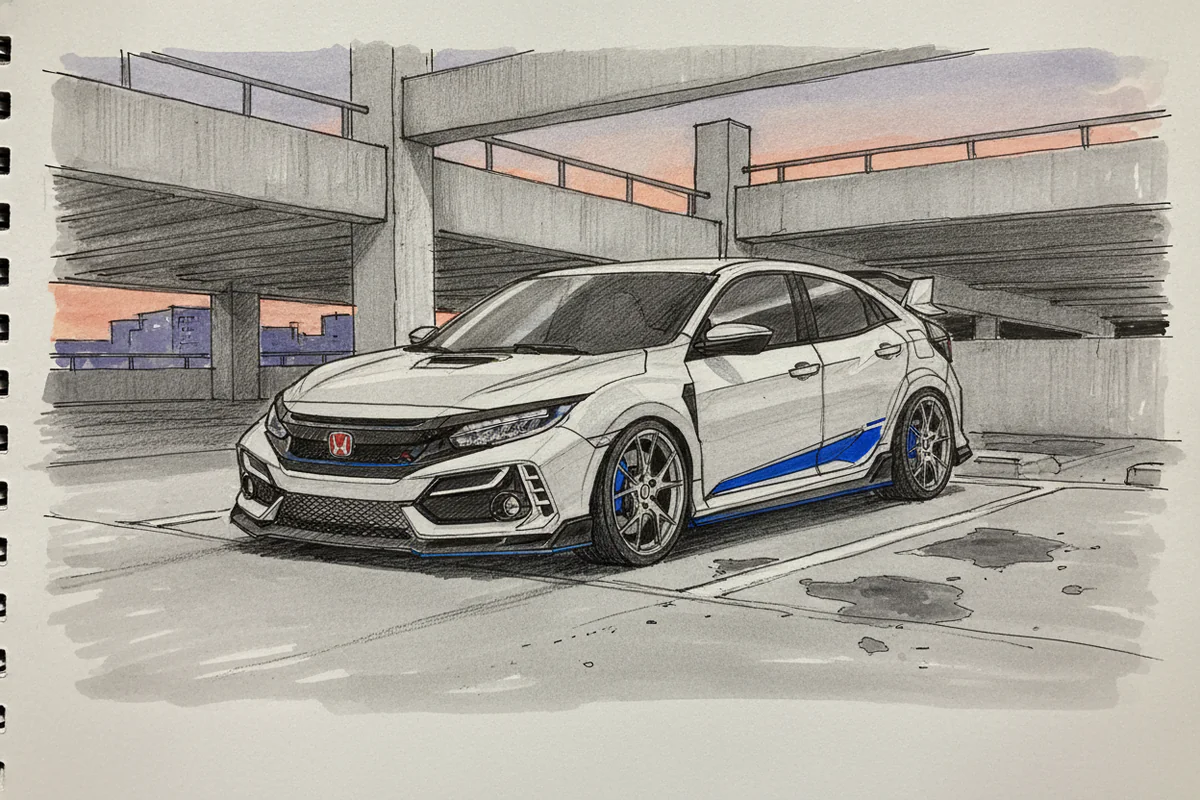
The Honda Civic has been sold as basic transportation since 1972. Cheap to run, easy to park, sensible insurance costs - on paper it reads like the last car a young enthusiast should fall in love with. And yet, for somewhere around three generations of people who got obsessed with cars, the Civic was the beginning of everything.
There's an actual reason for that, and it goes back further than the Fast and Furious franchise, further than the JGTC race series, further even than VTEC. It starts with Honda treating a small economy car like it deserved real engineering.
The platform that made modification make sense
The third and fourth-generation Civics from the mid-1980s through early 1990s established something important: the car was light, front-wheel-drive, and came with a family of interchangeable engines. Honda's modular approach to the D-series and later the B-series meant that swapping a more powerful engine into your hatchback wasn't some black magic operation - it was a documented procedure with a community of people who'd already done it and written down everything that went wrong. That's not nothing. For a teenager with $3,000 saved and a copy of a Honda-Tech forum thread printed out, that accessibility was everything.
The 1992-1995 EG hatchback in particular became a kind of blank canvas. It weighed under 2,200 pounds in base trim. Put a B16 or a B18 in it and you had a car that could embarrass much more expensive machines at an autocross event. People figured this out quickly.
VTEC and the mythology around it
Honda introduced VTEC - Variable Valve Timing and Lift Electronic Control - on the Integra in 1989, and it filtered into Civic engines not long after. The B16A that came in the JDM Civic SiR made 158 horsepower from 1.6 liters, naturally aspirated. In 1991. That number sounds modest now but it was genuinely shocking at the time, and the way the engine delivered power - building through the rev range and then hitting the VTEC crossover point around 5,500 RPM with an audible change in tone - gave young drivers something to talk about, show off, and endlessly debate on message boards.
The VTEC mythology got a little out of hand, obviously. The jokes wrote themselves and eventually the car culture internet ran them into the ground. But underneath the memes there was a real thing: Honda had built an engine that rewarded you for learning to drive it properly. You had to rev it. You had to understand the power band. That's an education in itself.
Price put it within reach
This part matters more than people like to admit in retrospective write-ups about car culture. The Civic was cheap to buy used, cheap to insure for a young driver, and the parts ecosystem was massive. A cracked bumper or a smashed tail light cost almost nothing to replace, because so many of them were on the road. Body kits, wheels, intakes, exhaust systems - by the late 1990s there was an entire aftermarket industry that had grown up specifically around Civics and Integras, which drove prices for those parts down further.
Compare that to getting into a sport compact from a European brand. Same era, much harder to source parts, much higher insurance premiums, fewer people around who'd already made the same mistakes you were about to make. The Civic's ubiquity was a feature, basically.
The import scene gave it cultural weight
Through the late 1990s and into the early 2000s, the import tuner scene in the United States pulled the Civic into full cultural territory. Magazines like Sport Compact Car and Turbo ran feature builds. The Super Street crowd brought JDM parts over that weren't officially sold in North America. Honda's racing heritage - Formula One wins, the NSX, the real touring car series results - gave enthusiasts something to point at when they wanted to explain why their econobox was worth taking seriously.
And then in 2001 the first Fast and Furious film put a blacked-out EK Civic hatchback on screen alongside Ferraris and Dodge Vipers, and the car's place in popular culture became permanent. That movie had problems as a realistic depiction of anything, but it also introduced an entire demographic to the idea that a Honda could be something worth caring about aesthetically and mechanically. That wasn't the start of Civic enthusiasm, but it was the moment it went mainstream enough to stick.
For people who wanted to display that enthusiasm beyond the garage - and plenty did - Honda wall art and gifts became one way to keep that connection visible at home, which tells you something about how deep the attachment runs.
Why the reputation has lasted through weaker generations
The Civic went through some rough years. The 2006-2011 generation is widely considered uninspiring, and the early 2010s models weren't exactly setting anyone's heart on fire either. Honda seemed to have drifted away from the people who'd made the nameplate mean something. And yet the enthusiasm never fully went away, partly because the used market kept the classic generations alive and accessible, and partly because Honda eventually course-corrected hard with the FK8 Type R in 2017 - a front-wheel-drive car that set a production car lap record at the Nurburgring and came with a Brembo brake package and 316 horsepower from a 2.0-liter turbocharged engine. That's not an economy car wearing a bodykit. That's Honda making an actual statement about what the Civic can be when they commit to it.
The current FL5 Type R continues that trajectory. The base Civic Sport still sells to people who'll never modify it. But the lineage that connects a 1992 hatchback with a B-swap to a modern Type R with track-tuned suspension is coherent and traceable, and a lot of the people buying new Civics today learned to care about cars through an older one.
What it actually gave people
The honda civic enthusiast history isn't really a story about one car. It's a story about accessibility meeting genuine engineering ambition. Honda built something affordable that also happened to reward mechanical curiosity, and the community that formed around that combination turned out to be durable. People who started with a cracked EG hatch at 19 are now in their 40s still paying attention to what Honda does next. That's a long feedback loop, and it started with a car that cost less than a used pickup truck.
Most economy cars don't get that. Most of them are driven until they stop and then forgotten. The Civic kept generating people who wanted to understand it, then modify it, then race it, then buy another one - and that cycle has been running for over thirty years without showing much sign of stopping.