Cat wall art for adults has a reputation problem. You search for it, you get pastel watercolors with Comic Sans captions, or some aggressively ironic "I work hard so my cat can have a better life" poster that was funny in 2014. Neither is hanging in your living room. But there's genuinely good cat art out there - prints that treat the subject like an actual visual subject instead of a punchline or a nursery decoration.
Why most cat wall art fails adults
The category skews toward gifts. Someone's buying for their aunt, they don't know what she likes, they see a cat, done. That buying pattern pulls the whole market toward safe and cute. The result is a ton of product designed to be inoffensive rather than interesting. If you actually want to live with something on your wall for five years, "inoffensive" is a terrible brief.
The other failure mode is the opposite - maximalist collector energy, six cats in Victorian clothes playing poker, that whole thing. Fine if that's your aesthetic. But it's not a universal solution.
What actually works as cat wall art for adults
Black and white photography is the easiest win. A cat caught mid-jump, or just sitting in window light with hard shadows - that's a legitimate photograph. It could be in a design magazine. The subject happens to be a cat, but the image is doing real compositional work, not just being cute.
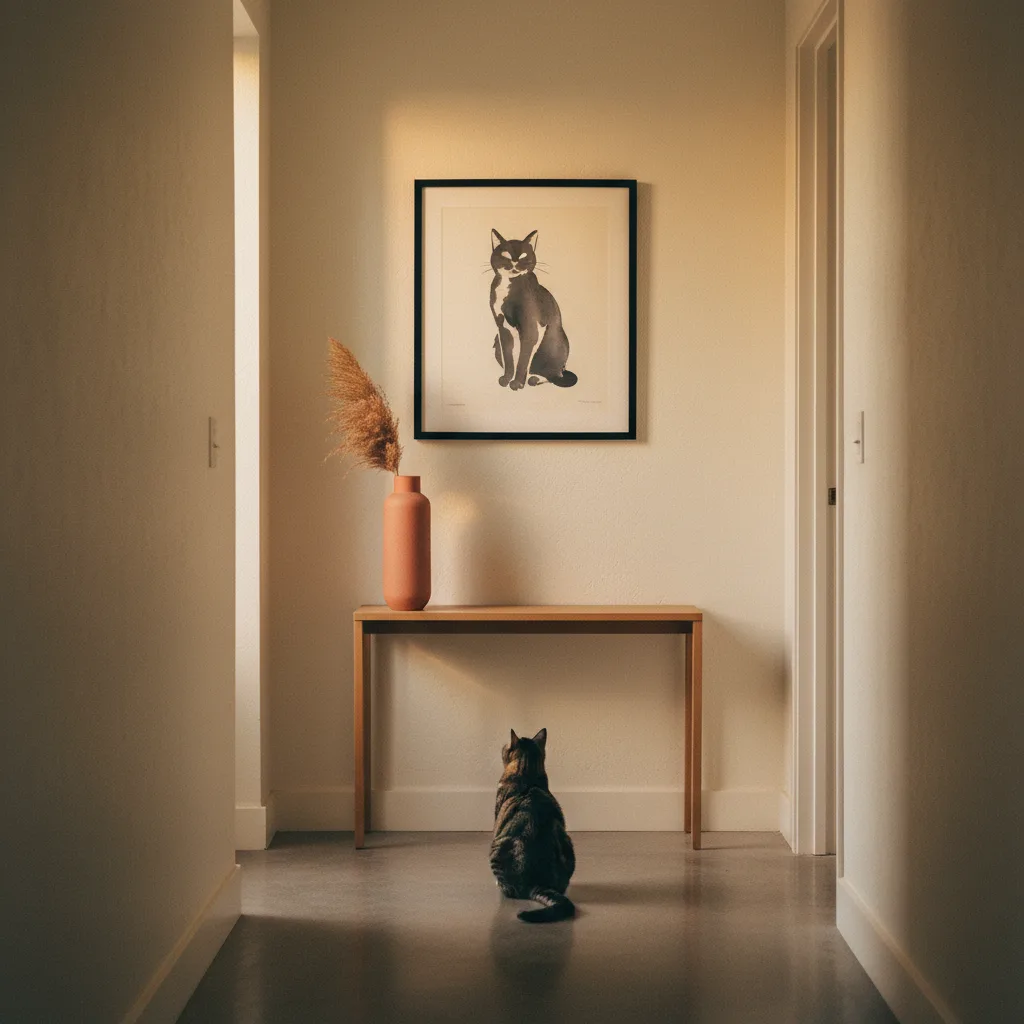
Abstract and graphic styles land well too. Think flat design, strong silhouettes, geometric shapes built from a cat's form. These read as design objects first. The cat is the concept, not the mascot.
And honestly, Japanese and East Asian art traditions have been painting cats for centuries without making them saccharine. Ukiyo-e inspired prints, ink-wash style, minimalist brushwork - these have actual art history behind them and they look serious on a wall.
Matching the print to the room
This matters more than people admit. A high-contrast black and white photo needs the wall and furniture to support it - works great in a modern or Scandinavian interior, looks a bit cold in a warm, wood-heavy room. For warmer spaces, muted earth tones or a sepia-adjacent palette integrates better.
Size is where people consistently underestimate. A 12x16 print in a living room disappears. If it's the main piece on a wall, go bigger than you think - 24x36 minimum for a feature wall. Cat canvas prints are available in sizes that actually fill a wall properly, and canvas specifically tends to read as "art" rather than "poster" even at mid-range price points.
Canvas vs. poster vs. metal - quick take
Canvas is the default for good reason. It has texture and depth, it doesn't need a frame, and it doesn't glare under light. For cat prints specifically, canvas handles the tonal range in photography really well - the darks stay dark without looking muddy.
Metal prints are worth considering if the image is high-contrast and modern. The reflective surface adds something to the right kind of image - not great for soft watercolor styles, genuinely impressive for graphic or photographic prints with strong blacks. Check the full wall art options if you want to compare finishes side by side before deciding.
Standard posters work fine. Don't let anyone tell you they're not real art. Frame them properly - actual frame, real glass or acrylic, mat if the proportions call for it - and they look as good as anything else.
The "is this embarrassing" test
Here's the actual filter: would you hang it in a room you'd show a guest who doesn't know you're a cat person? If the answer is yes, it passes. If it only works because the viewer already knows you're "the cat person," it's probably relying on context instead of quality.
That's not a judgment on loving cats. It's just a useful way to separate prints that are genuinely good from prints that are only meaningful as self-identification. Both have their place - but the second kind belongs on a mug or a notebook, not necessarily as your main wall piece.
The good news is the first kind exists, it's not hard to find, and it doesn't cost more. You just have to know what you're looking for when you filter.