
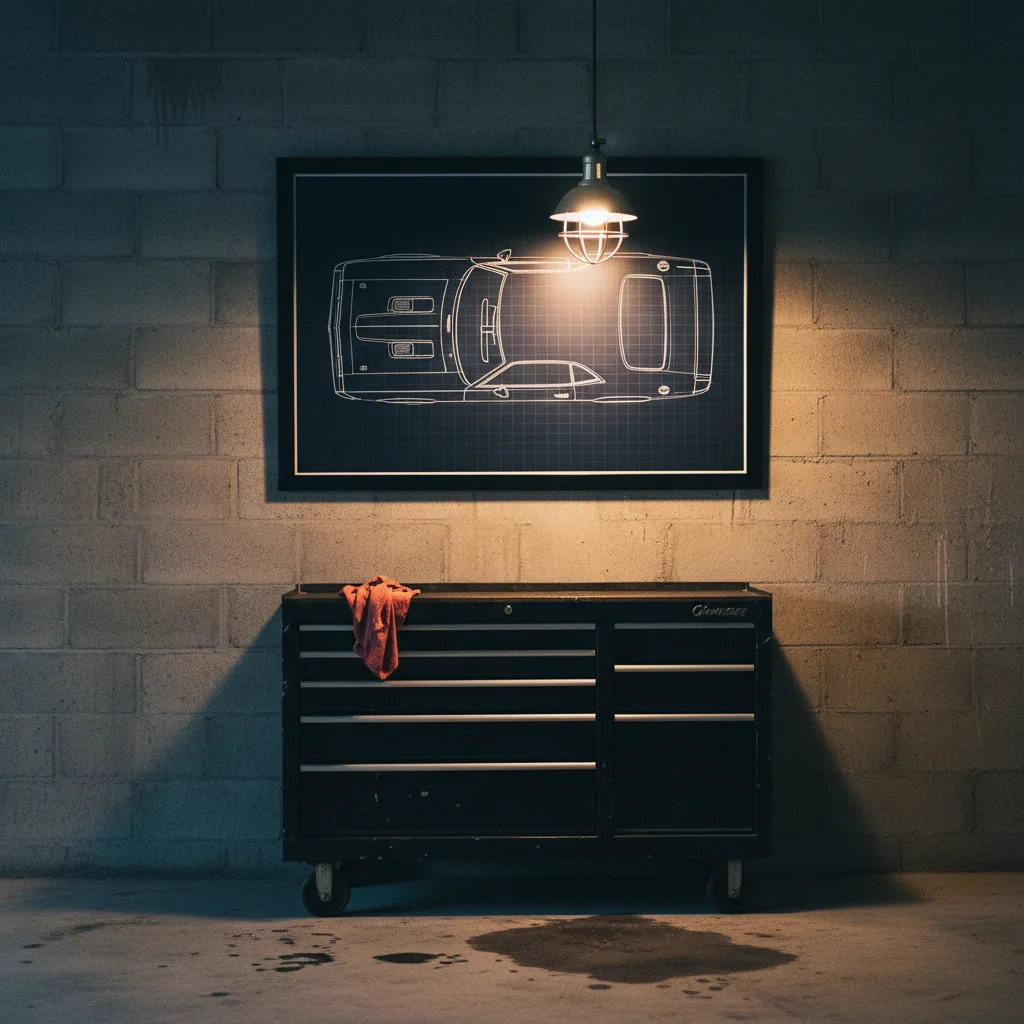
Most garage wall art ideas you find online are either too precious for the space or so generic they could hang in a dentist's waiting room. A garage is loud, dusty, temperature-swinging, and usually dominated by something you actually care about - a car, a workbench, a bike. The art on the walls should match that energy, not fight it.
Why the garage is actually a great room for wall art
Seriously, think about how much bare wall space most garages have. Above the tool chest, along the side wall, that big empty stretch above the garage door - it's more display space than most living rooms. And nobody's going to complain that a print is "too bold" or "too masculine" in here. You can go big, go dark, go loud, and it works. The garage is basically the one room where restraint is the wrong call.
The catch is environment. Garages get cold at night and hot in summer. Humidity can be rough if you live anywhere near the coast or run a lot of water in the space. Cheap paper posters curl at the edges within a season. That narrows your real options pretty fast.
The best garage wall art ideas by material
Metal prints are the honest answer for a working garage. Aluminum substrate, dye-infused directly into the metal - no paper, no canvas, nothing to warp or peel. They handle humidity without complaint and the surface is easy to wipe down when grease or dust settles on them. The image quality is also genuinely sharp, almost backlit-looking in the right light. If you're putting something above a workbench where it might take the occasional splash of degreaser, metal is the only format that makes sense.
Canvas is fine if the garage is insulated and climate-controlled - think finished man cave more than raw working space. The stretcher bars can warp in extreme temperature swings, and the coating on budget canvas prints doesn't love sustained humidity. On a well-insulated wall, though, a large-format canvas of a Porsche 911 or a JDM scene looks genuinely good. Better than metal for warm, moody subjects where you want texture in the print.
Paper posters - unframed - just don't belong in a garage. Framed behind acrylic, they're fine. But bare poster paper in a space with temperature swings is a three-month countdown to curled corners and faded color.
What subjects actually work in here
Cars, obviously. A close-crop of a Mustang grille, a wide shot of a Porsche on a mountain road, a flat-black muscle car with nothing else in the frame. Car prints in a garage aren't a cliche - they're appropriate. The space earns it.
Abstract works too, specifically high-contrast geometric stuff or industrial-textured designs. Black, gray, deep red, matte gold. Not watercolor botanicals. Not soft pastels. The room has a register and the art should be in it.
If the garage doubles as a gaming or movie space, cyberpunk prints are a natural fit - neon on black, dense cityscape compositions. They read well under LED strip lighting, which a lot of finished garages run anyway.
Size and placement - get this right
The most common mistake is going too small. A 12x16 print on a 10-foot wall looks lost. For a garage, think 24x36 minimum for a single piece, or a set of two or three prints in the same color family grouped close together. If you're doing a group, keep the spacing tight - 2 to 3 inches between frames. Wide-spaced arrangements look accidental in large rooms.
Height matters more than people think. Eye level in a garage is roughly where you stand next to a car, not sitting-room height. Center prints around 57-60 inches from the floor. If you're mounting above a pegboard or tool wall, treat the top of the tool wall as your floor line and measure from there.
Where to start if you're actually shopping
The wall art section at EnjoyPoster has the car and abstract verticals that make the most sense for garage spaces, and you can filter to the formats that hold up - metal and canvas both available. If you want something beyond the walls, a printed mug on the workbench or a graphic tee hanging off a peg isn't the worst idea either, but the walls are where you'll get the most return for the effort.
Pick one wall. Start there. The garage deserves better than bare drywall.