Knowing how to tell if a canvas print is good quality before it ships is one of those things nobody thinks about until they've already hung a washed-out, warping rectangle on their wall. The product page looked great. The price felt reasonable. Then reality arrived in a brown box. This guide covers the actual signals - the ones that separate a print worth buying from one that'll embarrass you in six months.
How to tell if a canvas print is good quality just from the product listing
You can filter out a lot of bad sellers before you even add something to your cart. The first thing to look at is the canvas weight. Good canvas runs around 360-400 gsm (grams per square meter). If the listing says nothing about gsm, that's already a red flag - reputable printers mention it because it matters. Anything below 300 gsm is going to feel thin, and thin canvas shows every imperfection in the stretcher bars underneath.
Printing method is the other big one. Giclée inkjet printing with archival pigment inks is what you want. It's not just marketing language - pigment inks genuinely resist fading for decades where dye-based inks start going yellow or pink within a few years, especially near a window. If the listing says "high-quality printing" and nothing else, assume the cheaper option.
The stretcher bars - more important than most people think
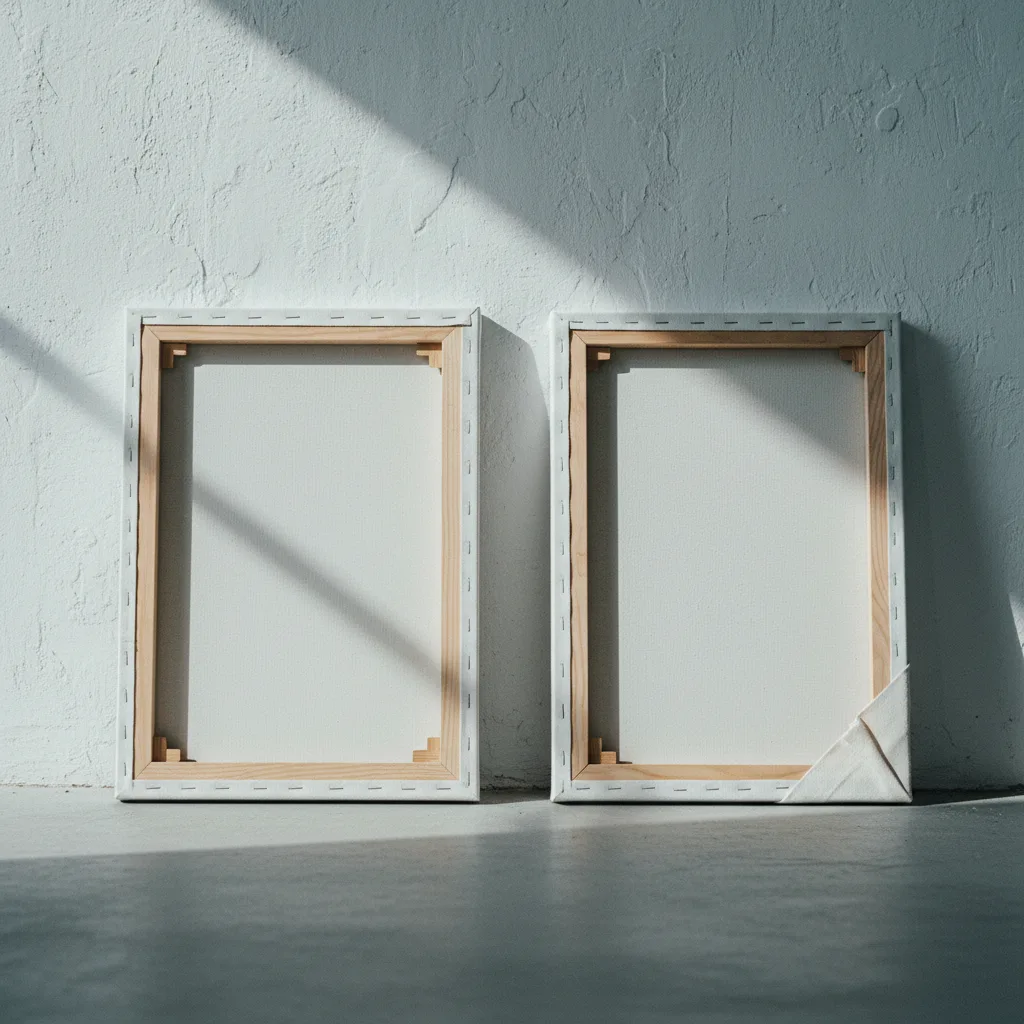
The wooden frame inside is called the stretcher bar, and it's where a lot of cheap canvases fail. You want solid pine or spruce, ideally kiln-dried so it doesn't warp when humidity changes. Budget prints use MDF or thin finger-jointed wood that bows over time, which pulls the canvas surface into a subtle wave you'll notice the moment sunlight hits it at an angle.
Bar thickness matters too. A small print (under 20 inches) can get away with 1.5 cm bars. Anything larger than 60 cm on the long side needs bars at least 1.8-2 cm thick, and a center cross-bar if it's going over 80 cm. If the listing doesn't specify bar material or thickness, email and ask. A serious printer will answer in two sentences. A dropshipper will send you a generic response about their "premium quality standards."
Color accuracy and resolution - the visual side
This one is trickier to assess from a listing, but not impossible. Check if the store publishes the print resolution in DPI. 150 DPI is the minimum you'd tolerate on canvas from a normal viewing distance; 300 DPI is better. Below 150 and you're going to see pixelation on any image with a hard edge or fine detail - car lines, pet fur, anything sharp.
Color profiles matter too. A printer using a calibrated ICC profile for their specific canvas and ink combination is going to produce more accurate colors than one just printing JPEG files straight off a customer upload. You probably can't verify this directly, but you can look at customer photos in reviews - not the staged ones the seller picks, but the unfiltered ones. If the blues look purple or the blacks look brown, that's the ICC profile being wrong or missing entirely.
Browse the wall art section at EnjoyPoster and you'll see specs listed upfront. That's what a printer confident in their output actually does.
What the edges tell you
Gallery wrap edges - the part that folds around the back of the frame - are a fast tell on quality. A good wrap mirrors the image (the background color continues around the sides) or uses a clean white edge, and the corners are folded neatly with no bunching. Cheap prints have folded corners that look like badly wrapped presents, and the image gets stretched or cut in odd places because whoever set up the file didn't account for the wrap bleed.
If the listing only shows the front of the canvas and no edge or back shots, that's worth noting. Sellers who are proud of their finish show it from multiple angles.
Price as a rough filter
A decent 40x60 cm canvas print on quality materials with proper pigment inks costs money to produce. If a large canvas is going for under €15 shipped from overseas, the math doesn't work for quality inputs. That's not snobbery - it's just arithmetic. You're either getting a thin canvas, dye ink, or both.
That doesn't mean expensive automatically means good. But it does mean suspiciously cheap is almost always exactly what it looks like. For cars, pets, gaming prints and more, the EnjoyPoster canvas range covers the spec questions so you don't have to dig.
One last thing to check
Returns policy. A printer confident in their output offers reprints or refunds on quality defects without a fight. If the policy is buried in small print and full of carve-outs, that tells you what they expect you to receive.