Home office wall art is one of those things people treat as a finishing touch, something to deal with after the desk, the monitor arm, the cable management rabbit hole. That's backwards. What's on the wall behind you - and what's in your eyeline when you look up from the screen - affects how the room feels to work in more than most of the gear people obsess over.
What home office wall art is actually doing
It's not decoration in the passive sense. When you spend six, eight, ten hours in a room, the visual environment either drains you slowly or gives you something back. Blank walls read as temporary. Cluttered walls read as noise. A single large print that you actually like - something with weight, a real image or a strong abstract - anchors the room and makes it feel like a place you chose, not a corner you got stuck in.
There's also the Zoom factor. Like it or not, your background is now part of your professional presence. A canvas print or a couple of well-placed posters behind you says more than you think. It doesn't have to be corporate. It just has to look intentional.
Where to put it
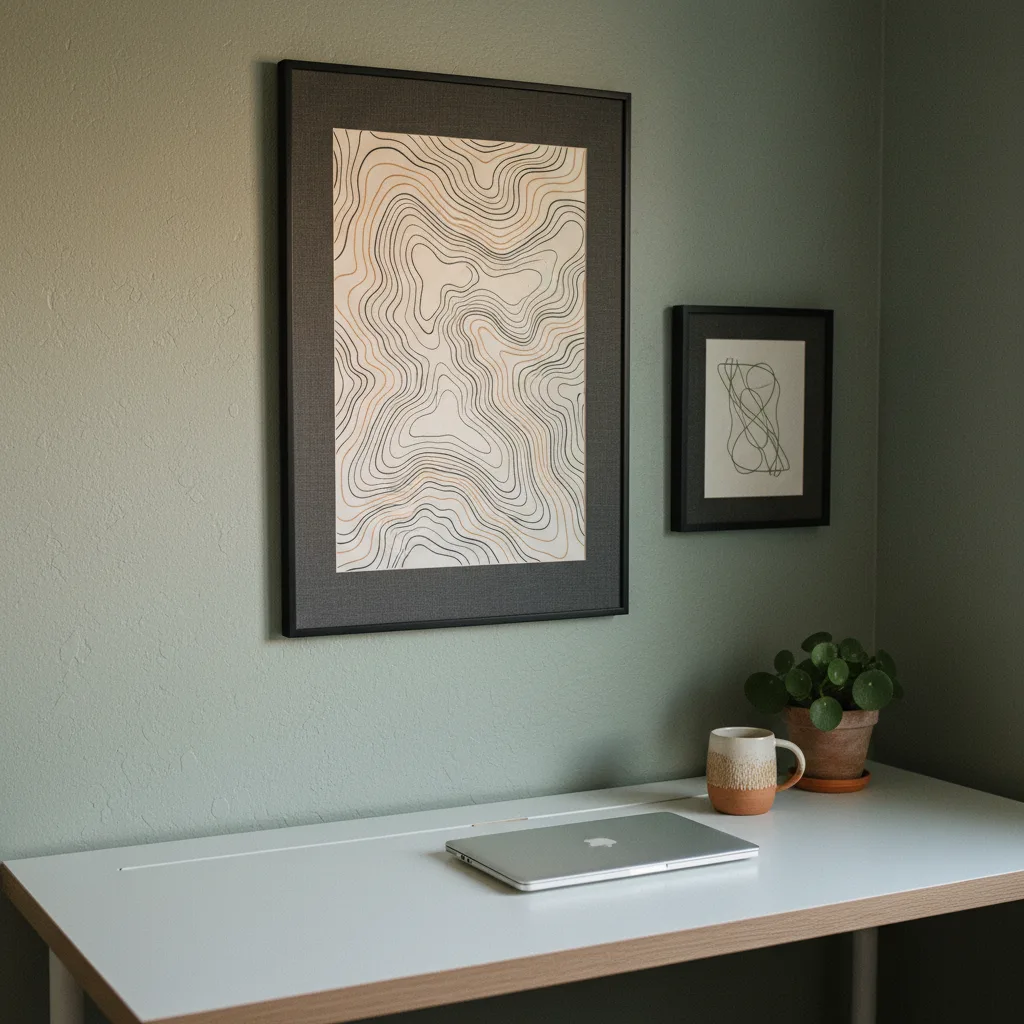
Behind the monitor, not beside it. If the art is off to the side, your eye keeps catching it during calls. Behind the screen, it becomes the backdrop - good for video, and good for your own focus because it's not competing with whatever you're reading.
Height matters more than people admit. Center of the main piece should sit roughly at eye level when you're seated, maybe slightly above. Hanging everything at standing-height is the single most common mistake in home offices and it makes the room feel like a hotel corridor.
If you have a dedicated wall opposite your desk - the one you actually stare at while thinking - that's prime real estate. Something with a bit of depth works well there. A landscape, a car shot with real distance in the image, an abstract that doesn't resolve into anything too quickly. You want something that rewards a few seconds of looking without demanding attention.
Styles that work and ones that don't
Motivational quotes in script fonts: no. Almost universally. They read as placeholder art, the kind that comes pre-installed in a startup's breakout room. If you want words on the wall, make them something specific - a line from a book you actually read, a single word in a typeface you like, something that doesn't also appear on a $12 mug at the airport.
Bold graphic prints hold up well in office light, which is usually harsher than living room light. A high-contrast car print - a Porsche shot, a Mustang detail - looks better under a desk lamp than a soft watercolor does. Metal prints specifically are worth considering for office spaces because they don't fade and the reflective surface actually benefits from direct light rather than fighting it.
Abstract prints are underrated for focus work. They give your brain something to land on without a narrative to follow, which is genuinely different from staring at a photograph of a place you wish you were.
Check out the full wall art catalog - the car and abstract categories in particular have stuff that works at desk scale without looking like you raided a college dorm.
Size: bigger than you think
Most people size down out of caution and end up with something that looks lost. For a standard home office wall, a single 24x36 or larger print reads correctly. Two or three small prints in a cluster usually just look like you couldn't commit. One strong piece beats a gallery wall in a workspace - fewer decisions, less visual noise, actually easier to live with over time.
Canvas vs. poster vs. metal
Canvas is forgiving in most rooms, good for photography and softer images. Posters are cheaper and more flexible if you're likely to want something different in a year. Metal prints are the right call if you want something that looks sharp in a well-lit room and doesn't need framing. For a Zoom background specifically, metal or canvas both read better on camera than an unframed poster, which can look flat.
Canvas prints and metal prints are both in the wall art section if you want to compare formats side by side. For something lower commitment, postcards are actually a decent way to test an image before you commit to a large format - sounds minor, but it helps.
One actual recommendation
Pick one wall. Put one large piece on it. Make sure it's something you'd stop and look at outside a store context. That's the whole system. The rest is just avoiding the traps most people fall into - wrong size, wrong height, wrong wall, or just never getting around to it because it feels like a low priority until you're three years into working from home and you still hate your Mondays.