
By the late 1990s, Cadillac had a problem that was hard to argue with. The average buyer age was somewhere north of 65. The cars were large, soft, and quiet in a way that stopped feeling like luxury and started feeling like a waiting room. The DeVille sold well enough, but to whom? The brand that once defined American prestige had become shorthand for a certain kind of irrelevance - a car your grandfather drove to church and to his cardiologist.
The cadillac brand comeback history that followed is genuinely one of the stranger turnaround stories in the auto industry, because it didn't happen through marketing. It happened through engineering decisions that a lot of people inside GM probably thought were too risky.
Art and Science, or: the rebrand that could have gone either way
Around 2002, Cadillac launched what it called the "Art and Science" design language. Hard angles, sharp creases, a look that owed more to stealth aircraft than to the chrome-drenched barges of the 1970s. The CTS that debuted that year looked like nothing else on the road - and I mean that in a good way, though plenty of people at the time weren't sure which way to take it.
The design alone wouldn't have done much. What mattered was what went under the hood, and more importantly, what Cadillac chose to do with the platform.
In 2004, they started racing the CTS-V at the Nurburgring. Not as a PR stunt, or not only as one - they were actually using the lap data to improve the suspension tuning. The production CTS-V that came out in 2004 had a 400-horsepower LS6 V8 pulled straight from the Corvette Z06. It was rear-wheel drive. It had a manual transmission option. It lapped faster than the BMW M5 of the same era.
Car journalists did not know what to do with this information.
The CTS-V years and why they mattered
The second-generation CTS-V, released for 2009, went further. 556 horsepower from a supercharged 6.2-liter LSA engine, Brembo brakes, a Tremec six-speed manual, magnetic ride control. It ran the Nurburgring in 7:59 - faster than the Dodge Viper ACR at the time, faster than the Ferrari 599. The sedan version, not a stripped track-day special.
That result got attention in places Cadillac hadn't been mentioned seriously in decades. Road and Track, Car and Driver, enthusiast forums where the default assumption had been that American luxury cars were soft approximations of the real thing. The CTS-V wagon that followed - yes, a high-performance estate car - developed an almost cult-like following among people who wanted the practicality of a family hauler and the ability to embarrass Porsches at a stoplight.
There's something worth noting about what Cadillac was doing here. They weren't chasing BMW or Mercedes by copying them. The CTS-V had a character that was distinctly its own - brutal in a way European sport sedans weren't, with that supercharged V8 making a sound that had no equivalent in Munich or Stuttgart. It polarized people, which is usually a sign you've made something real.
The stumble (because there was one)
The mid-2010s got complicated. Cadillac announced it was moving its headquarters to New York - away from Detroit, toward fashion and lifestyle branding. Johan de Nysschen came in as president with a plan to restructure the entire lineup with a new alphanumeric naming scheme. CT6, XT5, XT4. Clean, logical, and pretty easy to forget.
De Nysschen left in 2018. The New York office eventually closed. The naming strategy got partially walked back when Cadillac brought the Escalade and other familiar names back to the forefront. There was a period where it genuinely wasn't clear whether Cadillac knew what it wanted to be - a European-style luxury brand, a performance brand, an American icon, or something else entirely. The answer, messily, ended up being "most of those things at once."
Blackwing: the argument that settled the debate
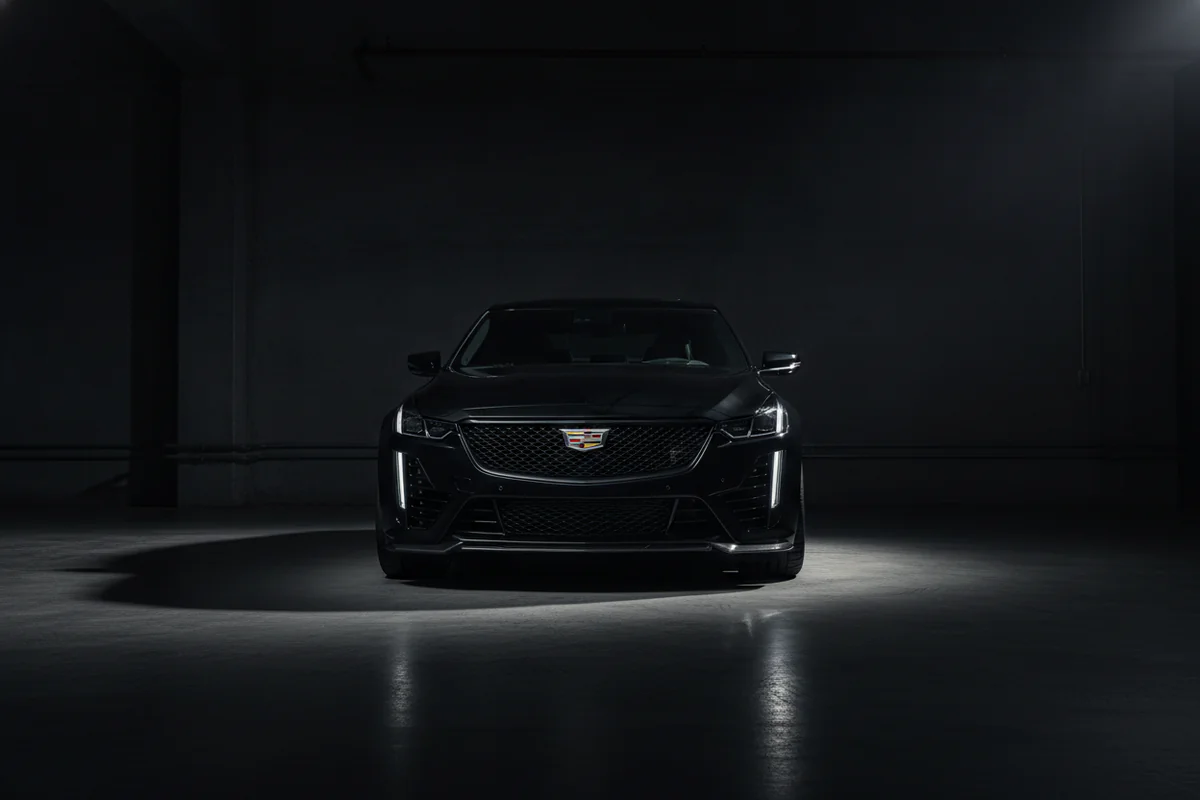
If the CTS-V made the case that Cadillac could build a performance car, the CT4-V Blackwing and CT5-V Blackwing - released for 2022 - made the case that Cadillac wanted to build one. The distinction matters.
The CT5-V Blackwing uses a 668-horsepower supercharged 6.2-liter V8, still offers a six-speed manual transmission (in 2022, when almost everyone else had given up on rowing your own gears in a sedan), and comes with a performance envelope that puts it in direct conversation with the BMW M5 Competition and Mercedes-AMG E63 S. Some comparisons have gone Cadillac's way. Road and Track named it their Performance Car of the Year in 2022.
The CT4-V Blackwing is in some ways more interesting - a smaller, lighter car with a twin-turbocharged 3.6-liter V6 making 472 horsepower, and a character that rewards drivers who want to work for their fun rather than just point-and-go. Both cars come with magnetic ride control and available carbon ceramic brakes. Both are built at the Lansing Grand River plant in Michigan, by hand, with build plates signed by the assembly team.
That last detail feels almost anachronistic, which might be why it resonates. Cadillac is leaning into the craft angle in a way that feels genuine rather than performed - and for a brand that spent years being accused of trying too hard to seem relevant, genuine matters.
Where the enthusiasm actually lives now
Walk around a Cadillac enthusiast community online or at a car show and the age range looks nothing like that 1990s dealer demographic. There are Blackwing owners in their 30s, CTS-V owners who track their cars on weekends, people who chose a Cadillac over a German alternative specifically because they wanted something with a distinct American character rather than a slightly rebadged approximation of one.
The cultural side of this is real too. Cadillac iconography - the crest, the 1950s fins, the broader visual history of the brand - carries enough weight that it shows up in everything from hip-hop references to Cadillac wall art and gifts that people actually want in their homes. That kind of cultural staying power isn't manufactured.
Cadillac is also, somewhat quietly, betting on an electric future with the Lyriq and the upcoming Celestiq. Whether those cars carry forward the performance credibility that the Blackwing established is an open question. Electric vehicles can absolutely be fast - but fast and interesting are different things, and Cadillac's best recent work has been interesting in ways that go beyond spec sheets.
The comeback story is real, and it was built on engineering first. Everything else followed from that.