
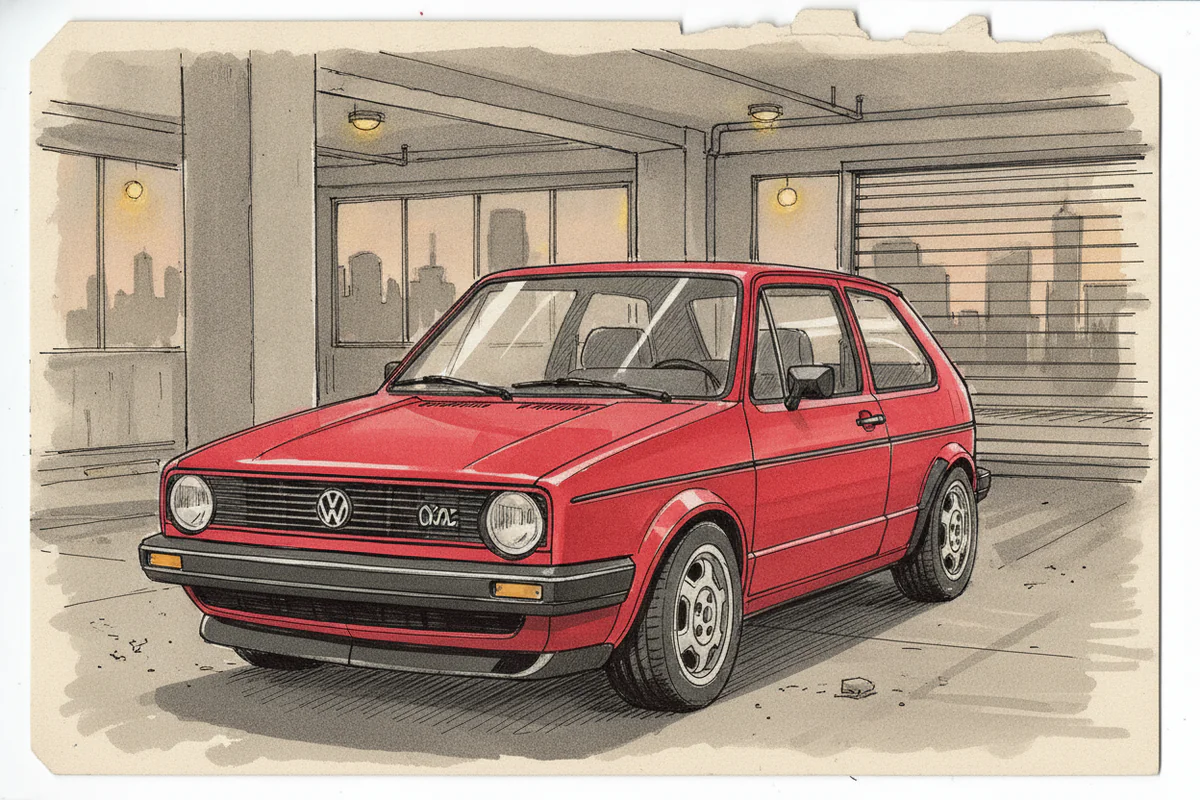
Nobody asked for it
In the mid-1970s, Volkswagen was in the middle of a careful, somewhat anxious transition. The Beetle era was winding down and the front-wheel-drive Golf had just arrived to replace it. The brief was sensible: affordable, practical, European family transport. A performance version was not in that brief. So a small group of engineers and product planners built one anyway, mostly on their own time, and brought it to management as a near-finished concept. The GTI - Grand Tourisme Injection, though almost nobody calls it that - debuted at the Frankfurt Motor Show in 1975 as a sort of apology for being practical, and went on sale the following year.
That 1976 Mk1 GTI made 110 horsepower from a 1.6-litre fuel-injected engine, which sounds unimpressive until you factor in that the car weighed around 810 kilograms. It had a slightly stiffened suspension, wider wheels, a flat-bottomed steering wheel, and that now-iconic red stripe running through the front grille. Inside, a golf-ball-shaped gear knob that cost almost nothing to produce became one of the most recognized design details in automotive history. Volkswagen planned to build about 5,000 of them. They sold over 400,000 Mk1 GTIs before it was replaced.
What it actually invented
Before the GTI there were fast small cars - the Mini Cooper, various French hot Renaults - but nothing quite followed the same formula with the same coherence. The GTI's particular trick was that it gave you almost all of the daily usability of the ordinary Golf with a driving experience that felt genuinely rewarding rather than just quick in a straight line. Handling, gearshift feel, the way the car communicated through the steering - these things were dialed up without making the car difficult to live with. You could take it to a track day on Saturday and use it for groceries on Tuesday and neither activity felt like a compromise.
That formula is what spawned the hot hatch as a proper category. The Peugeot 205 GTI, the Ford Escort XR3i, the Fiat Uno Turbo - they all came after and all owed something to what VW had demonstrated was possible. The segment is still healthy today, which makes the GTI's original contribution genuinely unusual. Most trends from 1976 are over.
The generation wars
Ask any group of GTI owners which generation is the definitive one and you will get a debate that goes longer than you planned for. There are a few recurring camps.
The Mk1 purists will tell you the original is the only one that had the right weight and the right directness, that everything since has been a gradual softening toward comfort. They are not entirely wrong. The Mk2 (1984-1992) added safety and refinement and a 16-valve engine option that was genuinely exciting for its era, and sold in huge numbers, but it was bigger and heavier than the original. The Mk3 arrived in 1991 and was heavier still, and the GTI version was slow enough that people made jokes about it at the time - VW had clearly prioritized crash safety and NVH reduction over the performance character that made the name mean something.
Then came the Mk4 (1997-2006), which split opinion badly. The interior quality took a significant jump, fit and finish improved noticeably, and the 1.8 turbo engine was quick. But critics said it felt numb, too comfortable, too focused on feeling premium rather than feeling alive. Some of those critics were right. The steering in particular was a common complaint.
The Mk5, launched in 2004, is probably the generation most often cited as the sweet spot by people who actually drove all of them. It brought back genuine steering feel, had a 2.0 TSI engine with real response, and the interior stayed honest without trying too hard to feel like a luxury car. The ride-to-handling balance was very well judged. And the DSG dual-clutch gearbox option, whatever the traditionalists thought of it, was genuinely fast in a way that made sense for the car.
Mk6 refined the Mk5 without changing much. Mk7 (2013) is widely considered the best modern GTI - lighter than the Mk6 by about 35 kilograms due to the MQB platform, more power, better brakes, and a version called the GTI Performance that added a limited-slip differential and 230 horsepower. The current Mk8 has attracted criticism for its touch-sensitive controls replacing physical buttons, which is probably fair - the physical controls were part of the GTI's sensibility, and a capacitive slider for volume feels wrong in a car that built its reputation on tactile satisfaction.
The culture around it
GTI owners have always been a particular type. Not necessarily the loudest car people in the room, but the ones who have opinions about tire compounds and can talk at length about the difference between adaptive dampers and a good fixed setup. The Worthersee festival in Austria, held annually near the lake of the same name, draws tens of thousands of VW and Audi enthusiasts and has been running since 1982. That kind of sustained community around a single nameplate is rare.
There's a whole aesthetic that has grown up around the car too - the tartan "Clark" seat fabric that appeared in the Mk1 and keeps getting revived in special editions, the red brake calipers, the period rally posters and race photography. For people who want that on a wall, Volkswagen wall art and gifts covers a lot of that ground. Anyway - the point is that the GTI developed a visual identity that has stayed consistent enough to be recognizable across fifty years of model changes, which is not something most cars manage.
Why it still matters
The GTI has survived long enough that it now has to compete with cars it helped create, and with performance SUVs, and with electric performance hatches that are faster by almost every measurable metric. VW has responded by keeping the GTI as a petrol-only model while electrifying most of the Golf range around it, which is either a smart piece of brand preservation or a holding pattern - probably both.
What the original engineers figured out in the 1970s was that a performance car doesn't need to be extreme to be good. It needs to be honest. The controls need to tell you what the car is doing, the engine needs to reward how hard you use it, and the whole thing needs to feel like it was designed for a driver rather than assembled from a list of specifications. The GTI got that right in 1976, mostly nailed it again in 2004, and is still trying to hold onto it now. That's a harder thing to do than it looks - and it's why the argument about which generation was best is still worth having.