
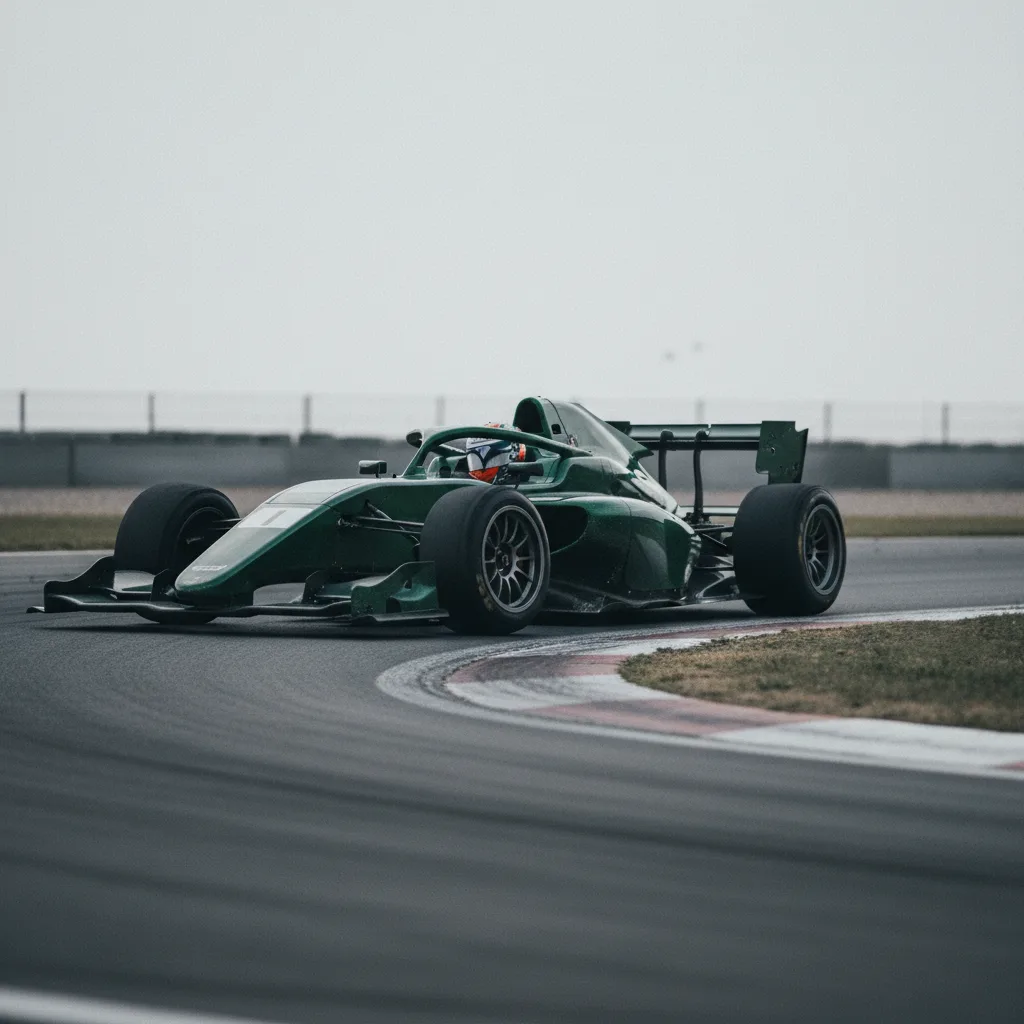
Track day photography wall art is a specific thing, and people who get it know immediately why a shot of a Porsche 911 mid-corner at 80mph is more interesting to live with than a studio render of the same car on a white background. It's not just aesthetics. It's the difference between a picture of a thing and a picture of a thing doing what it was built to do.
What makes track day photography different from regular car photography
Most automotive photography is essentially product photography. The car is clean, the light is controlled, and the goal is to make you want to buy it. Nothing wrong with that, but it tells you almost nothing about the car as a physical object under stress. Track day photography works differently. You get body roll, tire squish, brake dust, a driver who is actually committed to a line. The car looks like it has a job.
That tension is what reads on a wall. A photo of a Mustang parked outside a coffee shop is fine. A photo of a Mustang with the rear stepping out under braking into a hairpin is a different conversation entirely.
Corner braking shots and why they're so good
Late braking into a corner is where a lot of the drama lives in motorsport. The nose dips, the front tires are doing three things at once, and the whole car is sort of negotiating with physics. A good photographer catches that moment before the driver has fully committed to the apex - when the outcome is still technically open. That visual uncertainty is what makes the image interesting. It's not a frozen trophy. It's a frozen problem being solved at speed.
For wall art, that translates to something you actually keep looking at. Your eye moves through the frame differently than it does with a static beauty shot.
The apex moment as a composition
The apex photo - car at minimum radius, clipping the inside kerb - is probably the most photographed moment in track driving, and it's also the most commonly wasted. When it's done badly it's just a car going around a corner. When it's done well, the geometry of the track, the angle of the car, and the light all line up into something that actually has structure. You can feel the vector of the thing. That's the shot worth printing large.
Canvas does something useful here - the slight texture breaks up the compression artifacts that tank digital prints of fast-moving subjects, and large format gives the composition room to work. A track day shot printed at 12x16 is a thumbnail. At 24x36 on canvas it starts to be something you can actually read.
Which cars photograph best at track days
Honest answer: cars with visual drama at low-to-medium speed, because that's what most track day photography actually captures. Wide-body cars, anything with visible aero, older cars where the mechanical effort shows. A heavily modified Porsche GT3, a Civic Type R with full aero kit, a classic Mustang on a vintage circuit - these read well because the car's intent is legible in the shape.
JDM cars are consistently good subjects. Something about the combination of wide arches, low ride height, and the way they sit on track geometry produces images that work as art in a way that a lot of modern luxury cars don't, where the design language is deliberately smoothed out.
If you're shopping for car wall art specifically in the track day category, look for shots where the car isn't centered in the frame and the track surface is doing something - painted kerbs, track markings, a bit of rubber buildup at the apex. That context is what separates a car photo from a track photo.
Printing format matters more than most people think
Track day photography wall art works best in horizontal format, for the obvious reason that most track moments are wide - you want the entry, the apex, and some sense of where the car came from. Vertical crop loses the context that makes the image read as motorsport rather than just a car photo.
Metal prints do something interesting with the dark tones and highlight separation you get in track photography - shadows under wheel arches, bright track surface, the contrast between a dark car and a lit kerb. Canvas is warmer and handles motion blur better. Neither is wrong, it depends on the room and how much you want it to feel like a print versus a photograph.
Browse the full wall art catalog and filter by cars - the track day material is in there alongside the studio and street photography, and the difference is immediately obvious once you know what you're looking for.