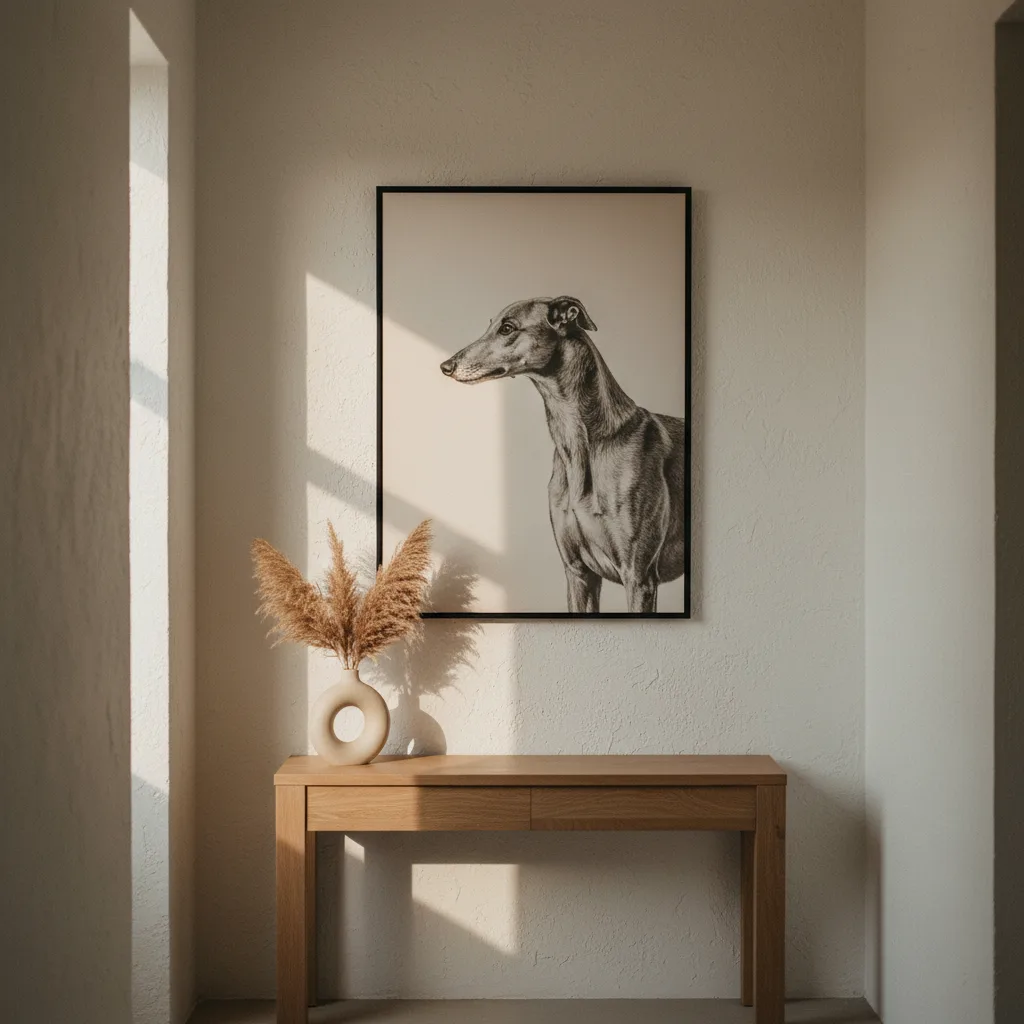
If you're hunting for dog wall art ideas, the breed matters more than most people expect. A golden retriever in warm afternoon light? Practically prints itself. A pale cream labradoodle against a white background? You get a beige blur and some eyes. Choosing the right subject - and the right treatment - is the difference between a print you hang in the living room and one that quietly gets moved to the garage.
Why some breeds just work better
It comes down to contrast and silhouette. Dogs with a strong, readable outline - think German shepherds, huskies, Dobermans, border collies - look good even at a distance, even in a thumbnail. You can make out what you're looking at immediately. That matters for wall art because prints get viewed from across the room as much as up close.
Flat-faced breeds are a different story. Pugs and French bulldogs are enormously popular as pets, but their faces compress into a mess of folds in print unless the photographer is very deliberately working with light. It can be done. It's just harder, and the margin for error is small.
The breeds that consistently produce great dog wall art ideas
Golden retrievers are the obvious answer and they're obvious for a reason. The coat catches light beautifully, the face is expressive without being complicated, and the color palette - that warm amber and cream - works with almost any interior. If you have a golden and a halfway decent photo, you have a good print.
Siberian huskies are almost unfair. The two-tone coat, the pale eyes, the mask markings - a husky portrait in black and white or desaturated color looks like something from a photography exhibition. They read as dramatic without any heavy editing.
German shepherds and Belgian Malinois have that sharp, alert expression that translates to a kind of intensity on canvas. Portraits shot at eye level, face filling the frame, work especially well. The tan-and-black coloring gives you natural contrast without needing to do much in post.
Dalmatians are an underrated choice. The pattern is graphic enough that it holds up even if the pose is fairly simple. Black and white photography with a dalmatian is almost cheating - it just looks intentional.
Border collies, especially the black-and-white variety, have that same graphic quality. Add in the herding stare - that slightly unnerving focus - and you get a portrait with real character.
Smaller dogs and the challenges they bring
Chihuahuas, dachshunds, toy breeds - these can work, but they need a tighter crop and a cleaner background than bigger dogs. A chihuahua lost in a wide outdoor shot looks like a mistake. Pull in close on the face, get the ears in frame, and suddenly you have something. The breed isn't the limitation; the framing is.
If your dog is small and you want a print that actually reads well, go portrait orientation, crop tight, and use a background with some tonal contrast against the coat. Simple.
Black dogs specifically
This is a real issue and worth saying plainly: black dogs are hard to photograph and harder to print. The detail disappears. Flat black becomes a shape with a nose. If you want wall art of a black lab or a black chow, you either need a photographer who knows how to light dark coats, or you lean into it - high contrast, graphic treatment, let the silhouette do the work rather than fighting for fur texture you won't see anyway.
A black lab silhouette against a sunset sky, treated almost like a linocut print, can look incredible. Just don't expect a standard portrait to carry the same weight as a golden in the same setting.
What format to use for dog wall art
Canvas works well for most portrait-style dog prints - the texture adds something to fur. Metal prints are good if the photo has strong contrast and you want the colors to pop harder. For a more casual feel, a standard pet poster is honestly fine and cheaper to replace when the dog gets older and you want an updated photo up there.
You can browse the full range at EnjoyPoster's wall art section, or if you want to put your dog on something other than a wall, mugs and phone cases work surprisingly well for close-up dog portraits too - check the mug page if that's a direction you want to go.
The main thing: get a photo where the dog is actually in focus, the background isn't fighting the subject, and the face is readable. The breed matters, but a good photo of a "hard" breed beats a bad photo of a photogenic one every time.