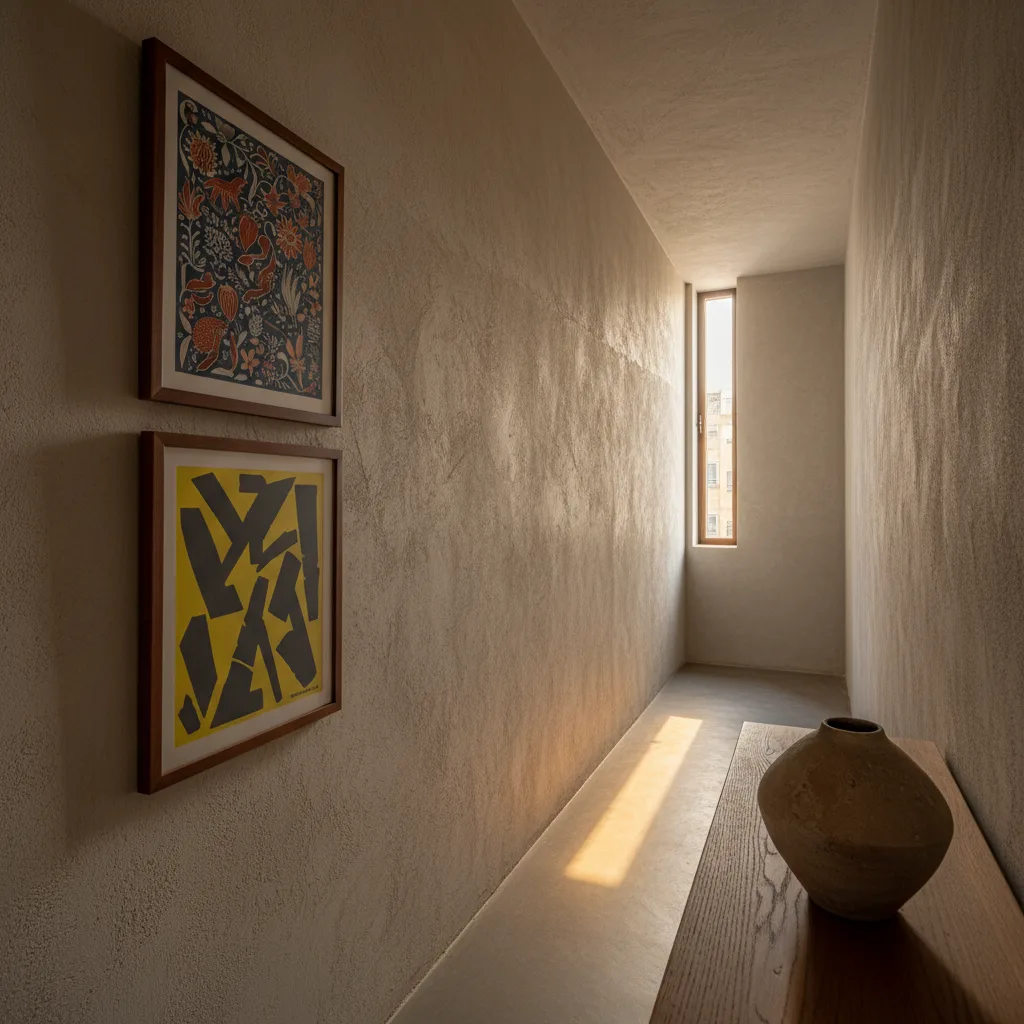
Wall art trends 2026 have broken pretty sharply from what felt safe two years ago. The coastal grandmother palette is fading out, the blank-wall-as-aesthetic thing is basically dead, and what designers are actually ordering - for clients and for themselves - skews bolder, more specific, and honestly a lot more interesting. Here is what is actually moving.
The maximalism correction is real
For years the safe answer was one large neutral print, lots of white space, done. That still works in staged listings photos but people who actually live in their homes are over it. The shift happening now is toward intentional density - a gallery wall that commits, not three frames floating awkwardly in a void. Designers are combining large wall art anchors with smaller pieces that build a conversation. The key word there is intentional. Slapping twelve random prints together still looks bad. But a tight grouping around a real theme - a specific car era, a dog breed, a color story - reads as collected rather than cluttered.
Wall art trends 2026: the subjects that are winning
Cars are having a serious moment and it is not slowing down. Not generic sports car silhouettes - specific cars. A 1973 Porsche 911 RS in white. A first-gen BMW M3 on a wet track. People want the actual thing they love, not a stand-in. The car prints category is one of the clearest signals that personalization is the actual trend underneath all the other trends.
Cyberpunk aesthetics are holding stronger than anyone expected. The neon-on-dark city scene that felt like a 2022 fad never really left - it just matured. The versions selling now have more compositional confidence. Less cluttered, darker backgrounds, stronger focal architecture. If you wrote it off as a phase, look again.
Pet portraits - particularly dog art and cats - have moved from novelty into staple. People are commissioning or buying semi-realistic prints of their specific animals rather than generic breed illustrations. Golden retrievers especially. There is an argument that pet wall art is the most emotionally durable category in the whole market because the subject never goes out of style for the person who owns it.
Format matters more than it used to
Canvas is still the default but metal prints are growing fast among people who care about the finish. The reflectivity on a metal print does something in rooms with directional lighting that canvas just cannot replicate. It is not for every image - flat illustrative work tends to look better on canvas or poster stock - but high-contrast photography and dark-palette digital art genuinely look better on metal. Worth knowing before you order.
Posters are back in a non-ironic way. Not the dorm-room throwback version - actual quality poster prints with real paper weight, framed properly. Part of this is cost - a great poster in a decent frame gets you 80% of the visual impact of a canvas at maybe 40% of the price. Designers working with tighter client budgets have noticed.
What is quietly fading
Watercolor botanicals. They are not gone but they are plateauing hard. The market got saturated around 2023 and the versions that are still selling are either very high quality or very cheap - the middle is struggling. Same story with the "live laugh love" era of script typography, which at this point reads more as a dated relic than a style choice.
Abstract that is abstract for no reason is also losing ground. Buyers are getting more discerning. A strong abstract with a clear color commitment and compositional logic still sells. Random brushstrokes in terracotta and sage, less so.
The practical upshot
Buy something specific to something you actually care about. That is genuinely the throughline of every 2026 trend worth paying attention to - specificity beats generic every time. A canvas print of the exact car you grew up wanting, the breed of dog you have had for eight years, a city you lived in - that piece will outlast any trend cycle because it means something to the person looking at it every day.
The wall art that ages badly is always the wall art that was chosen to look correct rather than to mean something. Designers know this. The market is finally catching up.