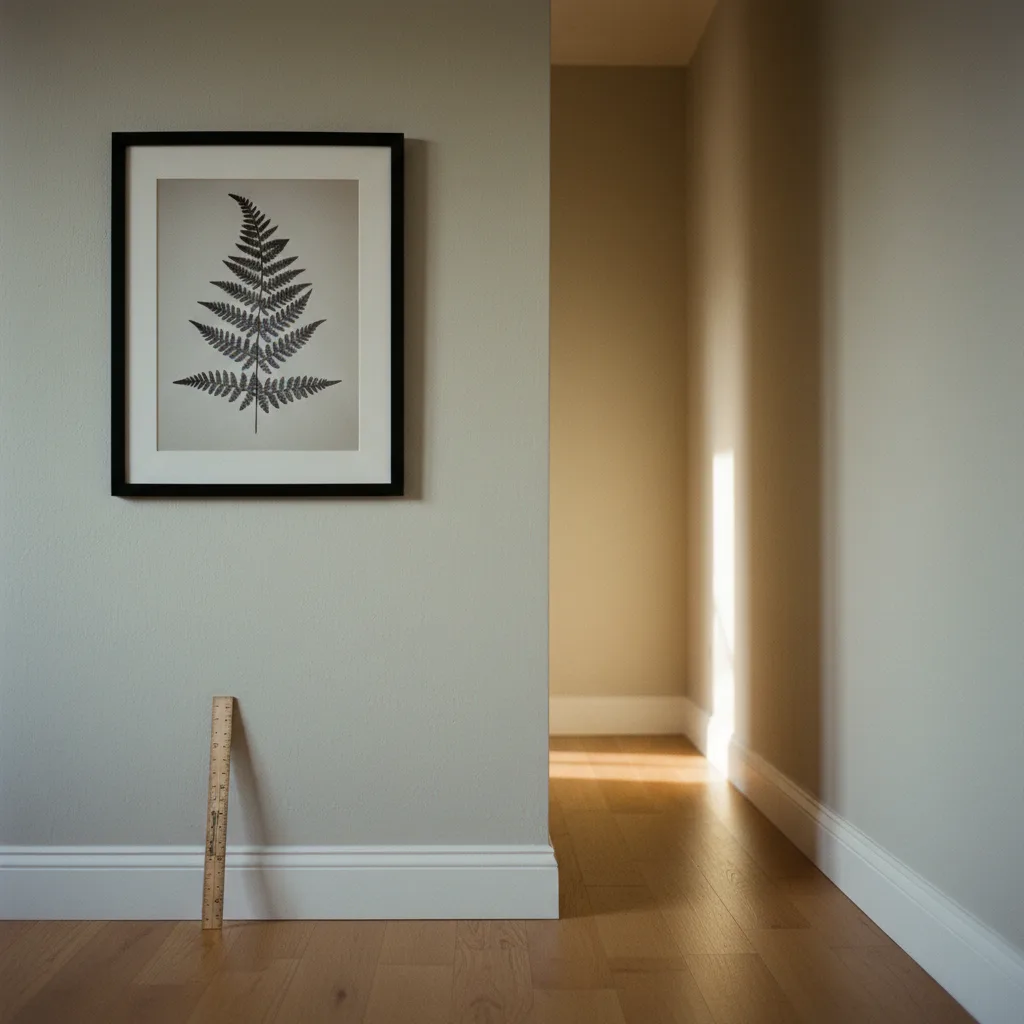
If you've ever searched how high to hang art, you've probably hit the same answer everywhere: 57 inches. Center of the frame, eye level, done. It's the standard galleries use, it's what most interior designers repeat, and it's genuinely good advice - but it's not a law, and applying it without thinking can make a room feel off in ways that are hard to diagnose.
Where the 57-inch rule actually comes from
Museums and commercial galleries settled on 57 inches as the center height for hung work because it lands at average standing eye level for an adult. The idea is that when you're walking through a space looking at art, your eyes shouldn't have to travel up or down to meet the center of the piece. Your gaze lands naturally, the composition reads as intended, you don't get a crick in your neck. That's it. There's no deeper geometry involved - it's just ergonomics that got codified into a rule.
The number sometimes gets cited as 57-60 inches depending on the source, which already tells you it's a guideline, not a specification.
The problem with treating your home like a gallery
Galleries have white walls, no furniture, and ceilings that go up forever. Your living room has a sofa. That changes everything.
When art hangs above furniture - a couch, a console, a bed - the relevant eye level isn't your standing height, it's your seated height or the visual weight of the furniture beneath it. Hanging a print at 57 inches center above a sofa that sits 36 inches off the floor often leaves a gap that looks like the art is floating away from the room. The standard recommendation for art above a sofa is 6 to 8 inches above the back of the couch - which puts the center of most prints well below 57 inches.
Same logic applies to a bed. 57 inches center might put the bottom of a tall canvas somewhere around your pillow. Too high. A better starting point is 4-6 inches above the headboard.
How high to hang art at 57 inches - when it actually applies
The rule earns its reputation in a few specific situations. A large wall art piece on an empty wall with no furniture anchoring it? 57 inches center is a reliable default. A hallway gallery wall where people walk past and look straight ahead? Yes, use it. Art positioned at standing height in a home office or studio where you're mostly upright? Same.
If you're building a gallery wall with multiple frames, treat the collection as a single unit - find the visual center of the whole arrangement and put that at 57 inches, not each individual frame.
The furniture anchor method works better for most rooms
Forget the tape measure for a second. Stand back, look at the wall and the furniture together, and ask whether the art reads as connected to the room or like it wandered in from somewhere else. Art that hovers six inches above a sofa looks grounded. The same piece at 57 inches center often looks stranded.
The practical test: cut a piece of paper the size of your print, tape it to the wall, live with it for a day. Move it up or down until it feels right. That's not a cheat - that's just using your eyes, which is the whole point.
Small rooms, low ceilings, and other cases where lower is right
Low ceilings compress a room visually. Hanging art high pulls the eye up and makes the ceiling feel even lower. If your ceilings are under nine feet, consider dropping everything 2-3 inches lower than you'd normally go. It sounds counterintuitive but the room reads as taller because the proportions aren't fighting each other.
Staircase walls are the one place where you genuinely need to throw the rule out. The eye level changes as you move up the stairs - the only thing that works is stepping back and eyeballing spacing between frames so the visual rhythm of the arrangement moves with you as you climb.
One last thing
Most people hang art too high - that part of the conventional wisdom is correct. When in doubt, go a few inches lower than your first instinct. It looks better in person almost every time, regardless of what the tape measure says. Browse the full wall art catalog if you're still figuring out what to hang - picking the right piece first makes the placement question a lot easier to solve.